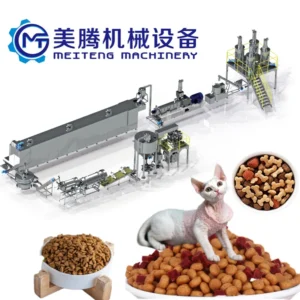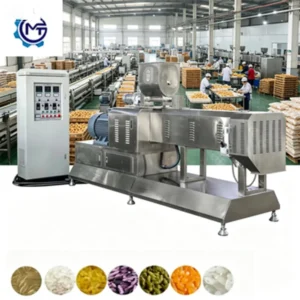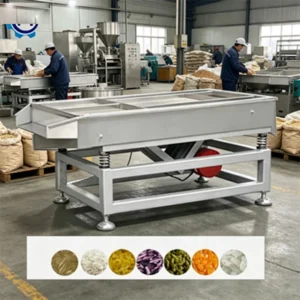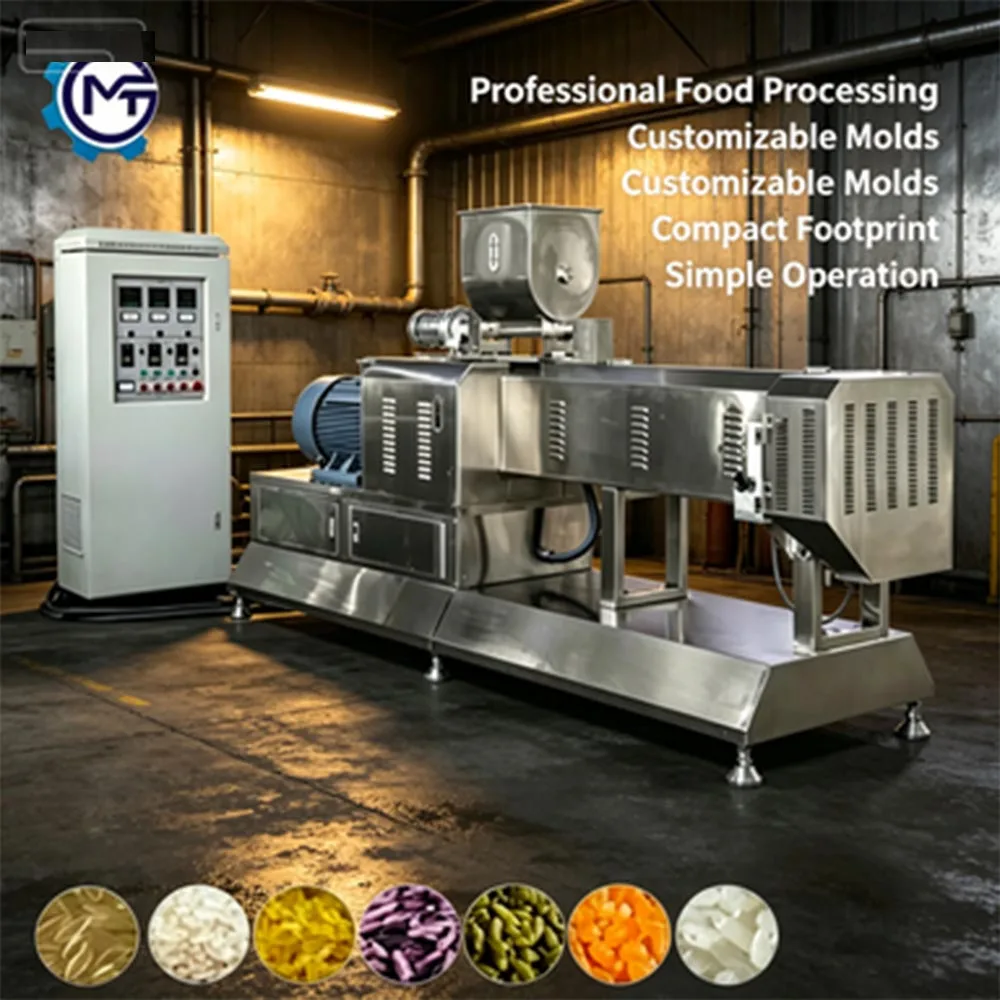
Throughput-Matched Station Integration — every mixer, extruder, dryer, and coating drum in this aquatic feed line is sized to the same output target so no single station bottlenecks the next.
Technical Specifications
| Parameter | Value |
|---|---|
| Product Type | Twin Screw Aquatic Feed Extrusion Production Line |
| Extruder Configuration | Twin screw extrusion technology |
| Control System | Intelligent PLC automatic control system |
| Contact Material | Food grade 304 stainless steel |
| Production Scope | Floating and sinking fish feed pellets |
| Line Stations | Raw material mixer, extruder, dryer, seasoning coating machine, vibrating sieve, conveyor equipment |
| Pellet Adjustability | Pellet size, hardness, buoyancy adjustable per breeding requirements |
| Operation Mode | Full continuous automatic production from mixing through extrusion, drying, seasoning, screening to discharge |
| Energy Design | Optimized energy saving transmission structure and heating system |
| Maintenance Interface | Humanized operation interface with simple parameter adjustment |
| Assembly State | Complete matched production configuration |
| Output Capacity | Rated for medium to large scale commercial mass production (basis to be confirmed) |
| Voltage & Frequency | Configurable per target market electrical standard (basis to be confirmed) |
| Overall Dimensions | Per line layout drawing (basis to be confirmed) |
Application Suitability
| Application | Material or Output |
|---|---|
| Floating feed for koi and goldfish | Fish meal, soybean meal, corn powder with buoyancy-controlled expansion |
| Sinking feed for catfish and tilapia | Compound protein blends with density-adjusted pellet formulation |
| Tropical fish ornamental feed | Fine-grain raw material mixes with precise pellet sizing |
| Freshwater aquaculture feed | Multi-source protein and starch blends for varied pellet hardness |
| Medium to large scale commercial feed plants | Continuous production from raw material batching to finished product discharge |
Why "Nominal Capacity" Doesn’t Tell You If the Line Will Actually Work
Capacity only matters when it is measured on your exact raw material formulation, not on a generic test medium.
I have watched operators in Ecuador and Honduras stand in front of an extruder that was rated at a certain throughput on paper, only to see the screw slip the moment their actual recipe — heavy on fresh meat slurry and fat — entered the barrel. The extruder is the most visible station, but the real problem usually starts upstream or downstream. A mixer that cannot keep pace starves the extruder. A dryer sized for a lighter load leaves pellets too moist for safe storage. The aquatic feed production line full equipment range shown here is configured so that every station shares a single verified throughput target, calculated against the buyer’s own ingredient profile [NEED_CITE: twin screw extrusion throughput dependency on raw material moisture and fat content].
How Each Station Connects to the Next
The mixer feeds a consistent blend into the twin screw extruder, where barrel temperature zones and screw element arrangement determine starch gelatinisation and pellet density. From the extruder, wet pellets move directly into the dryer, where residence time and air temperature are matched to the moisture leaving the die. The seasoning coating machine then applies fats or palatants at a rate the pellet surface can absorb, and the vibrating sieve removes fines before the conveyor carries finished product to packing. Each of these transitions is a potential bottleneck if capacity is not aligned.
Matching Dryer and Coating Capacity to Extruder Output
A dryer that is too small forces the extruder to slow down, because pellets leaving the die at high moisture cannot pile up waiting for dryer space. Similarly, an undersized coating drum creates a backlog of unseasoned pellets that cool past the optimal absorption window. This aquatic feed production line full equipment range is specified so the dryer’s evaporation rate and the coating drum’s retention time both correspond to the extruder’s output on the buyer’s actual formulation [NEED_CITE: post-extrusion drying requirements for aquatic feed pellet stability].
What Screw Configuration Means for Floating and Sinking Pellets
Twin screw extrusion allows operators to adjust the shear profile by rearranging screw elements along the barrel. For floating pellets, a higher-shear configuration promotes full starch expansion at the die, trapping air cells inside the pellet. For sinking pellets, a lower-shear arrangement limits expansion and increases density. The die plate hole diameter and pattern further control pellet size. Because the extruder on this line uses food grade 304 stainless steel contact parts, screw and barrel sections can be swapped without corrosion concerns when switching between floating and sinking formulations. The PLC control system stores parameter sets for each recipe, reducing changeover time between production runs.
The Cost of a Mismatched Line Configuration
When a feed producer buys an extruder based on a catalogue rating and then sources the dryer, mixer, and conveyor separately, the result is often a line where the weakest station dictates actual output. Operators end up running the extruder at a fraction of its capability because the dryer cannot handle the volume, or the mixer cannot supply enough blend. Over time, this mismatch accelerates wear on screw elements running below their designed load, and pellets that sit too long between stations lose the moisture and temperature window needed for consistent coating adhesion [NEED_CITE: effects of station imbalance on extruder wear and product consistency].
What This Supplier Brings to the Project
Every station in this aquatic feed production line full equipment range comes from one supplier, meaning throughput calculations are performed across the entire line rather than per individual machine. Screw configuration and die design are specified to the buyer’s actual raw material, not copied from a generic build. Before shipment, the line undergoes a trial run in the in-house testing workshop using the customer’s own ingredients, so pellet buoyancy, size, and density are verified before the equipment leaves the factory. Electrical schematics confirm voltage, frequency, and control language for the target market. CE certification has been held since 2014 and ISO standards are maintained at the company level.
Documentation & Verification
- Line layout drawing showing throughput-matched station capacities for your pellet format
- Screw and die configuration record matched to your raw material formulation
- Electrical schematic confirming voltage, frequency, and PLC language for your site
- Trial run report on your actual ingredients performed before shipment
- CE declaration of conformity and ISO certificate for the complete line
- Wear parts list with recommended replacement intervals per station
Installation, Commissioning & Support
- Foundation layout provided per station weight and vibration profile of the twin screw extruder
- Dedicated power circuit sizing confirmed for PLC-controlled motors across all line stations
- Equipment shipped in modular sections for sequential assembly on food grade 304 stainless steel frames
- First-run parameter tuning on your raw material conducted during on-site commissioning
- Operator training covers PLC recipe storage for switching between floating and sinking pellet formats
- Spare screw elements and die plates supplied with initial wear parts package
Preparing a Useful Inquiry
To receive a line configuration that matches your actual production conditions, share your raw material formulation including protein, fat, and starch percentages, your target pellet diameter and buoyancy type, and your daily output goal. Also confirm your workshop voltage, frequency, and preferred control language so the electrical design aligns from the start.
Frequently Asked Questions
Q: How is throughput matched between extruder, dryer and coating stations to prevent bottlenecks?
A: Each station’s rated capacity is calculated against the same target output using the buyer’s raw material profile. The dryer’s evaporation rate, the coating drum’s retention time, and the extruder’s screw speed are all aligned so wet pellets move continuously without waiting at any transfer point.
Q: What station options are available for different pellet sizes and buoyancy targets?
A: The twin screw extruder accepts interchangeable die plates for varying pellet diameters. Screw element arrangements are adjusted to control expansion for floating or sinking formats. The vibrating sieve can be fitted with different screen meshes to match the pellet size range being produced.
Q: Which supporting equipment is included and which is optional?
A: The standard configuration includes the raw material mixer, extruder, dryer, seasoning coating machine, vibrating sieve, and conveyor equipment. Additional stations such as a cooling conveyor or automated packing system can be added depending on the buyer’s downstream requirements.
Q: How are voltage, frequency and control language configured per station for the target market?
A: The electrical schematic is confirmed with the buyer before production. PLC interface language, motor voltage, and frequency are set to match the local supply standard, and all stations share a unified control architecture to simplify maintenance and troubleshooting.