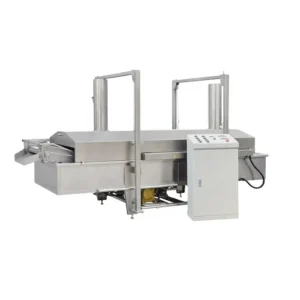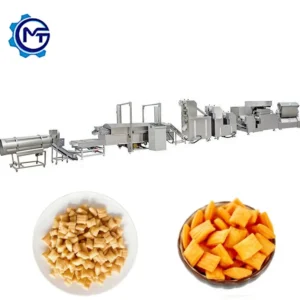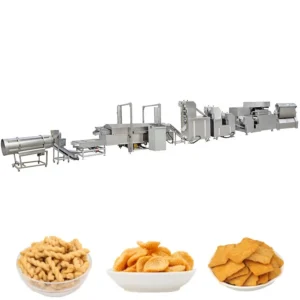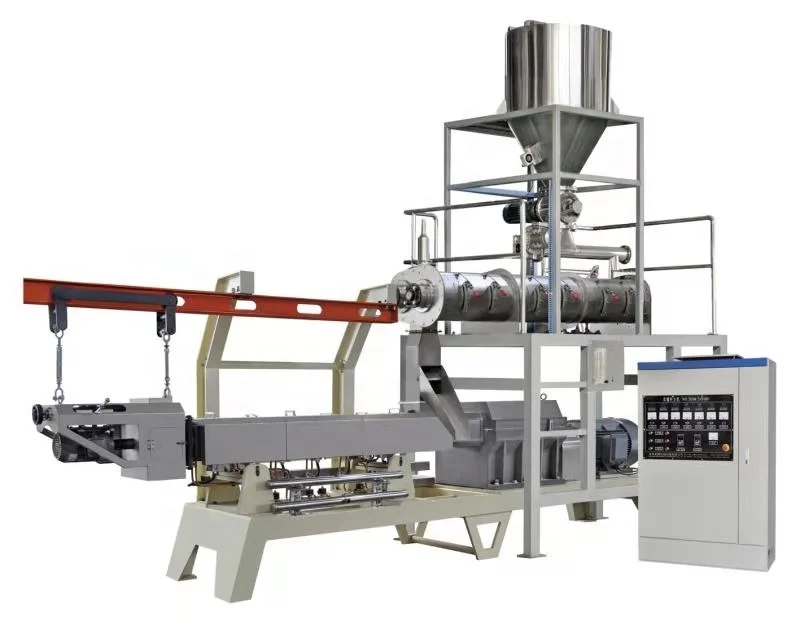
Full Line Integration — Every station from the twin screw extruder to the double-drum flavoring system is throughput-matched under one manufacturer, so a bottleneck at the fryer or seasoning drum never limits the extruder’s real output.
Technical Specifications
| Parameter | Value |
|---|---|
| Product Type | Twin Screw Extruder Fried Snack Production Line |
| Model Options | MT65 / MT70 / MT70c / MT75 |
| Screw Type | Twin screw |
| Screw Material | Alloy 38CrMoAl, nitriding process |
| Main Motor | Siemens brand |
| Feeding System | Speed-adjusted converter, food-grade stainless steel twin screw feeder |
| Cutting System | Rotary cutting knife on die head seat, V-belt drive |
| Gearbox | Automatic lubrication function |
| Frying System | Fully automatic fryer; energy source options — electric / diesel / gas |
| Flavoring System | Double drums with powder hopper, conveyor, and sprayer |
| Cooling Method | Increased radiator on driving part for forced cooling |
| Control System | Configurable (PLC / MCC / manual — confirm with buyer) |
| Voltage & Frequency | Configurable to target market standard (confirm before production) |
| MT65 Rated Power | 22 kW |
| MT65 Output Capacity | 100–150 kg/h (basis not stated in source — confirm raw material and moisture content) |
| MT65 Dimensions | 22000 × 1200 × 2200 mm |
| MT70 Rated Power | 30 kW |
| MT70 Output Capacity | 150–200 kg/h (basis not stated in source — confirm raw material and moisture content) |
| MT70 Dimensions | 25000 × 1500 × 2200 mm |
| MT70c Rated Power | 45 kW (real power 55 kW) |
| MT70c Output Capacity | 200–250 kg/h (basis not stated in source — confirm raw material and moisture content) |
| MT70c Dimensions | 30000 × 3500 × 4300 mm |
| MT75 Rated Power | 55 kW |
| MT75 Output Capacity | 200–300 kg/h (basis not stated in source — confirm raw material and moisture content) |
| MT75 Dimensions | 33000 × 3500 × 4300 mm |
| Assembly State | Complete production line (extruder, fryer, flavoring system) |
| Certification | CE (verify against manufacturer certificate) |
| Warranty | One year from equipment arrival at customer site |
Application Suitability
| Application | Material or Output |
|---|---|
| Nacho chips and tortilla chips | Corn flour / corn powder blends, fried and seasoned |
| Bugles-style cone snacks | Corn-based dough, extruded through cone die, fried |
| Doritos-style triangular chips | Corn grits or corn flour, sheeted and fried |
| General fried puffed snacks | Various corn and grain flour formulations requiring frying and flavoring stages |
| Snack line capacity expansion | Existing puffed snack producers adding frying and double-drum seasoning |
Why Nominal Line Capacity Rarely Survives the First Production Run
Capacity is only real when verified on your actual corn flour blend at your target moisture level.
A fried snack production line quoted at a specific hourly output often assumes a standard corn flour formula with a given starch content and moisture percentage. When the buyer’s raw material arrives and the starch ratio differs, the extruder may produce a denser pellet that fries unevenly, and the downstream fryer cannot compensate [NEED_CITE: raw material variability in extrusion processing]. The seasoning drum then receives product at a rate it was never designed to handle, and the twin screw extruder snack machine manufacturer ends up shipping a line that never reaches its nameplate numbers. Running the buyer’s formula through a testing workshop before the contract is signed removes that guesswork.
Matching Extruder Output to Fryer Residence Time
A fried snack production line only performs when the extruder throughput and the fryer belt speed are calibrated to the same product. If corn pellets exit the die at a rate faster than the fryer can achieve full oil penetration, the result is a center that remains doughy while the surface browns. The fully automatic fryer on this line accepts energy from electric, diesel, or gas sources, which means the thermal recovery rate must be confirmed against the extruder’s actual kilogram-per-hour output on the buyer’s specific formula before the line ships.
Die Geometry and the Shape of the Final Chip
The rotary cutting knife mounted on the die head seat determines chip length and cross-section before the product ever reaches the oil. For Bugles-style cones, the die orifice and the cutter timing must produce a consistent wall thickness so that frying expands the shell uniformly. A die specified for flat tortilla chips will not yield the same result on a cone geometry, which is why the screw and die configuration record must reference the buyer’s exact target shape and corn flour blend rather than a generic catalog setting [NEED_CITE: die design influence on extruded snack geometry].
What the Screw Configuration Actually Controls
The twin screw design with 38CrMoAl nitrided alloy provides the shear and residence time needed to gelatinize corn starch inside the barrel before the material reaches the die. The speed-adjusted converter on the stainless steel feeder keeps the material input steady, which matters because any surge or starvation changes the moisture-to-starch ratio mid-barrel and alters expansion at the die face. The automatic lubrication gearbox protects the drive train during the sustained torque loads that corn flour extrusion demands, and the increased radiator on the driving section provides forced cooling to prevent thermal drift during long production runs.
The Cost of Underspecifying the Downstream Stations
When a fryer is sized to a nominal extruder output rather than the real output on the buyer’s corn formula, oil temperature drops every time a new batch enters and recovery takes longer than the belt cycle allows. The double-drum flavoring system then receives chips at an inconsistent temperature, which causes powder adhesion to vary from drum to drum [NEED_CITE: seasoning adhesion and product temperature correlation]. These mismatches do not show up in a quotation spreadsheet — they appear on the first full production day when the line cannot hold its stated节拍.
Why Sourcing the Complete Line from One Manufacturer Matters
Every station on this fried snack production line — extruder, fryer, and double-drum flavoring system — is specified and supplied by a single manufacturer, which means throughput calculations are not handed off between separate vendors who each assume the other will absorb the variance. The screw and die configuration is selected against the buyer’s raw material and target product rather than copied from a generic build. An in-house testing workshop allows trial runs on the buyer’s actual corn flour before the line ships. Pre-sales engineering covers line layout, utility planning, and capacity calculation across every station, and on-site installation through commissioning and operator training is included.
Documentation & Verification
- Line layout showing throughput matching between extruder, fryer, and flavoring drums
- Screw and die configuration record tied to buyer’s corn flour formula and chip shape
- Trial run report on buyer’s raw material verifying output and product texture before shipment
- Electrical schematic with voltage and frequency confirmed to buyer’s facility standard
- CE declaration of conformity (verify against current manufacturer certificate)
- Wear parts list covering screws, dies, cutting knives, and fryer belt components
Installation, Commissioning & Support
- Foundation must accommodate line lengths from 22 m (MT65) up to 33 m (MT75) with level tolerances for extruder-to-fryer alignment
- Dedicated power circuit required for main motor (22–55 kW depending on model) plus separate fryer heating load
- Line arrives in modular sections; extruder, fryer, and flavoring drums are assembled and aligned on-site
- First-run commissioning includes screw speed, feeder rate, fryer temperature, and drum seasoning calibration
- Operator training covers die changeover, cutting knife adjustment, and fryer oil filtration routines
- Spare screws, dies, and cutting knives stocked; gearbox lubrication and radiator cleaning on scheduled intervals
What to Include in Your Inquiry
To configure the right fried snack production line, share your corn flour or grain flour specification including starch content and moisture percentage, your target chip shape and weight per piece, and the daily output you need to meet. Confirm your facility voltage, frequency, and available energy source for the fryer — electric, diesel, or gas — along with the control language your operators require. If you have existing upstream mixing or downstream packing equipment, provide the interface details so the line layout accounts for those connections.
Frequently Asked Questions
Q: How is output capacity verified before the line ships?
A: We run your actual corn flour formula through our in-house testing workshop and document the real throughput, product expansion, and texture. The trial run report is shared with you before shipment so you can confirm the line meets your expectations on your own raw material, not on a generic placeholder formula.
Q: Can the fryer be configured for our facility’s energy source?
A: Yes. The fully automatic fryer supports electric, diesel, or gas heating. The energy source is confirmed during the specification stage so that thermal recovery rate, oil capacity, and utility connections are matched to both the extruder output and your plant infrastructure.
Q: How are screw and die chosen for our specific chip shape?
A: The screw configuration and die orifice are selected based on your target product geometry, corn flour starch content, and desired expansion ratio. A configuration record is produced for your approval before manufacturing begins, ensuring the line produces the correct shape and density from the first run.
Q: What electrical and control details are confirmed before production?
A: Voltage, frequency, control system type (PLC, MCC, or manual), and operator interface language are all confirmed during the specification phase. The electrical schematic is reviewed against your facility standard so that no rework is needed during on-site commissioning [NEED_CITE: industrial voltage and frequency standards by region].