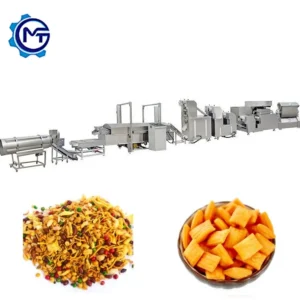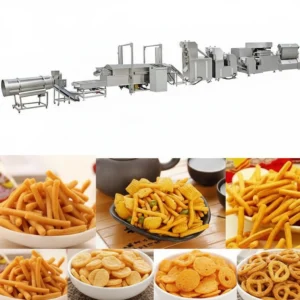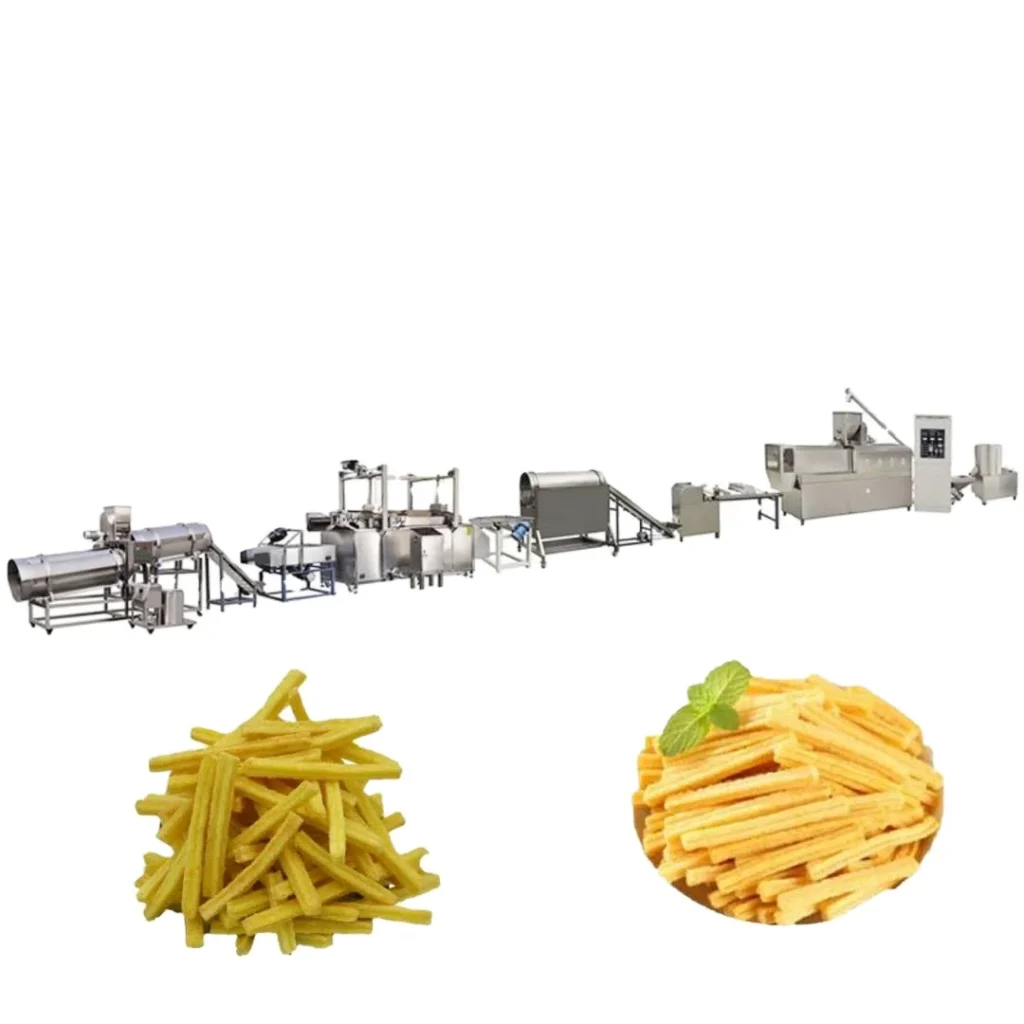
Matched line throughput — every station from mixer to flavoring drum is specified as a set, so no single unit bottlenecks the fried snack production line for sale.
Technical Specifications
| Parameter | Value |
|---|---|
| Model | MT100/MT120 |
| Product Type | Fried Snack Production Line / Golgappa Making Machine |
| Extruder Type | Single screw extruder |
| Output Capacity | 120 kg/h (basis not stated in source — confirm raw material formulation and moisture content) |
| Rated Power | 50-70 kW |
| Power Consumption (Electricity) | About 100 kW |
| Power Consumption (Gas/Diesel) | About 50-60 kW |
| Voltage & Frequency | Three phases: 380V/50Hz; Single phase: 220V/50Hz (customizable to local voltage) |
| Overall Dimensions (L×W×H) | 12000-26000 × 1200 × 2200 mm |
| Raw Materials | Wheat flour, corn starch, potato starch |
| Energy Options | Electricity, gas, diesel, or steam |
| Material of Construction | Food grade stainless steel 201/304 |
| Electrical Components | Siemens (China) or Chinese top brand motors; Delixi or Delta inverters |
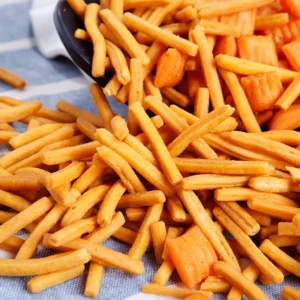
| Product Shapes | Screw shell, round tube, square tube, ring, cartoon shapes (via die adjustment) |
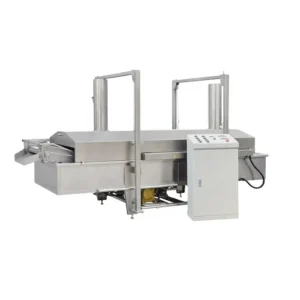
| Line Stations | Mixer → Screw conveyor → Single screw extruder → Pulling and cutting machine → Automatic fryer → Automatic flavoring line → Cooling |
| Standards | CE, ISO 9001 |
| Warranty | One year |
Application Suitability
| Application | Material or Output |
|---|---|
| Golgappa / pani puri production | Wheat flour and potato starch dough, extruded and fried to hollow crisp shells |
| Salad strip and crisp snack manufacturing | Corn starch and wheat flour blends, cut to thin strips before frying |
| Millet crust and savory wafer snacks | Starch-based formulations with grain inclusions, secondary puffing via frying |
| Cartoon-shaped extruded fried snacks | Die-shaped pieces from wheat or potato starch for children’s snack lines |
Why "120 kg/h" Means Nothing Without the Material Context
A capacity figure is only as honest as the raw material formulation behind it.
I once watched a buyer invest in a fried snack line based entirely on a brochure number. When his wheat flour blend ran with a moisture content several points above what the extruder was tuned for, actual throughput dropped sharply and the fryer downstream sat half-empty. The whole line rhythm collapsed. A fried snack production line for sale should always be evaluated against the specific starch or flour blend you plan to run, not a generic test material. That is why a trial run on your actual formulation matters far more than any nameplate number [NEED_CITE: typical moisture content ranges for wheat flour and potato starch in extrusion].
Every Station Specified, None Undersized
The MT100/MT120 fried snack production line for sale covers every stage from raw material intake to finished, flavored product. The mixer feeds a screw conveyor that delivers material at a controlled rate into the single screw extruder. From there, the pulling and cutting machine shapes the extruded rope into uniform pieces before they enter the automatic fryer. The flavoring line and cooling section close the loop. Because one manufacturer supplies each station, the conveyor speed, fryer dwell time, and drum capacity are matched to the extruder output rather than assembled from mismatched standalone units.
Energy Source Flexibility Across the Frying and Drying Stages
The fryer and any intermediate drying stations can run on electricity, gas, diesel, or steam. This matters when your facility already has a central steam boiler or when local gas pricing makes electric heating uneconomical. Specifying the energy source before production starts avoids the situation where a fryer arrives wired for electric resistance heating but the workshop only has gas supply infrastructure [NEED_CITE: industrial fryer energy source selection criteria]. The MT100/MT120 line documentation includes a utility planning sheet so these decisions are locked in before the machines are built.
Reading the Spec Sheet: What the Numbers Actually Mean for Snack Frying
The single screw extruder on this line is rated at 50-70 kW, which is typical for secondary-puffing snack lines running starch-based formulations. Single screw designs work well here because wheat flour, corn starch, and potato starch do not require the intense mixing and shear that twin-screw setups provide for high-protein or high-fat recipes. The overall line length of 12,000 to 26,000 mm reflects the inclusion of cooling conveyors and flavoring drums after the fryer, not just the extruder footprint. The die-adjustable product shapes — screw shell, round tube, square tube, ring, and custom cartoon shapes — are changed by swapping the die plate at the extruder barrel end, which takes minutes rather than hours. Food grade stainless steel 201/304 construction on contact surfaces keeps the line compliant with food safety audits. The Delixi or Delta inverters give operators speed control over the screw conveyor and cutting machine, letting them fine-tune piece length without stopping the line.
The Real Cost of Mismatched Stations
I have seen snack producers buy an extruder that runs well on its own, only to find the fryer cannot keep up because its oil volume and belt speed were never calculated against the extruder output. The result is product backing up on the conveyor, inconsistent frying, and oil degradation from overloaded batches. In other cases, the flavoring drum is too small for the line throughput, forcing operators to run it in batches and breaking the continuous flow. These integration gaps cost more in lost production time than the price difference between a matched line and a pieced-together one [NEED_CITE: production line bottleneck analysis in food processing].
Why Buyers Source This Line From One Manufacturer
The complete station coverage means you receive a line layout and capacity calculation that shows throughput matched at every point, not just at the extruder. Screw configuration and die selection are specified to your raw material formulation before the extruder ships, rather than defaulting to a generic build. The in-house testing workshop runs your actual wheat flour or starch blend through the extruder and fryer so you see real product before the line leaves the factory. Electrical schematics and voltage confirmation are documented per order, so a 220V/60Hz market does not receive a 380V/50Hz panel by mistake. Pre-sales consultation through installation, commissioning, and operator training are handled by the same technical team that configured the line.
Documentation & Verification
- Line layout and capacity calculation sheet showing matched throughput for your starch formulation
- Machine specification sheet per station including extruder motor rating and fryer energy source
- Screw and die configuration record tied to your target snack shape and raw material
- Trial run report on your actual wheat flour or potato starch blend before shipment
- CE declaration of conformity and ISO 9001 certificate for the complete line
- Factory test record with photographs of product output from your material
Installation, Commissioning & Support
- Foundation and floor space planning for the 12,000-26,000 mm line length with utility connection points marked
- Dedicated electrical circuits sized for the 50-70 kW extruder motor and fryer heating elements
- Assembly and station alignment by the installation team covering all conveyor transfers
- First-run parameter setting for extruder barrel temperature, cutter speed, and fryer oil temperature on your formulation
- Operator training on die changes, inverter adjustments, and daily cleaning of food grade stainless steel surfaces
- Wear parts list covering screws, dies, and cutting blades with recommended replacement intervals
What We Need to Configure Your Line
To specify the MT100/MT120 for your facility, send us the exact starch or flour formulation you plan to run, along with the target moisture content and the product shapes you want from the die options. Let us know your local voltage and frequency, and whether your workshop has gas, steam, or electric supply available for the fryer. If you have existing upstream mixing or downstream packing equipment, share the interface dimensions so the line can be matched to your current layout.
Frequently Asked Questions
Q: How is the output capacity of 120 kg/h verified, and what raw material formulation is it based on?
A: The 120 kg/h figure is a rated value and its basis is not stated in the source documentation. Actual throughput depends on your specific wheat flour, corn starch, or potato starch formulation and its moisture content. We run a trial on your actual raw material in our testing workshop before shipment so you receive a verified capacity report tied to your own recipe rather than a generic benchmark.
Q: What voltage and frequency configurations are available, and how do I confirm the correct setup?
A: The line supports three-phase 380V/50Hz and single-phase 220V/50Hz as standard, with customization available for other local voltage requirements. Before order confirmation, we provide an electrical schematic and voltage confirmation sheet for your review. Your facility electrician should verify the available supply and dedicated circuit capacity against the 50-70 kW extruder rating and fryer heating load.
Q: Can individual stations be purchased separately, or must the full line be ordered together?
A: Individual stations such as the extruder, automatic fryer, or flavoring drum can be specified independently. However, when stations are sourced from different suppliers, throughput matching becomes the buyer’s responsibility. Purchasing the complete line ensures conveyor speeds, fryer dwell time, and drum capacity are calculated against the extruder output from the start.
Q: What shapes can the extruder produce, and how long does a die change take?
A: Available shapes include screw shell, round tube, square tube, ring, and custom cartoon shapes, all produced by changing the die plate at the extruder barrel end. A die swap is a manual operation that does not require specialized tools. Operators trained during commissioning can typically complete a changeover within a short production break.
Q: Which line stations are standard, and which are optional?
A: The standard configuration includes the mixer, screw conveyor, single screw extruder, pulling and cutting machine, automatic fryer, automatic flavoring line, and cooling section. Packing systems and any intermediate drying stations can be added as optional equipment depending on your product format and facility layout requirements.