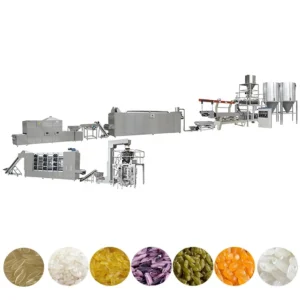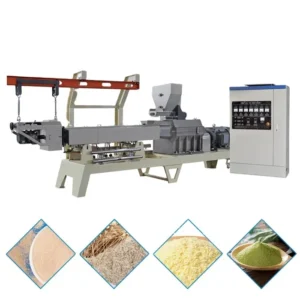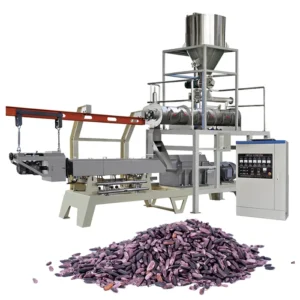
Thermally segmented barrel zones — each heating and cooling circuit on the MT65, MT70 and MT85 extruders is independently controlled, allowing operators to dial in the exact starch gelatinisation window required by high-fibre or multi-grain artificial rice formulas.
Technical Specifications
| Parameter | Value |
|---|---|
| Product Type | Nutritional Artificial Rice Processing Line |
| Models Available | MT65, MT70, MT85 |
| Screw Type | Twin-screw |
| Power Consumption (MT65) | 60 kW |
| Power Consumption (MT70) | 85 kW |
| Power Consumption (MT85) | 165 kW |
| Output Capacity (MT65) | 70–100 kg/h (basis not stated in source — confirm raw material, moisture, rice grain size) |
| Output Capacity (MT70) | 100–120 kg/h (basis not stated in source — confirm raw material, moisture, rice grain size) |
| Output Capacity (MT85) | 200–300 kg/h (basis not stated in source — confirm raw material, moisture, rice grain size) |
| Overall Dimensions (MT65) | 28000 × 1200 × 2200 mm |
| Overall Dimensions (MT70) | 30000 × 1500 × 2200 mm |
| Overall Dimensions (MT85) | 34000 × 3500 × 4300 mm |
| Mixer Motor | 4.0 kW |
| Mixer Batch Output | 3.0–4.0 kg/time |
| Mixer Dimensions | 1.2 × 0.9 × 1.4 m |
| Screw Conveyor Motor | 1.1 kW |
| Screw Conveyor Throughput | 0–150 kg/h (basis not stated in source — confirm material bulk density) |
| Screw Conveyor Dimensions | 2.5 × 0.6 × 2.3 m |
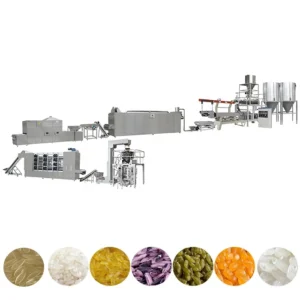
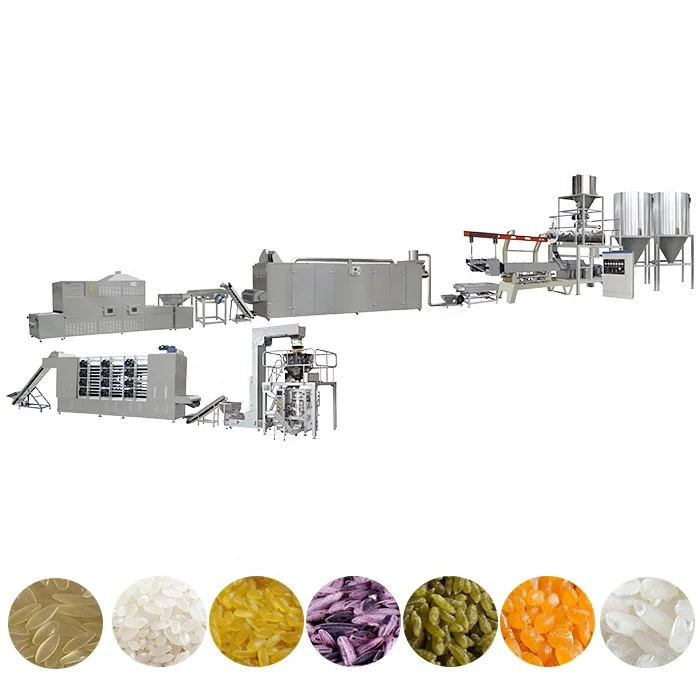
| Line Stations | Mixer → Screw Conveyor → Extruder → downstream stations configurable per project |
| Control System | PLC / MCC (options available) |
| Certification | CE |
Application Suitability
| Application | Material or Output |
|---|---|
| Fortified rice for nutrition programmes | Rice flour blended with vitamin and mineral premix |
| Instant convenience rice | Pre-cooked starch base for fast rehydration |
| Multi-grain extruded rice | Buckwheat, black rice, millet and purple potato blends |
| Golden rice production | Beta-carotene enriched rice flour formulations |
| High-fibre diabetic-friendly rice | Bran and whole-grain flour with adjusted gelatinisation profile |
What "Rated Capacity" Leaves Out About Artificial Rice Lines
A number on a brochure means nothing until it is tested against your actual flour blend and moisture content.
I once commissioned a nutritional artificial rice production line manufacturer had quoted at a comfortable output figure, only to watch the extruder choke when the client switched from standard white rice flour to a buckwheat-heavy formula with extra bran. The starch behaviour was completely different — gelatinisation temperature shifted, expansion collapsed, and the rice grains came out dense and misshapen. The screw profile had to be rebuilt from scratch, and we spent two weeks on site re-tuning barrel temperatures zone by zone. That gap between catalogue capacity and real-world throughput is where most artificial rice projects stall [NEED_CITE: twin-screw extrusion behaviour on high-fibre grain blends].
How Screw Configuration Shapes the Rice Grain
The twin-screw extruder at the heart of every MT line does far more than push dough through a die. The screw elements — kneading blocks, reverse flights, and conveying sections — determine how much shear energy the flour receives and for how long. A formula heavy in buckwheat or black rice needs a gentler shear profile to avoid breaking down the fibre matrix before the starch has fully gelatinised. Change the screw arrangement and the same machine can produce a firm, separate-grain texture or a softer, quick-cooking instant rice. Die selection further refines grain length and cross-section so the final product visually matches the target market expectation.
Matching Every Station to the Extruder’s Real Output
A common failure on artificial rice lines is a bottleneck hiding downstream. The extruder may run at its rated throughput, but if the dryer cannot remove moisture fast enough or the cooling conveyor is too short, wet grains pile up and stick together before packing. On the MT85 configuration, for example, the line stretches over 34 metres to accommodate sufficient drying and cooling residence time for higher output volumes. Each station — mixer, screw conveyor, extruder, dryer, cooler, and packing — must be specified against the actual output the extruder delivers on your specific formula, not its nominal peak.
Reading the Specs That Actually Matter
The power ratings across the three models — 60 kW for the MT65, 85 kW for the MT70, and 165 kW for the MT85 — indicate the thermal and mechanical energy available for starch conversion inside the barrel. Higher power allows the extruder to maintain barrel temperature when processing high-moisture or high-fibre blends that absorb more heat. Mixer batch size of 3.0–4.0 kg per cycle sets the blending rhythm; if your vitamin premix requires micro-dosing, you may need a separate pre-blending step before the main mixer to ensure even nutrient distribution. The screw conveyor’s stainless steel construction prevents flour dust leakage, which matters for both hygiene compliance and accurate ingredient dosing over long production runs [NEED_CITE: food-grade material handling standards for extruded rice lines].
The Cost of Skipping a Trial Run
Buying an extrusion line without testing your raw material first is a gamble with expensive consequences. I have seen installations where the first production run revealed that the client’s local rice flour had a different amylose ratio than the supplier’s test sample, producing grains that disintegrated during cooking. Retooling the screw combination and die plate after the machine is bolted to the factory floor costs time and money that a pre-shipment trial would have avoided entirely. The testing workshop exists precisely to surface these problems before the crate leaves the factory [NEED_CITE: pre-shipment extrusion trial protocols for grain-based products].
Why Procurement Lands Here
Complete line supply from batching through packing means throughput is balanced at every station rather than patched together from mismatched vendors. Screw configuration and die design are specified against the buyer’s raw material formula, not copied from a generic template. The in-house testing workshop allows trial runs on the client’s actual flour blend before the line ships, reducing on-site commissioning time. Twin-screw expertise spans fortified rice, multi-grain, and instant rice applications, so the process knowledge transfers directly to your product category. Electrical schematics, voltage confirmation, and control language are verified before production begins, eliminating the delays that occur when a 380 V machine arrives at a 415 V facility.
Documentation & Verification
- Line layout and capacity calculation matched to your rice flour blend and target grain shape
- Screw and die configuration record documenting element arrangement for your formula
- Trial run report produced on your raw material in the testing workshop before dispatch
- Electrical schematic with voltage and frequency confirmed for your local grid standard
- Operation and maintenance manual with wear parts list for screws, dies, and seals
Installation, Commissioning & Support
- Foundation must support the MT85’s 34-metre footprint with level tolerance for conveyor alignment
- Dedicated power circuit sized to the model’s rated consumption (60 kW to 165 kW) plus dryer and cooler loads
- Line ships in modular sections for container loading and reassembly on your factory floor
- Commissioning includes barrel temperature profiling and screw speed tuning on your raw material
- Operator training covers die changes, screw element swaps, and PLC parameter adjustments
- Wear parts inventory — screws, die plates, seals — supplied with the first shipment
What to Include in Your Inquiry
To size the right MT model and configure every station correctly, share your raw material formula including flour type, fibre content, and target moisture level. Specify the rice grain shape and cooking texture your market expects, along with daily output targets and available workshop floor space. Confirm your local voltage and frequency so the electrical package is built to match before production starts.
Frequently Asked Questions
Q: How is output capacity verified against my specific raw material blend?
A: Capacity figures in the specification sheet are based on standard reference conditions. For your actual formula — whether buckwheat-heavy, high-fibre, or vitamin-enriched — we run a trial in the testing workshop using your raw material. The resulting throughput, grain density, and cooking behaviour form the basis of the final line configuration and capacity guarantee.
Q: Which downstream stations are included and how is throughput balanced?
A: The baseline line includes mixer, screw conveyor, and extruder. Dryer, cooler, and packing stations are added based on your output target and floor layout. Each station is rated to handle the extruder’s verified throughput on your formula, preventing bottlenecks where wet grains accumulate before drying or packing falls behind.
Q: Can I run a trial with my raw material before the line ships?
A: Yes. Send a representative sample of your flour blend to the testing workshop. The trial covers screw configuration, barrel temperature profile, die selection, and grain cooking behaviour. You receive a full report with the recommended setup, so the line arrives at your factory already tuned to your product.
Q: What voltage and control language options are available?
A: The electrical package is configured to your facility’s voltage and frequency before production begins. The PLC and MCC control system supports multiple language options for the operator interface. Confirm these details during the quotation stage so they are locked in before manufacturing starts.