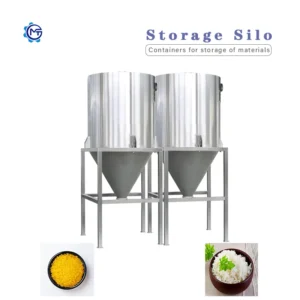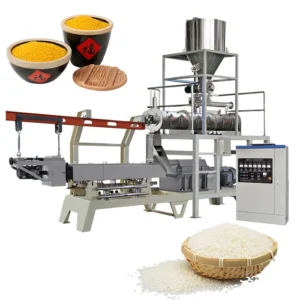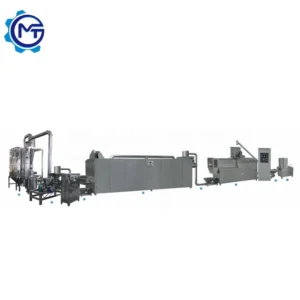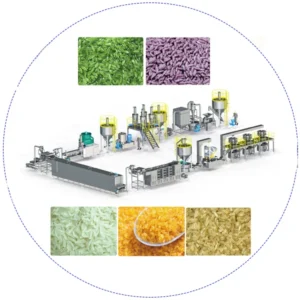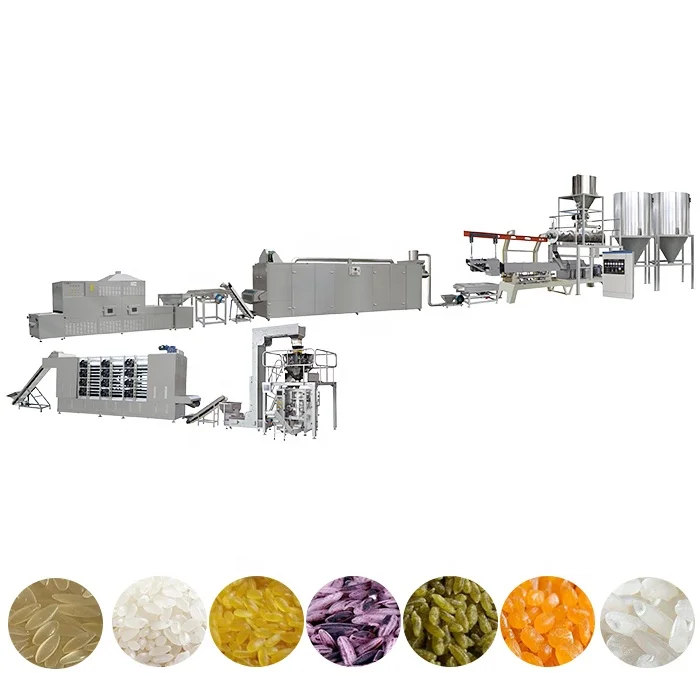
Integrated station matching — every conveyor, dryer and extruder in this noodle line is sized against the others so wet extrudate never piles up at a bottleneck.
Technical Specifications
| Parameter | Value |
|---|---|
| Product Type | Instant Noodle Production Line |
| Line Configuration | Mixing, feeding, extruding, screening, drying, cooling, packing |
| Extruder Type | Twin-screw extruder |
| Control System | Full automatic (PLC/MCC details and language to be confirmed) |
| Drying System | Vibrating screen with fan and drying box |
| Conveying System | Feeder, air conveyor, lifting machine |
| Output Capacity | (basis not stated in source — confirm noodle format and kg/h) |
| Voltage & Frequency | (to be confirmed before production) |
| Assembly State | Complete integrated production line |
Application Suitability
| Application | Material or Output |
|---|---|
| Instant ramen and fried noodle production | Wheat flour blends with kansui alkaline solution |
| Steamed and air-dried noodle formats | Wheat flour, starch, and salt mixtures |
| Grain-based extruded noodle variants | Buckwheat, rice flour, and composite grain flours |
What "Automatic" Really Means When Stations Are Not Balanced
An automatic noodle making machine for sale is only as automatic as its slowest station.
I have watched a twin-screw extruder push wet dough into a vibrating screen faster than the downstream drying box could handle. Within two hours the discharge chute was plugged solid and the operator spent the rest of the shift clearing hardened dough. The extruder itself was fine; the dryer fan and conveyor belt speed were never matched to it. That mismatch is what turns a full line into a bottleneck chain, and it happens when equipment is sourced station-by-station without a unified capacity calculation [NEED_CITE: line throughput matching principles in continuous food processing].
How the Feeding and Extruding Stations Set the Pace
The feeding system meters raw flour blend into the twin-screw extruder at a controlled rate. If the feeder surges, the screw channels flood and dough temperature spikes from excess shear; if it starves, residence time drops and gelatinisation is incomplete. Both conditions produce noodles that crack during drying or turn gummy when the buyer cooks them. The automatic noodle making machine for sale must therefore start with a feeder that holds a steady mass flow matched to the extruder screw speed and barrel heating profile.
Why the Vibrating Screen and Drying Box Are Sized Together
Wet extruded noodles land on the vibrating screen where a fan strips surface moisture before the strands enter the drying box. The screen amplitude and fan volume must account for the exact moisture content leaving the extruder die. If the screen is undersized, noodles overlap and fuse into clumps that the drying box cannot separate. The drying box then receives uneven loads, producing some strands that are brittle and others that are still tacky inside. This is where the integrated line approach prevents a fault that looks like a dryer problem but actually started two stations upstream [NEED_CITE: moisture migration in extruded noodle drying].
Reading the Specs That Actually Matter for Noodle Lines
The twin-screw configuration is central because it generates the shear and residence time needed to gelatinise wheat starch uniformly across the barrel length. Single-screw designs can handle simple doughs, but when the recipe includes alkaline salts or composite grain flours the mixing action of two intermeshing screws keeps the blend homogeneous. The control system ties feeder rate, barrel temperature zones, screw speed, and dryer fan output into one logic loop so that a recipe change at the mixer propagates through every station without manual recalculation. Voltage and frequency must be confirmed before the electrical cabinets are wired because a 50 Hz motor running on 60 Hz supply will shift every conveyor and fan speed, throwing off the entire line balance. The air conveyor and lifting machine between stations must also match the die output rate; a lifting belt that runs too fast stretches the warm noodle strands before they have set.
When Undersized Downstream Equipment Stops the Line
An extruder rated for a given output means nothing if the cooling conveyor cannot carry that volume to the packing station. Wet noodle strands sitting in a pile begin to ferment and stick together within minutes, and the cleanup downtime wipes out the shift’s production target. Buyers who select stations from different catalogues without a shared throughput document often discover the mismatch only after the machines are bolted to the floor. The cost of replacing a dryer or adding a second cooling belt after installation far exceeds the effort of matching capacities on paper during the specification phase [NEED_CITE: downtime costs from undersized auxiliary equipment in food lines].
What You Get When the Whole Line Comes From One Source
Every station in this noodle line is specified against the same capacity document, so the extruder output, drying box residence time, and packing rate are calculated together before production starts. The screw configuration and die geometry are selected for the buyer’s actual flour blend rather than copied from a generic build. An in-house testing workshop runs the buyer’s raw material on the extruder before shipment, generating a trial report that confirms noodle texture and moisture targets. Electrical schematics and voltage specifications are locked in before wiring begins, and the control language is set to the operator’s preference. Wear parts lists covering screws, dies, and screen meshes are included so the first replacement cycle does not catch the maintenance team unprepared.
Documentation & Verification
- Line layout and capacity calculation covering every station from mixer to packer
- Machine specification sheet for each individual unit in the noodle line
- Electrical schematic and voltage confirmation signed off before cabinet wiring
- Trial run report on buyer’s flour blend produced in the testing workshop
- Factory test record documenting extruder output and dryer performance before dispatch
- Operation and maintenance manual with wear parts list for screws, dies, and screens
Installation, Commissioning & Support
- Foundation and floor space plan drawn from the confirmed line layout dimensions
- Dedicated power circuit sized to the total connected load of extruder motor and dryer fans
- Modular assembly state allowing containerised shipment and on-site station alignment
- First-run commissioning with barrel temperature and screw speed calibration on local flour
- Operator training covering control interface, recipe storage, and emergency stop sequences
- Scheduled wear parts inventory covering twin-screw segments, die plates, and screen panels
What to Include in Your First Inquiry
Send the flour type and any secondary grain or starch percentages you plan to run, along with the target noodle format and daily output in kilograms. Include the available workshop floor area, ceiling height, and the local voltage and frequency so the electrical design starts from correct figures. If you have existing upstream mixers or downstream packing machines, list their capacity so the new line can be matched to them.
Frequently Asked Questions
Q: How is throughput matched between the extruder, dryer, and packing stations?
A: Each station is sized using a shared capacity calculation document. The extruder die output in kg/h drives the vibrating screen area, dryer box length, and cooling conveyor speed. If any station is changed during specification, the entire document is recalculated so no single unit becomes a bottleneck.
Q: What voltage and frequency options are available for each machine in the line?
A: Voltage and frequency are confirmed during the specification phase to match the buyer’s local supply. Motor ratings, heater elements, and control transformer taps are all selected before the electrical cabinets are assembled, preventing commissioning delays caused by supply mismatch.
Q: Can individual stations be purchased separately or only as a complete line?
A: Individual stations are available, but a capacity matching review is recommended before ordering. Purchasing a standalone extruder without specifying downstream drying and cooling capacity risks wet extrudate buildup, which is the most common cause of line jams in noodle production.
Q: How do I compare specifications across different extruder models in the catalogue?
A: Each extruder model carries a specification sheet listing screw diameter, length-to-diameter ratio, motor power, and barrel zone count. These parameters are compared against the buyer’s flour blend and target noodle texture to select the configuration that delivers the required gelatinisation and strand integrity.
Q: What supporting equipment is recommended for my target capacity?
A: The recommended mixer volume, feeder type, conveyor length, and dryer size all derive from the target hourly output and the moisture reduction required between extruder discharge and final packing. A line layout proposal is generated once these figures are confirmed.