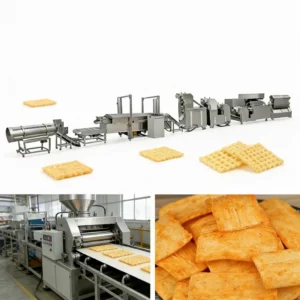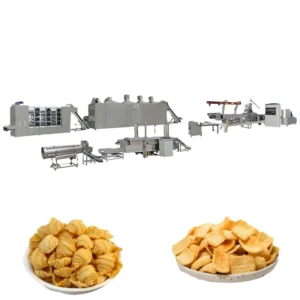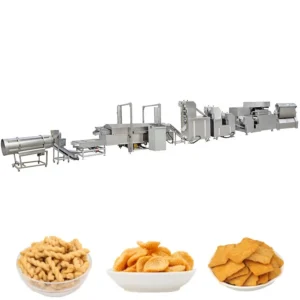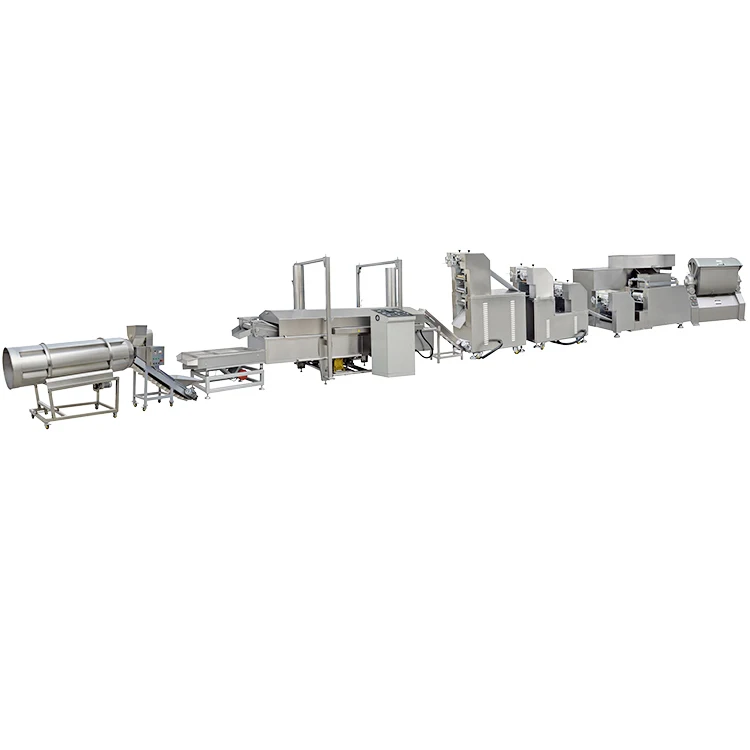
Throughput-Matched Line Design — Every station from the mixing system through the extruder, fryer, and flavoring drum is sized to the same output baseline, preventing the bottleneck effect that happens when an extruder outpaces downstream drying or coating capacity.
Technical Specifications
| Parameter | Value |
|---|---|
| Model | MT100 / MT120 |
| Product Type | Puffed Snack Production Line (Fried Chips / Golgappa / Pani Puri) |
| Extruder Type | Single-screw extruder (high and low pressure screw configuration) |
| Raw Material Compatibility | Wheat flour, corn starch, potato starch |
| Capacity | 120 kg/h (basis not stated in source — confirm raw material blend, moisture content, and product shape) |
| Rated Power | 50–70 kW (electric); 50–60 kW (gas or diesel option) |
| Voltage & Frequency | 380V/50Hz (three-phase); 220V/50Hz (single-phase); customizable |
| Energy Source Options | Electricity, gas, diesel, steam |
| Motor & Drive | Siemens (made in China) or equivalent; Delixi or Delta inverter |
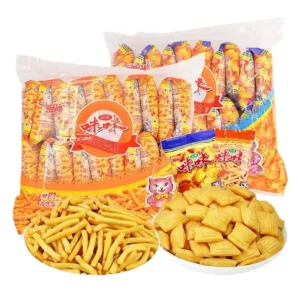
| Product Shapes | Screw shell, round tube, square tube, ring, cartoon shapes (die-adjustable) |
| Contact Material | Food-grade stainless steel 201 (304 option to be confirmed) |
| Line Sequence | Mixing → Screw conveyor → Single-screw extruder → Pulling & cutting → Fryer → Flavoring → Cooling |
| Overall Dimensions (L×W×H) | 12,000–26,000 × 1,200 × 2,200 mm |
| Certification | CE, ISO 9001 |
| Warranty | One year; lifetime technical guidance |
Application Suitability
| Application | Material or Output |
|---|---|
| Golgappa / Pani Puri production | Wheat flour and starch blends for hollow, crispy shells |
| Fried chip and turtle chip lines | Potato starch or corn starch sheeted and secondary-puffed |
| Four-layer crispy snack formats | Multi-layer starch-based dough with controlled expansion |
| Cartoon-shaped puffed snacks | Die-cut shapes from corn starch and wheat flour blends |
| Secondary puffing snack operations | Pre-formed pellets or direct extrusion into hot oil |
What "120 kg/h" Actually Depends On
Capacity on a puffed snack production line equipment for sale listing only means something when tied to a specific raw material blend and moisture level.
I once watched a snack line in West Africa stall within the first hour because the supplier quoted a throughput number based on pure corn grits, but the buyer was running a wheat-tapioca mix that expanded at barely half the rate. Material piled up at the cutting station while the fryer sat half-empty. The extruder was not wrong; the line was just never balanced for that formula. Before any capacity figure becomes meaningful, the supplier needs your exact flour-to-starch ratio and target moisture at the die exit. [NEED_CITE: starch gelatinisation behaviour across wheat, corn, and potato blends]
How Single-Screw Configuration Handles Starch Variability
A single-screw extruder with selectable high- and low-pressure screw configurations gives processors room to shift between starch-dominant and flour-dominant recipes without swapping hardware. High-pressure segments compress the dough tightly, producing denser pellets suited for turtle chips and four-layer crisps. Low-pressure segments allow more expansion, which is what you need for hollow golgappa shells. This flexibility matters when raw material costs shift seasonally and buyers reformulate to protect margins. The puffed snack production line equipment for sale in this range lets a single extruder cover multiple product formats through screw element rearrangement rather than capital expenditure on a second machine.
Matching Fryer and Flavoring Capacity to Extruder Output
The most common failure point on secondary puffing lines is a mismatch between what the extruder pushes out and what the fryer can absorb. If the fryer belt is undersized, product queues at the cutting station, moisture re-condenses on hot surfaces, and you get clumped, unevenly colored chips. This line specifies an automatic fryer and flavoring drum as integral stations rather than optional add-ons, meaning each is selected against the extruder’s output range. When the pulling-and-cutting machine feeds the fryer at a steady rate, oil temperature holds within a tight band and color consistency follows. [NEED_CITE: fryer residence time and oil temperature stability in continuous snack operations]
Reading the Specs That Shape Final Product Quality
The die is where raw material becomes product identity. A screw shell die forces dough through a helical channel, creating the spiral cross-section that traps seasoning powder in its grooves — useful for heavily flavored chip formats. A ring die produces the hollow tube that puffs into golgappa when it hits hot oil. Switching between them takes minutes, not hours, because the die plate bolts on with a standard clamp ring. The 50–70 kW rated power range covers the thermal and mechanical energy needed to gelatinise starch at the throughput this line is designed for, while the Delixi or Delta inverter on the main drive lets operators fine-tune screw speed to match different recipe viscosities. Food-grade stainless steel 201 on product-contact surfaces meets baseline hygiene requirements, though buyers in markets with stricter washdown protocols should confirm the 304 upgrade path before order. The overall footprint of up to 26 meters in length means buyers need to verify workshop clearance before committing to a layout.
When Undersized Downstream Equipment Costs You More Than the Machine Itself
A line where the extruder runs at full rate but the flavoring drum can only handle a fraction of that volume forces operators to either slow the extruder or let unseasoned product pass through. Slowing the extruder changes barrel temperature and residence time, shifting expansion rate and density. Unseasoned product reaching the packing station means giveaway weight and customer complaints. I have seen processors in South Asia run two shifts to hit the daily volume that a matched line would deliver in one, simply because the coating drum was treated as an afterthought. Every station on a secondary puffing line lives or dies by the station before it. [NEED_CITE: throughput balancing across extrusion, frying, and seasoning stages]
Why Buyers Source This Line from a Single Equipment Range Supplier
Complete line configuration under one supplier means the screw conveyor is sized to the mixer output, the fryer belt width matches the extruder die face, and the flavoring drum volume is calculated against the fried product’s oil uptake and seasoning adhesion rate. Screw and die configurations are specified to the buyer’s actual flour and starch blend, not copied from a generic build. An in-house testing workshop allows trial runs on the buyer’s raw material before the line ships, catching expansion or density problems while adjustments are still cheap. Multi-energy support across electricity, gas, diesel, and steam means the fryer and dryer can be matched to local fuel economics rather than forcing a single energy source. CE and ISO 9001 certification covers documentation needed for customs clearance and regulatory filing in most import markets.
Documentation & Verification
- Line layout drawing with throughput calculations for every station in the snack line
- Screw and die configuration record matched to your specific flour and starch formula
- Electrical schematic confirming voltage and frequency for your facility before production begins
- Factory trial run report on your raw material showing actual expansion and density results
- CE declaration of conformity and ISO 9001 certificate for customs and regulatory submission
Installation, Commissioning & Support
- Floor plan must accommodate up to 26,000 mm line length with utility drops at each station
- Dedicated three-phase circuit rated for 50–70 kW with voltage confirmed before energizing
- Line arrives in modular sections; extruder, fryer, and flavoring stations align on-site
- First-run parameter setting covers barrel temperature zones, screw speed, and fryer oil temperature
- Operator training includes die changeover, screw cleaning, and inverter adjustment for new recipes
- Wear parts list covers screws, dies, and fryer belt segments with reorder specifications
What We Need to Configure Your Line
Share your primary raw material — whether wheat flour, corn starch, potato starch, or a blend — along with the target product shape and expected daily output. Confirm your facility’s voltage, frequency, and available energy source for the fryer. If you have existing upstream mixers or downstream packing equipment, let us know the interface points so the line integrates without gaps.
Frequently Asked Questions
Q: How is the 120 kg/h capacity verified against my specific raw material blend?
A: The stated figure requires confirmation against your actual flour-to-starch ratio, moisture content, and product shape. We run a trial in our testing workshop using your raw material to measure real throughput, expansion rate, and density before the line ships, so the number you plan production around is based on your formula, not a generic benchmark.
Q: Which voltage and frequency options are available for my target market?
A: The line supports 380V/50Hz three-phase and 220V/50Hz single-phase as standard configurations. Voltage and frequency are confirmed during the specification stage and locked into the electrical schematic before production, ensuring the motor, inverter, and control panel match your facility’s supply without on-site rewiring.
Q: How are the fryer and flavoring stations sized to match the extruder output?
A: Each downstream station is calculated against the extruder’s output range for your specific product shape and recipe. The fryer belt speed and oil volume are set so product enters and exits at a steady rate, and the flavoring drum volume accounts for oil uptake and seasoning adhesion, preventing queues or idle gaps between stations.
Q: What die configurations are available, and how is the right one selected?
A: Available dies cover screw shell, round tube, square tube, ring, and custom cartoon shapes. Selection depends on your target product format — ring dies for hollow golgappa, helical dies for seasoned chip shapes. The die is matched during the trial run phase to confirm expansion behaviour and final product dimensions against your market specification.
Q: What spare wear parts are included, and how are replacements supplied?
A: The initial shipment includes a wear parts list identifying screws, dies, and fryer belt segments most likely to need replacement. Reorder specifications are documented so you can source directly or through our supply channel, and lifetime technical guidance covers wear assessment and replacement scheduling.