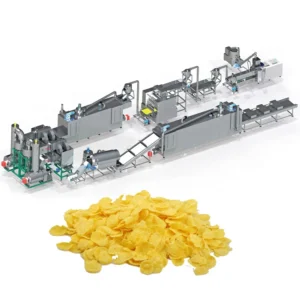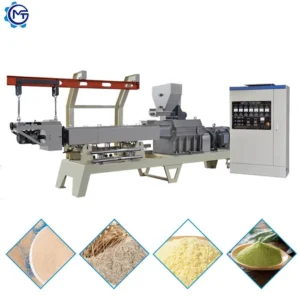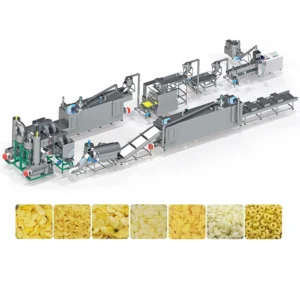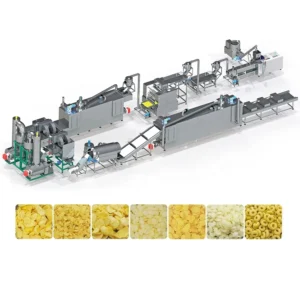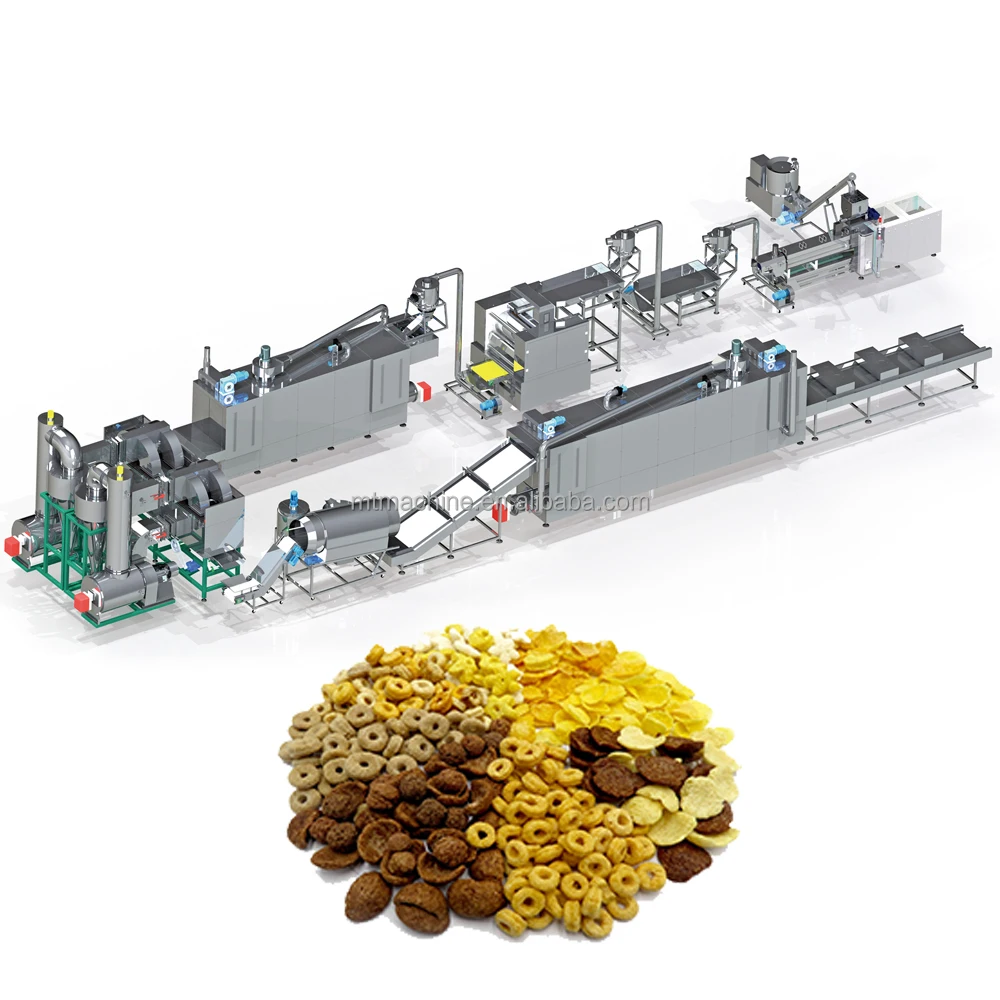
Turnkey Line Integration — Every station from mixer to packer is throughput-balanced so the extruder never outpaces the flaking or roasting oven downstream.
Technical Specifications
| Parameter | Value |
|---|---|
| Product Type | Corn Flakes Breakfast Cereal Production Line |
| Model Options | MT70 / MT75 / MT85 |
| Extruder Type | Twin Screw |
| Installed Power (MT70) | 160 kW |
| Installed Power (MT75) | 210 kW |
| Installed Power (MT85) | 190 kW |
| Power Consumption (MT70) | 120 kW |
| Power Consumption (MT75) | 150 kW |
| Power Consumption (MT85) | 140 kW |
| Output Capacity (MT70) | 150–200 kg/h (basis not stated in source — confirm raw material type and moisture content) |
| Output Capacity (MT75) | 300–500 kg/h (basis not stated in source — confirm raw material type and moisture content) |
| Output Capacity (MT85) | 300–400 kg/h (basis not stated in source — confirm raw material type and moisture content) |
| Overall Dimensions (MT70) | 41 × 1.5 × 2.2 m |
| Overall Dimensions (MT75) | 45 × 1.5 × 3.5 m |
| Overall Dimensions (MT85) | 43 × 1.5 × 3.2 m |
| Control System | PLC and MCC |
| Flaking Machine Drive | Double motors with hydraulic roller system |
| Flaking Temperature Control | Infrared sensor for even temperature pipe control |
| Dryer Heating Source | Gas or Electric |
| Roasting Oven | Hot air circulating, dual fans, cyclone dust removal |
| Coating System | Double tumble sugar melter, elevator, coating drum, spray nozzle |
| Raw Materials | Corn, rice, wheat, oat, barley powder |
| Die Shapes | Ball, tube, stick, ring, fruit loop, star, wheel, flower, heart |
| Standards | CE, ISO |
Application Suitability
| Application | Material or Output |
|---|---|
| Natural corn flakes production | Corn grits and corn flour blends |
| Sugar-coated breakfast cereal | Corn, rice, or wheat base with sugar glaze |
| Multi-grain cereal flakes | Wheat, oat, and barley powder blends |
| Shaped cereal variants | Fruit loops, stars, rings from interchangeable dies |
| Fortified nutrition cereal | Grain powder premixed with vitamin and mineral additives |
| Private-label retail cereal | Consistent flake density and coating for branded packaging |
Why Nominal Capacity Claims Sink Breakfast Cereal Projects
A corn flakes production line equipment manufacturer that quotes output without naming the raw material is quoting blind.
I once watched a Middle Eastern client feed whole-wheat blend into a line calibrated for standard corn flour. The high fiber content meant the screw could not grip the material properly, and the flakes came out shattered — an entire first production run scrapped before anyone understood why. Capacity numbers only hold meaning when tied to a specific grain formulation and moisture level [NEED_CITE: grain formulation effects on twin-screw extrusion throughput]. When a supplier cannot tell you what material their capacity figure is based on, that figure is a guess.
Twin Screw Extrusion as the Shaping Platform
How Die Geometry and Screw Profile Determine Flake Character
The twin screw extruder on this corn flakes production line equipment manufacturer setup accepts interchangeable die moulds, allowing a single extrusion platform to produce balls, tubes, rings, stars, and traditional flake precursors. Screw configuration and barrel temperature profile are matched to the grain blend so that starch gelatinisation happens at the right point along the barrel, giving the dough enough cohesion to hold shape through the die without tearing or collapsing.
The Flaking and Roasting Sequence That Builds Texture
After extrusion, the cooked pellets pass through a hydraulic double-roller flaking machine driven by independent motors, where an infrared sensor monitors roller surface temperature to keep flake thickness consistent across the full width. The sheets then enter a hot air roasting oven equipped with two circulating fans and a cyclone dust removal device. This controlled blistering step gives corn flakes their characteristic surface bubbles and audible crunch — a texture the market recognises immediately and rejects when it is wrong [NEED_CITE: surface blistering and moisture removal in cereal roasting ovens].
Reading the Power and Dimension Data Correctly
The three model tiers differ in installed power from 160 kW to 210 kW, with actual consumption ranging from 120 kW to 150 kW — the gap between installed and consumed figures reflects motor start-up load and heater cycling rather than continuous draw. Line lengths run between 41 and 45 metres, which means facility planning must account for a straight-run footprint plus lateral clearance for maintenance access on the flaking rollers and roasting oven panels. The PLC and MCC control architecture centralises temperature set points, roller pressure, and conveyor speed so that an operator can adjust the entire sequence from one interface rather than walking each station individually.
The Cost of Mismatched Downstream Capacity
An extruder pushing dough at full rate into a dryer or roasting oven that cannot keep up creates a pile-up that forces the entire line to slow down, negating whatever capacity advantage the extruder offered in the first place. Sugar coating stations with undersized tumble melters introduce a second bottleneck, because the coating drum cannot accept flakes as fast as the roasting oven delivers them. These imbalances are invisible on a spec sheet that lists only extruder output and become painfully obvious during the first continuous production shift [NEED_CITE: throughput balancing across cereal line stations].
Why Buyers Source This Line From a Single Supplier
Every station — mixing, extrusion, flaking, drying, roasting, coating, cooling, packing — is specified together, so throughput is calculated across the full sequence rather than assembled from standalone machines bought separately. Screw configuration and die selection are set to your grain formulation and target flake density before build, not copied from a generic template. An in-house testing workshop allows trial runs on your actual raw material before the line ships, so formulation issues surface in the factory, not on your floor. Electrical schematics, voltage, and PLC language are confirmed during engineering review to match the destination facility. Post-installation support covers commissioning, operator training, and wear parts supply for screws and dies.
Documentation & Verification
- Line layout drawing showing station sequence and throughput match across every conveyor transfer point
- Screw and die configuration record specifying profile to your grain blend and moisture target
- Trial run report produced on your raw material documenting flake density, expansion, and coating adhesion
- Electrical schematic with confirmed voltage, frequency, and PLC control language for your facility
- CE declaration of conformity and ISO certificate referencing the shipped equipment
- Wear parts list identifying screws, dies, and roller surfaces with reorder codes
Installation, Commissioning & Support
- Foundation must support line lengths up to 45 m with level tolerance for flaking roller alignment
- Dedicated electrical circuit sized for up to 210 kW installed load with correct voltage and frequency
- Line arrives in sectional modules requiring on-site assembly, belt tensioning, and utility hook-up
- First-run commissioning includes PLC parameter loading, barrel temperature profiling, and roller gap setting
- Operator training covers die changeover, sugar melter operation, and roasting oven fan balance adjustment
- Wear parts inventory recommended for screws, dies, and flaking roller surfaces from first production cycle
What to Prepare Before Requesting a Quote
Share the exact grain formulation you intend to run — including the ratio of corn to wheat or oat and the target moisture content at the mixer outlet — so the screw profile and die selection can be specified accurately. Provide your facility’s available floor length, ceiling height, and local voltage and frequency standards. If you plan to produce both natural and sugar-coated variants, confirm the split so the coating system capacity is sized accordingly.
Frequently Asked Questions
Q: How is line output capacity verified on my specific grain formulation and moisture level?
A: Before shipment, your raw material is run through the extruder in the in-house testing workshop. The trial produces actual flakes that are measured for density, thickness, and coating adhesion. The resulting report documents achievable throughput on your specific blend, so capacity is confirmed on real product rather than estimated from a generic grain baseline.
Q: Can the screw configuration and die design be specified to my raw material blend and target flake density?
A: Yes. Screw elements are selected based on your grain type, fiber content, and desired gelatinisation level. Die geometry is matched to the shape you intend to produce — whether standard flake precursors, rings, or stars — so expansion and density meet market expectations for each variant.
Q: What voltage, frequency, and PLC control language options are confirmed before production?
A: During engineering review, your facility’s power supply specification and preferred control language are locked into the electrical schematic. This confirmation happens before fabrication so that motor ratings, heater elements, and PLC interface labels all arrive correct, avoiding rewiring or reprogramming during commissioning.
Q: How do you ensure downstream stations are throughput-matched to the extruder?
A: Each station — flaking, drying, roasting, sugar coating, cooling — is specified as part of the integrated line layout. Conveyor transfer rates, dryer residence time, and coating drum volume are all calculated against the extruder’s verified output on your material, preventing bottlenecks that would otherwise force the entire line to run below capacity.
Q: Is a trial run on my raw material performed before shipment, and what does the trial report include?
A: A trial run is conducted using your supplied raw material before the line ships. The report records extruder screw configuration, barrel temperature profile, flake thickness measurements, roasting temperature and time, and final product density. This allows formulation adjustments to happen at the factory rather than after installation on your floor.