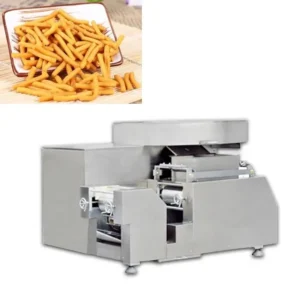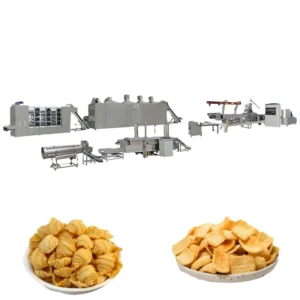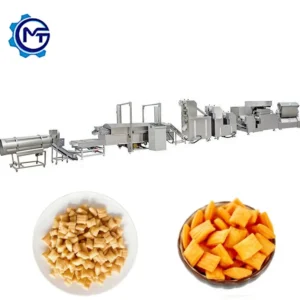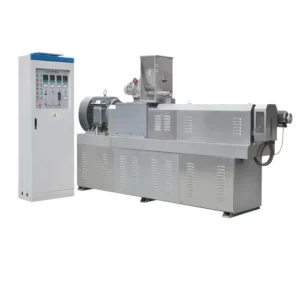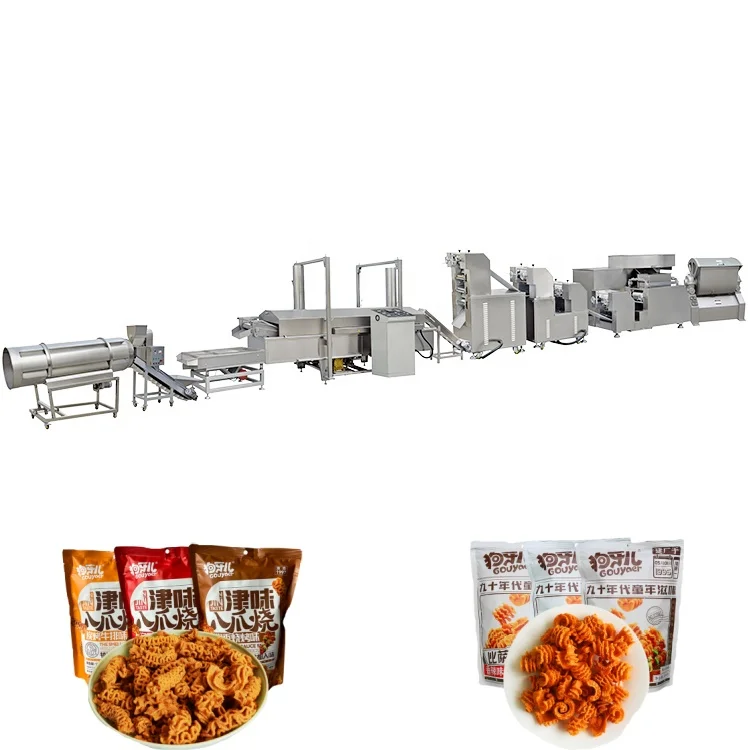
Matched throughput across stations — Every component from the single screw extruder to the automatic fryer is configured as a balanced set, preventing the bottlenecks that occur when machines are sourced separately.
Technical Specifications
| Parameter | Value |
|---|---|
| Model | MT100/MT120 |
| Product Type | Puffed Snack Processing Line with Single Screw Extruder |
| Extruder Type | Single screw extruder |
| Screw Configuration | High and low pressure screw |
| Rated Power | 50–70 kW (electricity); 50–60 kW (gas/diesel) |
| Voltage & Frequency | Three phases 380V/50Hz; Single phase 220V/50Hz (customizable to local voltage) |
| Output Capacity | 120 kg/h (basis to be confirmed — dependent on raw material, moisture, product shape) |
| Overall Dimensions (L×W×H) | 12000–26000 × 1200 × 2200 mm |
| Material | Food grade stainless steel 201/304 |
| Energy Options | Electricity / Gas / Diesel / Steam |
| Die Configuration | Adjustable dies for screw shell, round tube, square tube, ring, cartoon shapes |
| Motor | Siemens (China) or China top brand; Delixi or Delta inverter |
| Certification | CE / ISO9001 |
| Line Stations | Mixer → Screw conveyor → Single screw extruder → Pulling and cutting machine → Automatic fryer → Automatic flavoring line → Cooling |
Application Suitability
| Application | Material or Output |
|---|---|
| Golgappa / pani puri production | Wheat flour and corn starch blends |
| Secondary puffing snack foods | Potato starch and wheat flour formulations |
| Fried tube and ring snacks | Corn starch, wheat flour, or potato starch dough |
| Cartoon-shaped puffed chips | Mixed starch and flour blends for novelty formats |
| Fried octopus-style puffed snacks | High-moisture starch and protein composite dough |
Why Capacity Claims Fail When Raw Material Changes
A puffed snack processing line for sale often carries a headline output figure, yet that number rarely survives contact with the buyer’s actual recipe. Capacity must always be stated alongside the raw material, moisture percentage, and product geometry. I once saw a Middle East buyer receive a fried snack line rated for standard wheat flour trials, only to find that their octopus-based dough — higher in moisture and viscosity — caused the expansion rate to drop sharply after frying, throwing the entire line rhythm off balance [NEED_CITE: extrusion behavior variation across high-moisture protein-starch dough blends]. When the extruder pushes product faster than the fryer can handle, partially cooked pieces pile up on the conveyor. When the flavoring drum cannot keep pace, you get uneven seasoning coverage. These are not minor adjustments; they require rethinking screw speed, die pressure, fryer belt speed, and residence time together.
Balancing the Extruder and the Fryer
The single screw extruder in this line uses a high and low pressure screw configuration, which allows it to handle a broader range of dough consistencies than a fixed-pitch design. A puffed snack processing line for sale should always specify how the downstream stations absorb the extruder’s peak output, because the fryer is where most throughput mismatches surface first.
Die Geometry and Frying Behavior
The adjustable die system produces shapes ranging from thin-walled tubes to dense cartoon forms. Each geometry carries a different surface-to-volume ratio, which governs how quickly oil penetrates and moisture escapes during frying. Tube shapes with open cross-sections fry faster and more evenly than solid ring profiles, meaning fryer belt speed and oil temperature must be adjusted when switching dies. This line ships with a recorded screw and die configuration for your target shape so the fryer settings match from the first production run [NEED_CITE: relationship between extrudate geometry and frying residence time].
Reading the Specs That Actually Matter
The rated power range of 50–70 kW for electric heating or 50–60 kW for gas and diesel tells you the thermal load the workshop must supply — undersizing the electrical feed or gas line will trip breakers during startup surges. The 380V/50Hz three-phase default must be confirmed against your facility’s supply; running a 50Hz motor on 60Hz power alters screw speed and throughput in ways that invalidate any pre-shipment trial data. The stainless steel 201/304 contact surfaces resist the acidic and salty environments typical of fried snack seasoning stations, extending service intervals compared to painted carbon steel. The Siemens or equivalent motor paired with a Delixi or Delta inverter gives operators variable screw speed control, which is essential for dialing in expansion when switching between wheat flour and potato starch recipes.
The Cost of Skipping the Material Trial
Shipping an extrusion line without running the buyer’s actual raw material through the machines is one of the most common sources of commissioning failure. I watched a Southeast Asian snack producer spend weeks recalibrating their fryer temperature and belt speed because the supplier had tested only on generic corn starch. The dough they used locally contained a cassava flour blend that expanded differently under heat, producing chips that were either undercooked in the center or burnt on the surface. Every hour of trial-and-error on the production floor costs more than a pre-shipment test in the factory workshop [NEED_CITE: commissioning delays caused by untested raw material substitution in food extrusion].
Why Sourcing the Full Line From One Builder Matters
Every station on this line — mixing, extrusion, cutting, drying, frying, flavoring, cooling — is configured by a single engineering team, which means throughput calculations are cross-checked rather than assumed. The screw and die setup is documented against your target product shape, not copied from a generic build. An in-house testing workshop allows trial runs on your actual raw material before the machines leave the factory. The voltage, frequency, and control language are confirmed during the specification stage so commissioning proceeds without electrical rework. Pre-sales engineering consultation covers layout planning, utility connections, and phased installation scheduling so the line integrates into your facility without guesswork [NEED_CITE: food machinery documentation standards for export equipment].
Documentation & Verification
- Line layout and capacity calculation matched to your raw material and target shape
- Machine specification sheet with screw and die configuration record
- Electrical schematic with voltage and frequency confirmed to your local supply
- Trial run report on your actual dough formulation before shipment
- CE declaration of conformity and ISO9001 certificate
- Wear parts list covering screws, dies, and cutting blades
Installation, Commissioning & Support
- Foundation must accommodate a 12–26 meter line footprint with level tolerance for the extruder and fryer alignment
- Dedicated 50–70 kW electrical circuit or equivalent gas supply routed to each heating station
- Machines ship in modular sections requiring on-site assembly and conveyor belt tensioning
- First-run parameter setting covers screw speed, die pressure, fryer temperature, and flavoring drum timing
- Operator training includes die changeover, inverter adjustment, and daily cleaning procedures for stainless steel contact surfaces
- Spare screws, dies, and cutting blades shipped with the initial order to cover early replacement needs
What We Need to Configure Your Line
To prepare a proposal that reflects your actual production conditions, share your target product shape along with the raw material formulation and expected moisture content. We also need your workshop voltage and frequency, the local control language preference, and the daily output target so we can calculate station-by-station throughput. If your recipe uses a non-standard flour or starch blend, send a sample batch so we can run it through the testing workshop before finalizing the configuration.
Frequently Asked Questions
Q: How is line capacity verified and what conditions must I provide?
A: Capacity depends on your raw material type, moisture content, and product shape. We run your actual dough formulation through the single screw extruder in our testing workshop and record the output rate, expansion ratio, and fryer performance. The verified figure is documented in the trial run report that ships with your line, so you know the throughput before installation begins.
Q: How do I confirm voltage and control language for my market?
A: During the specification stage we collect your facility’s voltage, phase configuration, and frequency. The electrical schematic is drawn to match, and the inverter and control panel labels are set to your preferred language. This confirmation happens before production starts, avoiding rewiring or reprogramming during commissioning.
Q: What shapes can the single screw extruder produce?
A: The adjustable die system covers screw shell, round tube, square tube, ring, and custom cartoon shapes. Each shape requires a specific die plate and corresponding screw configuration, all recorded in your configuration document. Switching shapes involves changing the die and adjusting the cutting station timing.
Q: How is fryer capacity matched to extruder output?
A: The fryer belt speed, oil volume, and heating capacity are calculated against the extruder’s verified output on your dough formulation. If the extruder runs at a given mass flow, the fryer must provide sufficient residence time at the correct oil temperature. Undersizing the fryer causes undercooked product; oversizing wastes energy.
Q: What spare wear parts are included and how do I reorder?
A: The initial shipment includes a documented set of spare screws, dies, and cutting blades sized for your product shape. The wear parts list specifies part numbers and materials so you can reorder directly. Stainless steel contact parts resist corrosion from seasoning salts, extending intervals between replacements.