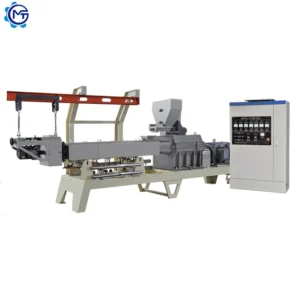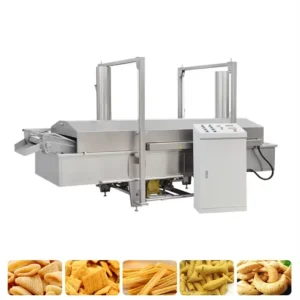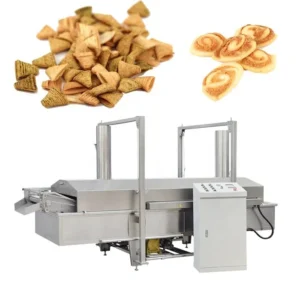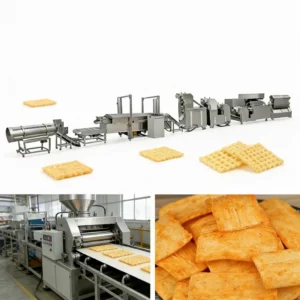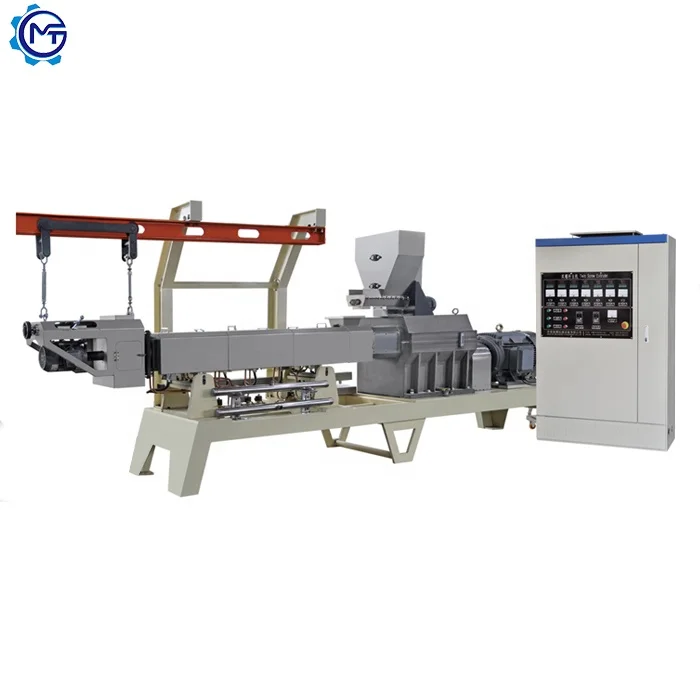
Station-Throughput Matching — Every conveyor, fryer, and flavoring drum on this fried rice puffed snacks line is sized against the single-screw extruder’s real output rather than a nameplate figure, so no single stage chokes the next.
Technical Specifications
| Parameter | Value |
|---|---|
| Product Type | Puffed Snacks Production Line with Frying and Flavoring |
| Extruder Type | Single-screw extruder |
| Main Product Shapes | Screw shell, round tube, square tube, ring, cartoon shapes |
| Raw Materials | Wheat flour, corn starch, potato starch |
| Output Capacity | 120 kg/h (basis not stated in source — confirm raw material blend and moisture content) |
| Total Installed Power | 50–70 kW |
| Voltage & Frequency | Three phases 380 V / 50 Hz, Single phase 220 V / 50 Hz (customizable to local voltage) |
| Overall Dimensions (L × W × H) | 12 000–26 000 × 1 200 × 2 200 mm |
| Construction Material | Food-grade stainless steel 201 (304 available) |
| Energy Options | Electricity, gas, diesel, or steam |
| Motor & Drive | Siemens (made in China) or China top-brand motor; Delixi or Delta inverter |
| Process Flow | Mixer → Screw conveyor → Single-screw extruder → Pulling and cutting machine → Automatic fryer → Automatic flavoring line → Cooling |
| Standards | CE, ISO 9001 |
Application Suitability
| Application | Material or Output |
|---|---|
| Fried puffed snack production in multiple shapes | Wheat flour and starch-based formulations |
| Golgappa / pani puri manufacturing at scale | Corn starch and potato starch blends |
| Secondary-puffing snack formats | Rice flour with optional protein additions (subject to trial) |
| Pilot or mid-volume snack lines | Batch runs down to partial hopper loads |
What "120 kg per Hour" Leaves Out on a Frying Chips Making Machine
Capacity means nothing until the fryer belt speed and flavoring drum dwell time can actually keep up with the extruder’s real output on your exact recipe.
I once watched a line in a Bogotá plant where the extruder pushed product faster than the fryer could drain and cool it. Pellets piled up, oil temperature dropped, and half the shift’s output went to waste. A frying chips making machine manufacturer should be matching every station’s throughput to the buyer’s formulation before the first weld is struck, not after commissioning reveals the bottleneck [NEED_CITE: throughput matching across snack line stations].
Station Coverage from Mixer to Cooler Under One Roof
A complete fried puffed snack line eliminates the finger-pointing that erupts when a mixer vendor blames the extruder and the extruder vendor blames the fryer. This configuration sequences mixing, screw conveying, single-screw extrusion, pulling and cutting, automatic frying, flavoring, and cooling in one integrated layout, letting the frying chips making machine manufacturer balance residence times and transfer points before the equipment leaves the factory.
Die Swaps That Actually Expand Your Catalog
Screw shells, round tubes, square tubes, rings, and cartoon shapes all come from the same extruder barrel by changing dies rather than entire screw sets. Operators report that a die changeover takes roughly the same time as cleaning the cutting blades between shifts, keeping downtime inside normal sanitation windows [NEED_CITE: die changeover intervals on single-screw snack extruders].
Reading Between the Spec-Sheet Lines
The 50–70 kW power band reflects the combined draw of the extruder main motor, fryer heating elements, and conveyor drives; confirming your site’s transformer headroom before ordering avoids commissioning surprises. Voltage customization covers three-phase 380 V and single-phase 220 V at 50 Hz, but export markets running 60 Hz require inverter reprogramming and motor rewinding — a detail that must be locked in before production starts. Food-grade stainless steel 201 handles most dry and lightly oiled snack environments; if your facility washes down with caustic detergents, the 304 option prevents premature surface pitting. Siemens-brand motors paired with Delixi or Delta inverters give local electricians access to widely stocked replacement parts across Latin America and Southeast Asia.
The Cost of Skipping a Raw-Material Trial
Buyers who skip the pre-shipment trial on their own flour and starch blend often discover on day one that the pellet density is wrong for their local market. I saw a Colombian customer’s recipe — heavy on soy flour for protein claims — collapse the extrudate so badly that the frying chips making machine output sank instead of puffing. Re-configuring the screw elements on site cost two weeks of lost production and a full set of replacement wear parts [NEED_CITE: on-site screw reconfiguration costs versus factory trial].
Why Source This Line from One Equipment Supplier
The extruder screw and die are configured to the buyer’s stated raw material rather than copied from a generic build, which matters the moment protein or fiber content shifts the melt viscosity. An in-house testing workshop lets us run your actual flour blend before the line ships, generating a trial report you can benchmark against. Every station — mixer capacity, fryer belt length, flavoring drum volume — is engineered to match the extruder’s tested output, preventing the mid-line pile-ups that separate vendors rarely coordinate. CE and ISO 9001 documentation ships with the line, satisfying import inspectors without last-minute scrambles. Electrical schematics and voltage confirmation sheets arrive before production begins, so your electrician knows exactly what breaker size and cable gauge to install [NEED_CITE: CE machinery directive documentation requirements].
Documentation & Verification
- Line layout drawing with each station’s throughput matched to your raw material blend
- Screw and die configuration record specific to your target product shape
- Electrical schematic confirming motor, inverter, and voltage before production starts
- Trial run report on your actual flour or starch formulation before dispatch
- Factory test record covering full-process run from mixer through cooling conveyor
- CE declaration of conformity and ISO 9001 certificate included with shipment
Installation, Commissioning & Support
- Floor plan must accommodate up to 26 000 mm line length with 1 200 mm walkway clearance on each side
- Dedicated 70 kW circuit with voltage confirmation sheet prevents motor burnout during first start-up
- Line ships in modular skids; on-site assembly typically spans several days depending on fryer size
- Commissioning engineer sets screw speed, barrel temperature, and fryer belt rate against your recipe
- Operators trained on die changeover, cutting blade replacement, and inverter fault resets
- Wear parts list includes screws, dies, and cutting blades with first replacement interval noted
Preparing Your Inquiry
To size the fryer and flavoring drum correctly, share your target raw material ratios, desired pellet shape, and daily output goal. Include your facility’s available voltage and frequency, ceiling height, and whether gas or steam is preferred for the frying station. If your recipe contains non-standard ingredients like legume flour or fiber additives, send a sample for an in-house trial run before we finalize the screw configuration.
Frequently Asked Questions
Q: How is throughput matched between the extruder, fryer, and flavoring stations?
A: Each station’s belt speed, drum volume, and heating capacity are calculated against the extruder’s tested output on the buyer’s raw material. The fryer belt length is extended or shortened so oil residence time aligns with the extruder’s continuous feed rate, and the flavoring drum rotation is tuned so seasoning coverage stays even without product back-up.
Q: Which raw material blends has this line been tested with?
A: Standard trials cover wheat flour, corn starch, and potato starch in varying ratios. Blends containing legume flour, rice flour, or fiber additives require a separate in-house trial so the screw profile and die land length can be adjusted to maintain pellet expansion and surface texture through the fryer.
Q: What energy options exist for the frying and drying stations?
A: Electricity, gas, diesel, and steam are all available. Gas-fired fryers shorten heat-up time and reduce per-kilogram energy cost where piped natural gas is available. Steam is preferred in plants that already operate a boiler for other processes, while electric heating suits smaller pilot lines or locations with strict combustion-ventilation limits.
Q: How do operators switch between product shapes on the same extruder?
A: Shape changes require a die swap and, in some cases, a new cutting blade profile. The barrel and screw remain in place; operators remove the die plate, insert the new die, re-torque the clamping ring, and adjust the cutter gap. Trial cuts confirm dimensions before full-speed production resumes.
Q: What spare wear parts ship with the initial delivery?
A: The line includes a documented wear parts list specifying screw sections, die plates, and cutting blades. The quantity of each item is agreed during order confirmation based on the buyer’s expected annual run hours and local procurement lead times for replacements.