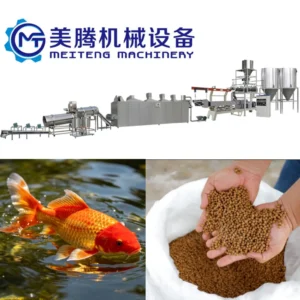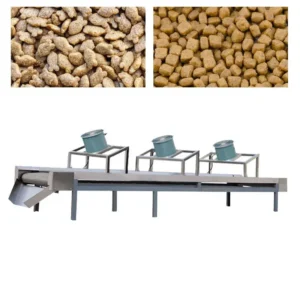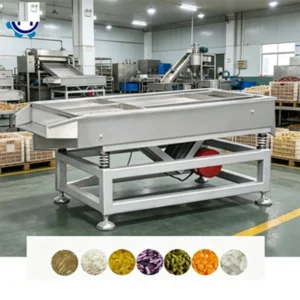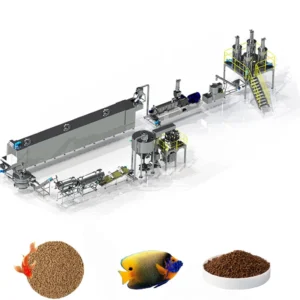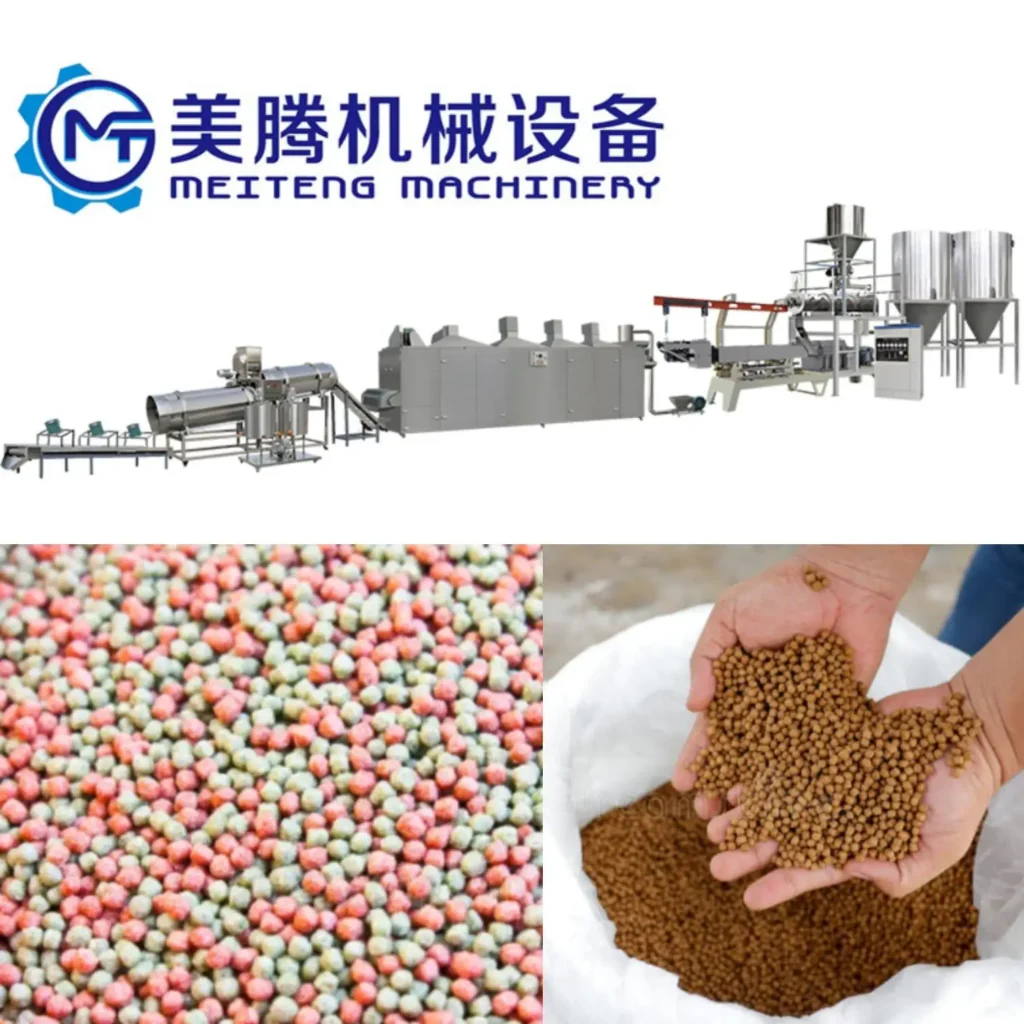
Integrated Line Throughput — every station from batching to packing is calculated against your actual formulation so the extruder, dryer and coater never starve or flood each other.
Technical Specifications
| Parameter | Value |
|---|---|
| Product Type | Fish Feed Processing Line |
| Extruder Type | Twin-screw |
| Contact Material | 304 stainless steel in food-contact zones |
| Output Capacity | Up to 2–3 t/h (subject to raw material formulation and pellet diameter confirmation) |
| Pellet Types | Floating and sinking |
| Target Species | Trout, salmon, catfish and comparable aquaculture species |
| Control System | PLC and MCC with configurable interface language |
| Power Supply | Voltage and frequency confirmed to destination market before production |
| Certification | CE declaration of conformity, ISO certified |
| Pre-shipment Testing | In-house trial run on customer-supplied raw material |
Application Suitability
| Application | Material or Output |
|---|---|
| Floating pellet production for trout and salmon | Fish meal, starch binders, vitamin premix at varied protein ratios |
| Sinking pellet production for catfish | Higher-density formulations with soy meal and grain fractions |
| Multi-species aquaculture feed plants | Changeover between floating and sinking pellet dies on a single line |
| Terrestrial feed manufacturers entering aquatic feed | Full line with operator training on extrusion density control |
| Turnkey aquaculture plant projects | Phased installation from batching silos through packing station |
What "2–3 Tonnes per Hour" Actually Depends On
The number only holds when your raw material formulation, moisture content and pellet diameter are locked in before the extruder is built.
I remember a Southeast Asian buyer who ordered an aquatic feed line based on a brochure capacity. Their formulation ran heavy on fish meal with high starch gelatinisation demand. Once the material hit the barrel, actual throughput dropped noticeably below the quoted figure. The screw combination was not matched to that viscosity. A fish feed processing line manufacturer who skips the formulation conversation is giving you a number that belongs to someone else’s recipe [NEED_CITE: twin-screw extrusion throughput dependence on raw material viscosity and moisture]. That is the reason we run customer-supplied material in the testing workshop first and record the screw and die configuration before the line ships.
Matching Every Station to the Extruder Output
An extruder that produces at full rate means nothing if the dryer cannot remove moisture fast enough or the coating drum cannot apply fat evenly before pellets cool. The fish feed processing line is laid out so that the mixer batch cycle, extruder throughput, dryer residence time and coating drum speed all share a common calculation sheet. Each station is specified against the same formulation, not against a generic reference product.
Screw Configuration Decides Pellet Density
Floating pellets for trout require a different expansion profile than sinking pellets for catfish. The screw element sequence — conveying, kneading and reverse elements — along with die land length and moisture at the barrel determine whether a pellet floats or sinks. On this line, the screw combination is selected after trial runs rather than copied from a standard build. The die plate is matched to the target pellet diameter and density specification the buyer’s market expects [NEED_CITE: screw configuration effect on extrudate expansion and pellet buoyancy].
Reading the Specs That Matter on a Feed Extrusion Line
Twin-screw versus single-screw is the first fork in the road. Twin-screw extrusion handles high-protein, high-fat formulations with better self-cleaning and more uniform residence time, which matters when switching between floating and sinking recipes on the same shift. The 304 stainless steel contact material withstands the chloride content in fish meal blends and holds up under repeated wash-down cycles. PLC and MCC control allows the operator to store recipes for different pellet types, keeping barrel temperature zones and screw speed consistent across batches. Voltage and frequency must be confirmed before the motor and heater elements are ordered — a 50 Hz motor running on a 60 Hz supply will overspeed and wear prematurely. These are not optional details; they are the difference between a line that commissions in days and one that takes weeks of on-site correction.
The Cost of Skipping a Factory Trial Run
When a line ships without a test on the buyer’s actual raw material, the first production run becomes the trial. That means raw material is consumed, time is lost, and screw elements may need replacing before the correct configuration is found. I have watched a buyer lose several days of commissioning because the die plate produced pellets outside the diameter tolerance the local market required. A pre-shipment trial run catches these issues while the machine is still in the workshop and adjustments cost nothing [NEED_CITE: cost of post-installation rework versus factory trial adjustment].
Why Source This Line Here
Every station is specified under one supplier, so throughput matching is calculated internally rather than negotiated between separate vendors. The screw and die configuration is recorded against the buyer’s raw material and target pellet specification before dispatch. An in-house testing workshop allows trial runs on customer-supplied formulations, not just on standard reference materials. Twin-screw extrusion experience spans aquaculture feed alongside pet food, snacks and cereal applications, meaning screw design draws on a wider process knowledge base. Pre-sales engineering covers line layout and utility planning through to commissioning and operator training on site.
Documentation & Verification
- Line layout and capacity calculation showing throughput at each station for your formulation
- Screw and die configuration record matched to your raw material and pellet density target
- Trial run report on customer-supplied raw material before shipment
- Electrical schematic with confirmed voltage, frequency and control language
- CE declaration of conformity and ISO certificate
- Operation and maintenance manual with wear parts list
Installation, Commissioning & Support
- Foundation plan provided based on full line footprint and extruder vibration load
- Dedicated power circuit sized to PLC-controlled motor and heater total draw
- Line arrives in modular sections for sequential assembly from batching to packing
- First-run parameter setting on your raw material with barrel temperature and screw speed logging
- Operator training covering recipe changeover between floating and sinking pellets
- Wear parts list including screw elements and die plates with reorder references
What to Prepare Before You Send an Inquiry
To size the fish feed processing line accurately, share your raw material formulation with protein and starch percentages, the target pellet diameter range, and whether you need floating, sinking or both pellet types. Confirm your local voltage and frequency so the motor and control panel are specified correctly. If you have existing upstream silos or downstream packing equipment, include their throughput rates so the new line integrates without bottlenecking.
Frequently Asked Questions
Q: How is the 2–3 t/h capacity verified, and what formulation is it based on?
A: That range is confirmed during a trial run using the buyer’s own raw material at a specified moisture level and pellet diameter. We record the screw speed, barrel temperature profile and die configuration that produced the verified output, and those parameters ship with the line documentation.
Q: How do you ensure the dryer and coater match the extruder without bottlenecking?
A: We calculate dryer residence time and coating drum speed against the extruder’s verified output for your formulation. The capacity calculation sheet shows each station’s throughput side by side, so no single unit limits the line rate.
Q: Can a trial run be performed on our own raw material before the line ships?
A: Yes. Send a representative sample of your formulation to our testing workshop. We run it through the configured extruder, record pellet density and expansion, adjust the screw combination if needed, and provide a written trial report before the line is crated.
Q: What voltage, frequency and control language options are confirmed before production?
A: We confirm your site’s supply voltage, frequency and phase before ordering motors and heater elements. The PLC interface language is set to your preference, and the electrical schematic reflects all confirmed values before assembly begins.
Q: What screw and die options support both floating and sinking pellets?
A: The screw element sequence is reconfigured between floating and sinking recipes, adjusting kneading and conveying zones to control expansion. Die plates with different land lengths and orifice diameters are supplied to match each pellet density target.