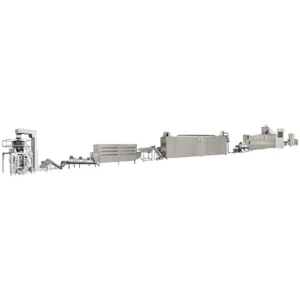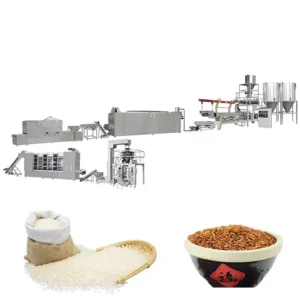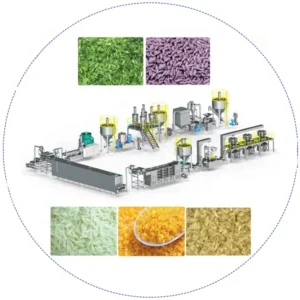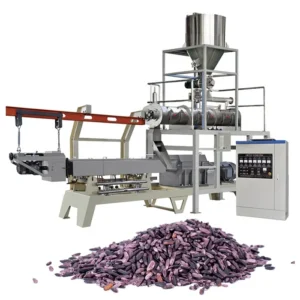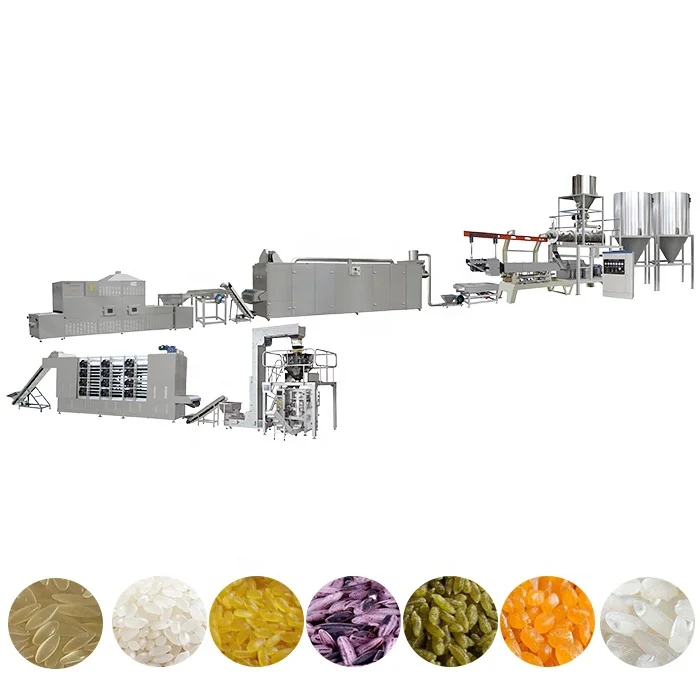
Matched Throughput Stations — every mixer, extruder and dryer in this line is sized against the actual kernel output rate rather than quoted as a standalone catalog number.
Technical Specifications
| Parameter | Value |
|---|---|
| Product Type | Fortified Rice Processing Line |
| Model Range | MT65 / MT70 / MT75 / MT85 / MT95 |
| Screw Type | Twin-screw |
| Installed Power | 85 kW (MT65), 120 kW (MT70), 180 kW (MT75), 235 kW (MT85), 260 kW (MT95) |
| Power Consumption | 60 kW (MT65), 85 kW (MT70), 135 kW (MT75), 165 kW (MT85), 195 kW (MT95) |
| Output Capacity | 80–100 kg/h (MT65), 100–120 kg/h (MT70), 300–500 kg/h (MT75), 200–300 kg/h (MT85), 800–1000 kg/h (MT95) (basis not stated in source — confirm raw material formulation, moisture content, and kernel size) |
| Overall Dimensions (L×W×H) | 28 × 1.2 × 2.2 m (MT65) up to 36 × 3.5 × 4.3 m (MT95) |
| Control System | Frequency speed control with high automation |
| Feeding System | Single or double screw feeding, selectable by material |
| Lubrication | Automatic lubricating and cooling system |
| Screw Construction | Wear-resistant alloy |
| Dryer Heating Source | Electric or gas |
| Dryer Type | Circulation mesh-belt dryer with frequency motor speed control |
| Certifications | CE, ISO |
Application Suitability
| Application | Material or Output |
|---|---|
| Fortified rice kernel production | Broken rice, rice, corn, millet with added vitamins and minerals |
| Artificial rice manufacturing | Grain blends including wheat, oats, buckwheat and starch base |
| Nutritional rice enrichment | Vitamin and mineral premixes integrated into extruded kernels |
| Couscous production | Wheat and grain semolina formulations |
Why a Standalone Extruder Quotation Rarely Matches Your Actual Throughput
A fortified rice processing line full equipment range must be calculated from the slowest station backward, not from the extruder nameplate forward.
I have watched buyers celebrate a competitive extruder price, only to discover on commissioning day that the dryer cannot keep up and the cooling conveyor overflows. The result is a line that runs at a fraction of the nameplate output because one undersized station chokes the rest [NEED_CITE: line throughput bottleneck analysis in food extrusion]. When operators throttle the extruder to match the dryer, you are paying for capacity you cannot use and burning energy on idle barrels.
How the Station Sequence Holds Together
The fortified rice processing line full equipment range follows a fixed sequence — mixing, extruding, vibrating, low-temperature drying, cooling, high-temperature roasting, cooling, packing. Each station must pass product to the next at the same mass flow rate. If the mesh-belt dryer runs slower than the extruder output, wet kernels pile up on the vibrating screen and stick together, ruining the surface finish that retail buyers expect.
Feeding System Selection and Kernel Uniformity
The choice between single and double screw feeding depends on the raw material blend. A high-starch formulation with added vitamin premix tends to bridge in a single-screw hopper, causing intermittent feed surges that show up as uneven kernel density. A double screw feeder breaks the bridge and meters the blend at a constant rate, keeping the twin-screw extruder barrel fill level stable. Stable barrel fill is what gives every kernel the same expansion ratio and the same nutritional profile across an eight-hour shift [NEED_CITE: twin-screw extrusion feeding consistency for fortified grain products].
Reading the Specification Sheet Against Your Raw Material
Installed power, screw diameter and barrel length together determine how much shear energy reaches the starch in your blend. The MT65 at 85 kW suits small-batch trials or specialty nutrition programmes, while the MT95 at 260 kW handles continuous industrial volumes. Yet the real indicator of fit is the screw configuration record: a short-pitch, high-shear arrangement gelatinises starch quickly for a dense kernel, whereas a longer-pitch, moderate-shear layout suits a lighter, more porous couscous texture. Ask for the configuration matched to your specific grain blend and target kernel size before comparing machines on motor power alone. The dryer heating choice — electric or gas — further affects running cost, and gas-heated mesh-belt dryers are often specified where local gas tariffs are lower than industrial electricity rates. Frequency-controlled belt speed on the dryer lets operators fine-tune residence time without stopping the line, which matters when ambient humidity shifts between seasons.
The Cost of Skipping the Line Layout Calculation
Buyers who assemble stations from separate vendors frequently end up with mismatched capacities. A dryer that is one model size too small forces the extruder to idle, wasting barrel heat and raising the cost per kilogram. A packing station that cycles slower than the cooling conveyor leaves kernels exposed to ambient moisture, and re-absorbed water can undo the drying work already done [NEED_CITE: moisture re-absorption in extruded grain products after cooling]. These mismatches rarely appear in a single-machine quotation; they surface only when the whole line runs together.
Why Sourcing Every Station from One Builder Matters
Throughput matching starts at the proposal stage: the line layout and capacity calculation document confirms that each station — from the batching mixer to the packing scale — is rated for the same mass flow. Screw configuration and die design are specified to the buyer’s grain blend and target kernel shape, not copied from a generic build. An in-house testing workshop runs the buyer’s actual raw material before shipment, so kernel density and expansion are verified before the equipment leaves the factory. Electrical schematics, voltage and frequency are confirmed against the destination market, and control language is set before the PLC panel is wired. Pre-sales consultation through on-site installation, commissioning and ongoing maintenance keeps one engineering team accountable for the entire line rather than passing responsibility between vendors.
Documentation & Verification
- Line layout and capacity calculation confirming matched throughput across every station
- Screw and die configuration record matched to your grain blend and kernel shape
- Electrical schematic with voltage, frequency and control language for your market
- Trial run report on your raw material conducted in the testing workshop before dispatch
- CE declaration of conformity and ISO certificate for customs and regulatory clearance
Installation, Commissioning & Support
- Foundation pad sized to the overall line length up to 36 m with level tolerance for the mesh-belt dryer
- Dedicated power circuit matching installed power up to 260 kW at the confirmed local voltage and frequency
- Station modules shipped in sections and bolted together on site to fit standard container loading
- First-run parameter setting including barrel temperature profile and dryer belt speed for your specific kernel
- Operator training covering feeding system changeover between single and double screw modes
- Wear parts list covering screws, dies and mesh-belt segments with recommended replacement intervals
What to Include in Your Inquiry
Send the grain blend formulation, including the percentage of broken rice, starch base and micronutrient premix, along with the target kernel dimensions and daily output goal. Include the available workshop length, ceiling height and the local voltage and frequency so the electrical package is specified correctly from the start.
Frequently Asked Questions
Q: How is output capacity verified for each extruder model on this line?
A: Capacity figures listed for each model are based on specific formulations and must be confirmed against your actual grain blend, moisture content and kernel size. We run your raw material in the in-house testing workshop and issue a trial run report showing real throughput and kernel quality before shipment.
Q: Which extruder model fits my production target and how do downstream stations scale?
A: Model selection starts with your required hourly output and grain formulation. Once the extruder is chosen, the dryer length, mesh-belt width, cooling conveyor and packing station are all sized to the same mass flow, and the line layout document shows the matched capacity at every station.
Q: What voltage, frequency and control language options are available for export markets?
A: The electrical package is configured to the destination country’s standard voltage and frequency before production begins. Control panel language and HMI labels are confirmed during the specification review so operators can read instructions in their preferred language on day one.
Q: Can the feeding system handle my specific grain and micronutrient blend?
A: The feeding system is available with single or double screw configuration, selected according to the flow characteristics of your blend. High-starch mixes with fine vitamin premixes typically need double screw feeding to prevent bridging and ensure uniform extruder barrel fill.
Q: What does the full line footprint look like and what utilities are required?
A: Overall line length ranges from 28 m to 36 m depending on the model, with widths up to 3.5 m and heights up to 4.3 m. Utilities include the confirmed three-phase power supply, water for the automatic lubrication and cooling system, and gas or electric supply for the dryer heating source.