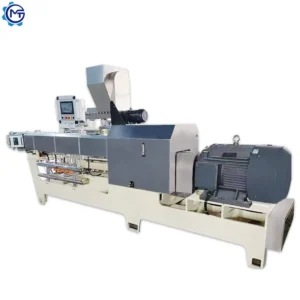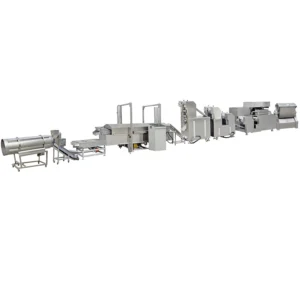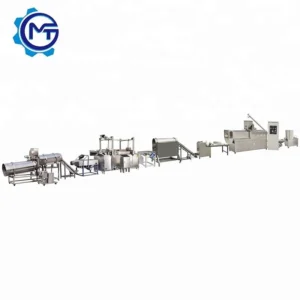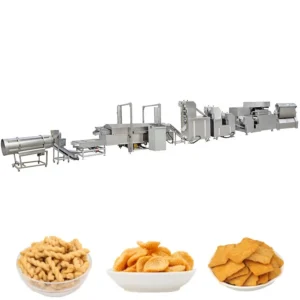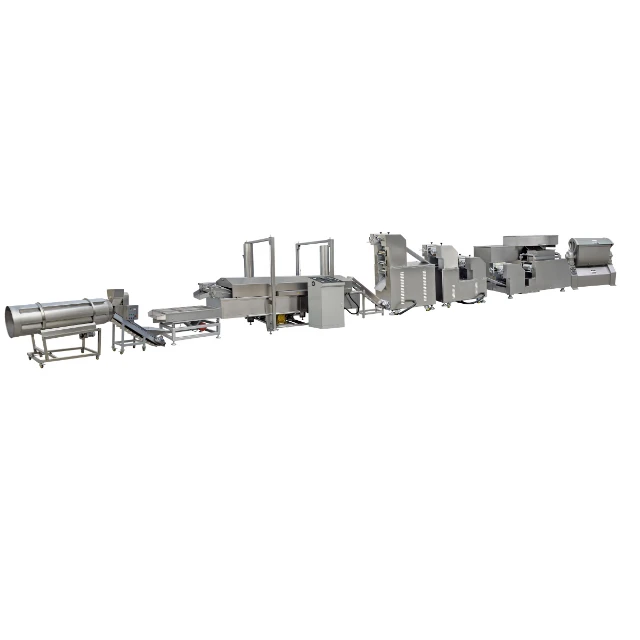
Integrated Station Matching — the mixer, extruder, cutting, and fryer capacities are calculated together so one stage does not choke the others on a fried 3D pellet chip line.
Technical Specifications
| Parameter | Value |
|---|---|
| Model | MT-65 / MT-70 / MT-85 / MT-75 / MT-95 |
| Product Type | Fried 3D Pellet Chips Snack Production Line |
| Main Motor Power | MT-65: 100 kW / MT-70: 130 kW / MT-85: 180 kW / MT-75: 185 kW / MT-95: 280 kW |
| Output Capacity | MT-65: 120–150 kg/h (basis not stated in source) / MT-70: 200–250 kg/h (basis not stated in source) / MT-85: 300–500 kg/h (basis not stated in source) / MT-75: 400–500 kg/h (basis not stated in source) / MT-95: 800–1000 kg/h (basis not stated in source) |
| Screw Type | Twin screw, co-rotating, sectional modules |
| Overall Dimensions (L×W×H) | MT-65: 22000×1200×2200 mm / MT-70: 24000×1500×2200 mm |
| Mixer Power | 4 kW / 7.5 kW / 15 kW (matched to extruder model) |
| Cutting Machine Power | 1.47 kW |
| Cutting Machine Dimensions | 2500×600×1100 mm |
| Fryer Belt Width | 600 mm stainless steel belt |
| Drying / Fryer Energy | Electricity / fuel gas / diesel |
| Voltage & Frequency | Configurable — e.g. 3ph 380V 50Hz, 3ph 415V 60Hz, 3ph 220V 60Hz |
| Line Stations | Mixer → Twin Screw Extruder → Cutting Machine → Fryer |
| Assembly State | Complete line from batching through frying |
| Standards | CE, ISO |
Application Suitability
| Application | Material or Output |
|---|---|
| Fried 3D corn bugles and pellet crisps | Corn powder, wheat flour, corn starch |
| Extruded-and-fried snack shapes | Potato starch, potato powder blends |
| Multi-format chip production | Die and roller changes for bugles, sticks, shells, tubes, waves, pillows, diamonds |
| Snack line expansion or new entry | Manufacturers scaling from batch frying to continuous pellet chip output |
Why the Fryer Belt Width Matters Before You Sign
A 600 mm belt sets the ceiling for how much product can pass through the oil per minute, regardless of what the extruder pushes out.
I once watched a fried pellet chip line in West Africa where the extruder ran fine but the fryer could not keep up. Semi-cooked pellets piled on the transfer conveyor, workers pulled them apart by hand, and half the shift was spent clearing jams. The extruder was sized for a higher throughput tier than the fryer could handle. When you survey a fried chips making machine manufacturer catalogue, the belt width, heating capacity, and oil volume must be read against the extruder output, not in isolation. [NEED_CITE: continuous fryer sizing against extruder throughput in snack lines]
Every Station Listed With Its Own Power and Footprint
This catalogue lays out the mixer, twin-screw extruder, cutting machine, and fryer as individual stations with separate motor ratings and dimensions. That visibility lets a buyer or project contractor check whether the workshop floor can take the full layout before a single crate is shipped. The fried chips making machine manufacturer range spans five extruder models, each paired with a mixer whose power scales accordingly — 4 kW at the entry level up to 15 kW on the larger units.
Matching Throughput Across the Cutting and Frying Stages
The cutting machine runs at 1.47 kW with a 2500×600×1100 mm frame, feeding directly into the fryer. If the cutter slows for a die change or the fryer belt stalls, the extruder output has nowhere to go. Seeing every station on one spec sheet means these bottleneck points are visible during the selection phase rather than discovered during commissioning. [NEED_CITE: snack line bottleneck analysis between extrusion and frying stages]
Reading the Extruder Specs Against Snack Output Targets
The twin-screw, co-rotating sectional screw design handles corn flour, wheat flour, and potato starch blends in a single continuous process — mixing, de-gassing, cooking, and forming before the cutter shapes the pellet. Motor power steps from 100 kW on the MT-65 to 280 kW on the MT-95, reflecting the barrel volume and screw diameter needed for higher throughput. The L/D ratio and screw module arrangement determine residence time and gelatinisation degree, which directly influence how well the pellet expands when it hits hot oil in the fryer. Voltage and frequency are configurable across common export standards, so a buyer in a 60 Hz market does not receive a 50 Hz motor that overheats on day one.
The Cost of Ignoring Station-to-Station Balance
An extruder running at full capacity into an undersized fryer forces operators to throttle the screw speed, which changes shear, temperature, and product density mid-run. Pellets that should puff evenly in the oil come out half-expanded or oil-logged. The line technically produces, but the reject rate climbs and the brand reputation takes a hit in the local market. [NEED_CITE: effects of extruder-fryer mismatch on pellet chip density and oil absorption]
What This Range Lets You Verify Before Committing
Every model in this fried chips making machine manufacturer range ships with a documented screw and die configuration matched to the buyer’s stated raw material. The in-house testing workshop runs trial batches before dispatch, so expansion behaviour and chip texture are confirmed on the actual flour or starch blend — not assumed from a generic build. Voltage, frequency, and control language are locked in before production starts, preventing the commissioning delays that happen when a panel label does not match the local grid. The CE declaration and ISO certificate are available in both electronic and original document form for customs and local regulatory filing.
Documentation & Verification
- Line layout showing station spacing and utility drop points for your floor plan
- Screw and die configuration record matched to your corn or potato starch blend
- Electrical schematic with confirmed voltage and frequency for your market
- Trial run report on your raw material before the line leaves the factory
- CE declaration of conformity and ISO certificate for import clearance
- Wear parts list with recommended spare quantities for the first operating years
Installation, Commissioning & Support
- Foundation must support the full line length, up to 24 metres on larger models
- Dedicated circuit required for the main extruder motor, up to 280 kW on the MT-95
- Fryer energy connection — electric, gas, or diesel — confirmed before piping layout
- On-site commissioning includes screw speed and barrel temperature profiling for your recipe
- Operator training covers die and roller swaps for shape changes across bugles, shells, and tubes
- Wearing parts package covers screws, dies, and cutter blades for the first replacement cycle
What to Include in Your First Enquiry
To size the right model from this range, share your primary raw material and any blend ratios, the chip shapes you plan to run, and the daily output target in kilograms. Include your workshop length and ceiling height so the line layout can be drafted to fit, along with local voltage, phase, and frequency. If you already have upstream batching or downstream seasoning and packing equipment, note the interface points so the conveyor heights and transfer speeds align.
Frequently Asked Questions
Q: How do I choose between the MT-65 and MT-85 for my target output?
A: Start with your raw material and moisture content, then ask for a capacity calculation based on those inputs. The MT-65 suits entry-level production while the MT-85 handles higher volumes, but actual throughput depends on the starch or flour blend and the pellet density your market expects.
Q: What voltage options are available for export markets?
A: The line is configurable for common industrial supplies including 380V 50Hz, 415V 60Hz, and 220V 60Hz three-phase. Confirm your local standard during enquiry so the motor nameplates, heating elements, and control panel components are specified correctly before production.
Q: Which spare parts should I order with the initial shipment?
A: Screw elements, die plates, and cutter blades are the primary wearing parts. Ordering a two- to three-year reserve at the time of purchase avoids downtime waiting for international shipping when the first replacement falls due.
Q: How are different chip shapes produced on the same line?
A: Shape changes are handled by swapping the extruder die and the cutting machine roller. Bugles, sticks, shells, tubes, and wave formats all run on the same twin-screw platform, with changeover taking minutes once operators are trained on the procedure.
Q: Which fryer heating source should I choose?
A: Electric heating gives precise temperature control where power costs are stable. Gas or diesel suits markets with higher electricity tariffs or unreliable grid supply. The choice affects both the fryer spec and the workshop utility planning, so decide before the line layout is finalised.