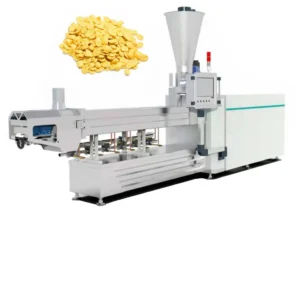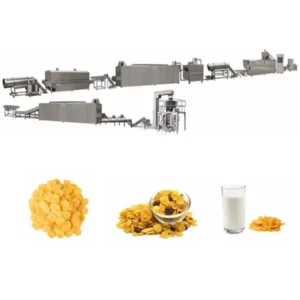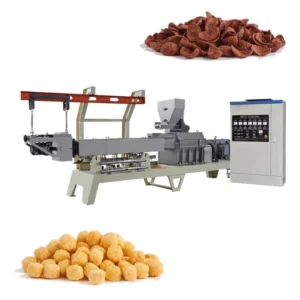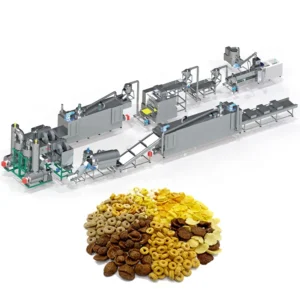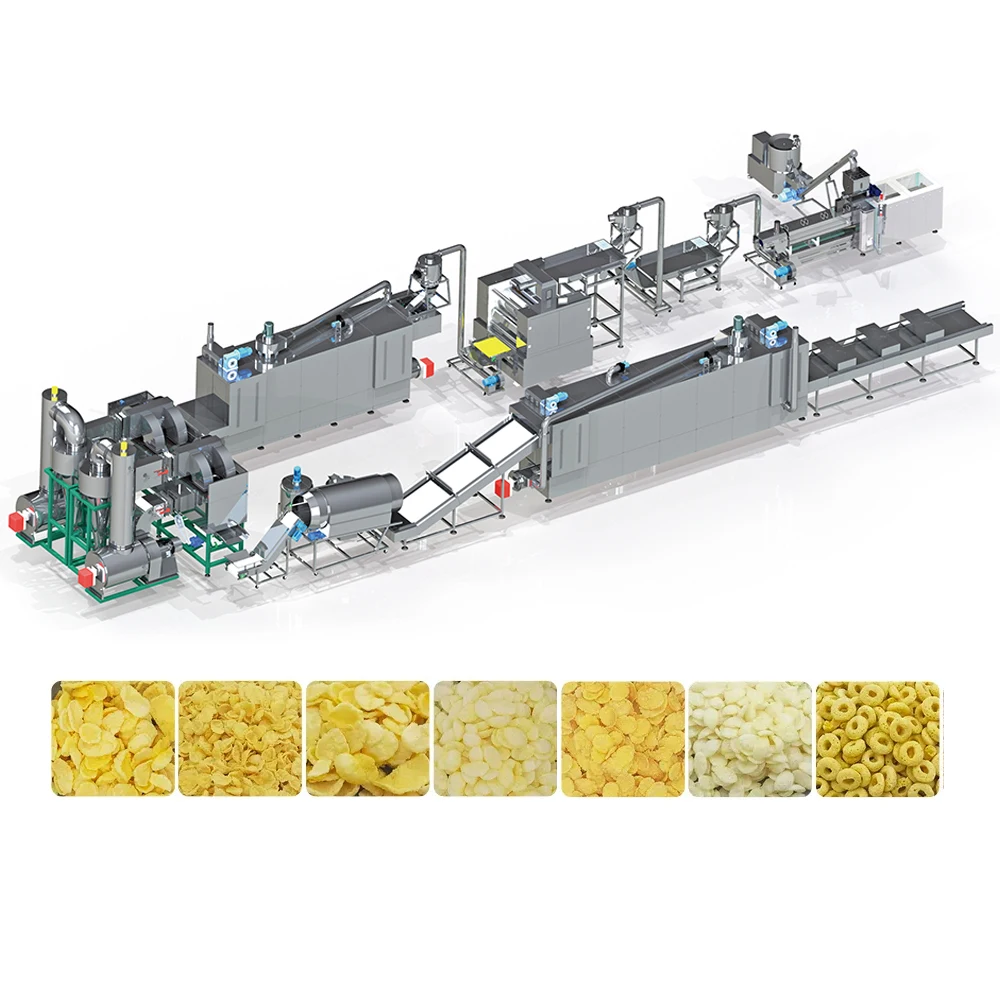
Complete Line Catalogue — every station from mixer to packing is spec-matched under one twin-screw extrusion platform so no single machine bottlenecks your corn flakes output.
Technical Specifications
| Parameter | Value |
|---|---|
| Product Type | Corn Flakes Breakfast Cereal Production Line |
| Model Options | MT70 / MT85 / MT75 |
| Installed Power | MT70: 160 kW; MT85: 190 kW; MT75: 210 kW |
| Power Consumption | MT70: 120 kW; MT85: 140 kW; MT75: 150 kW |
| Output Capacity | MT70: 150–200 kg/h (basis to be confirmed); MT85: 300–400 kg/h (basis to be confirmed); MT75: 300–500 kg/h (basis to be confirmed) |
| Overall Dimensions (L×W×H) | MT70: 41 × 1.5 × 2.2 m; MT85: 43 × 1.5 × 3.2 m; MT75: 45 × 1.5 × 3.5 m |
| Screw Type | Twin Screw |
| Control System | PLC control (flaking machinery); MCC and PLC available across line |
| Flaking Machinery | Hydraulic double-roller system, double motors for separate roller driving, infrared sensor for temperature pipe control |
| Dryer Heating Source | Gas / Electric |
| Roasting Oven | Hot air roasting, vibrating pan, high temperature spraying tubes, conciliation burner, dual circulating fans, cyclone dust removal |
| Coating System | Double tumble sugar melting, elevator, coating drum, spraying nozzle |
| Material Compatibility | Powder of corn, rice, wheat, oat, barley |
| Production Procedure | Mixing → Extruding → Flaking → Roasting → High temperature inflating → Sugar-coating → Roasting → Cooling → Packing |
| Assembly State | Complete production line, fully automatic |
| Standards | CE (since 2014); ISO certified |
Application Suitability
| Application | Material or Output |
|---|---|
| Natural corn flakes production | Corn powder or corn grits |
| Sugar-coated breakfast cereal | Corn, rice, wheat, oat blends with sugar or honey glaze |
| Multi-grain extruded flakes | Wheat, barley, oat mixed powder |
| Shaped cereal variants (balls, rings, loops, stars) | Corn and rice powder with adjusted die mould |
What the Nameplate Capacity Figure Leaves Out About Your Corn Flakes Line
The rated throughput of any corn flakes breakfast cereal production line full equipment set depends entirely on your actual raw material composition and moisture content.
I once spent a month re-tuning a line in Vietnam because the client’s corn flour carried noticeably higher fat than our trial recipe. The flakes came out soft, refused to crisp in the roaster, and the entire parameter set had to be scrapped. That taught me to always ask for a raw material sample before quoting a line. When buyers compare machines only by the nameplate number, they miss how moisture, fat, and starch ratios reshape the extrusion window [NEED_CITE: raw material behaviour in twin-screw cereal extrusion]. A corn flakes breakfast cereal production line full equipment package must be validated against your specific grain blend, or the dryer and roaster downstream will sit half-idle waiting for material that never reaches target texture.
Station-by-Station Catalogue: How Each Machine Fits the Line
The corn flakes breakfast cereal production line full equipment range covers every stage from raw powder intake to final packing. The twin-screw extruder sits at the core, where barrel temperature zones and screw configuration determine gelatinisation. Downstream, the hydraulic flaking mill presses extruded pellets into uniform sheets, while the hot air roasting oven with dual circulating fans delivers even crisping without scorching. Each station is sized to match the extruder tier you select, preventing the common problem where one undersized machine drags the entire line below its rated output.
Matching Dryer, Roaster and Coater to Your Extruder Tier
Undersized supporting equipment is a frequent cause of line stoppages. The MT70 tier pairs with a smaller-footprint dryer and roaster suited for lower throughput, while the MT85 and MT75 tiers demand proportionally larger hot air volumes and longer roasting residence times. The sugar coating drum must also match — too small a drum and coated flakes pile up and break before the glaze sets [NEED_CITE: throughput matching between extrusion and coating stations]. Every supporting station in this corn flakes breakfast cereal production line full equipment catalogue is listed with its corresponding capacity tier so you can verify alignment before ordering.
Reading the Specs: What Power, Dimensions and Control Mean on the Floor
Installed power across the three models ranges from 160 kW to 210 kW, reflecting the larger motors and heating elements needed for higher output. The overall line length stretches from 41 m to 45 m, which directly dictates your workshop bay requirement — plan for at least 5 m clearance at the packing end for pallet staging. PLC control on the flaking machinery maintains consistent roller gap and infrared temperature feedback, critical for keeping flake thickness within tolerance. Gas or electric dryer heating lets you align with local utility cost structures, and the cyclone dust removal on the roasting oven keeps the workshop air clean, reducing fire risk from fine cereal dust accumulation [NEED_CITE: dust control standards in cereal roasting operations].
The Hidden Cost of Mismatched Line Stations
When a line is assembled from separate vendors without throughput verification, the weakest station defines your real output. A flaker that cannot keep pace with the extruder forces frequent extruder stoppages, burning raw material and wasting heating energy. An undersized roaster means flakes exit with residual moisture, shortening shelf life and inviting mould complaints from distributors. These problems surface weeks after commissioning, long enough for the original equipment supplier to point blame elsewhere [NEED_CITE: post-commissioning line bottleneck disputes]. Sizing every station together eliminates this risk.
Why Source the Full Range From One Supplier
Every station from the twin-screw extruder through the sugar coating drum is designed and built under one roof, so throughput calculations are cross-checked before the line ships. Screw and die configuration records are written against your raw material sample, not copied from a generic template. An in-house testing workshop allows trial runs on your actual corn or multi-grain powder before the line is crated. Electrical schematics confirm voltage, frequency, and PLC language for your target market before production starts, preventing on-site rewiring delays. CE and ISO compliance documentation covers the complete line rather than individual machines, simplifying import clearance.
Documentation & Verification
- Line layout and capacity calculation showing matched throughput at every station
- Screw and die configuration record written against your raw material sample
- Electrical schematic confirming voltage, frequency, and control language for your market
- Factory test record and trial run report on your grain blend before shipment
- CE declaration of conformity covering the full production line
- Operation and maintenance manual with wear parts list for extruder screws and flaker rollers
Installation, Commissioning & Support
- Foundation plan based on the 41–45 m line length and 1.5 m width to level the extruder and flaker
- Dedicated power circuit matching the MT70 160 kW or MT85 190 kW or MT75 210 kW installed capacity
- Gas or electric dryer hookup specified to local utility standards before arrival
- PLC and MCC programming confirmed in operator’s language prior to commissioning
- First-run parameter tuning on your raw material with on-site engineer guidance
- Spare extruder screws, die plates, and flaker rollers supplied with initial shipment
What to Include in Your Inquiry
Share your grain formulation — corn, rice, wheat, oat, or a blend — along with typical moisture and fat readings from your supplier. Specify your target daily output so the right model tier can be matched. Confirm your workshop length, ceiling height, local voltage and frequency, and preferred PLC operating language. If you already have upstream milling or downstream packing equipment, note the interface points so the line can be sized to fit.
Frequently Asked Questions
Q: How do I choose between MT70, MT85, and MT75 for my corn flakes target?
A: Selection depends on your confirmed raw material and daily output target. The MT70 suits smaller-scale producers, while MT85 and MT75 serve higher-volume operations. A trial run on your grain sample in the testing workshop validates which model holds your required throughput before quotation.
Q: Which supporting machines are matched to each extruder to avoid bottlenecks?
A: Each model tier has a correspondingly sized flaker, dryer, roaster, and coating drum. The hot air roaster’s fan capacity and the coating drum volume are scaled so no station forces the extruder to idle, keeping the full line balanced.
Q: Can the same extruder produce shapes beyond standard corn flakes?
A: Yes. By changing the die mould, the twin-screw extruder produces balls, tubes, rings, fruit loops, stars, and other shapes. The downstream flaker is bypassed for puffed shapes, and the roaster handles crisping directly.
Q: What electrical and control details are confirmed before shipment?
A: Voltage, frequency, and PLC interface language are confirmed during the specification stage. The electrical schematic is reviewed with your local electrician to ensure the dedicated circuit and breaker ratings match the line’s installed power.
Q: What spare wear parts ship with the line and how are replacements handled?
A: Initial spare screws, die plates, and flaker rollers are included. A wear parts list in the documentation identifies each component by part number so reorders can be placed directly against the factory inventory without line downtime.