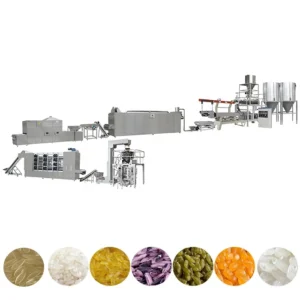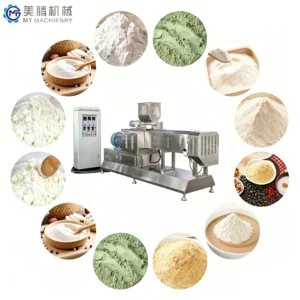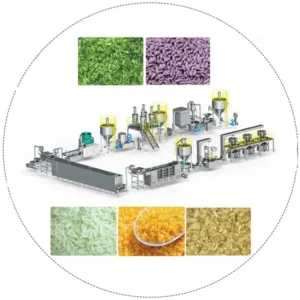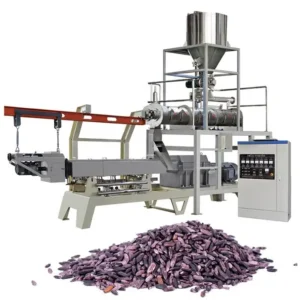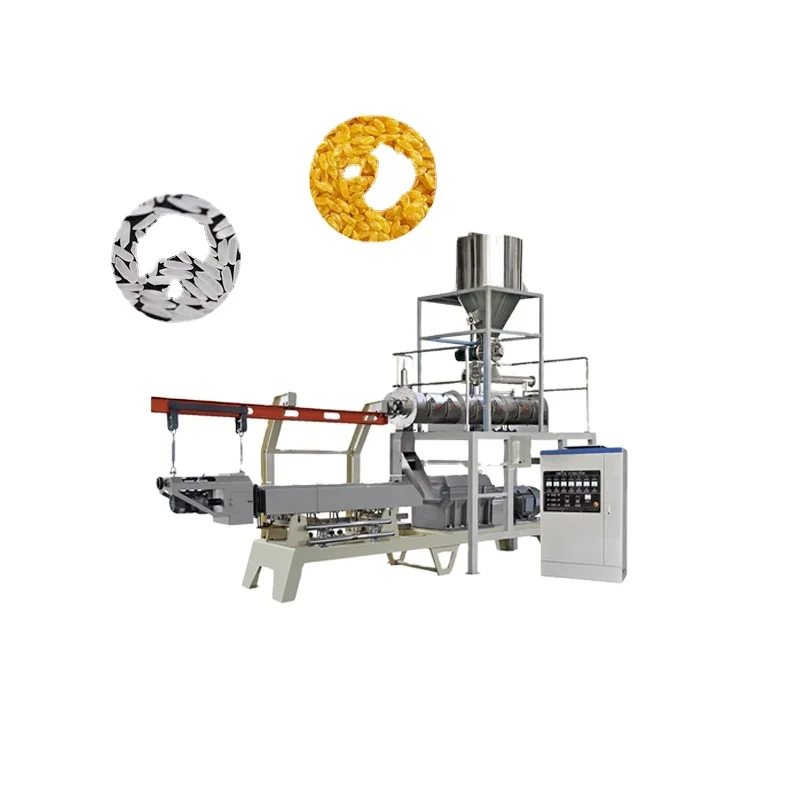
Integrated Line Engineering — Throughput across mixing, extruding, drying, and packing stations is calculated together so no single machine bottlenecks your fortified rice kernel output.
Technical Specifications
| Parameter | Value |
|---|---|
| Model | MT65 / MT70 / MT85 / MT75 / MT95 |
| Product Type | Fortified Rice Kernel Extrusion Line |
| Screw Type | Twin-screw, single or double screw feeding system selectable |
| Control System | Frequency speed controlling, PLC / MCC configurable |
| Lubrication | Automatic lubricating and cooling system |
| Installed Power | 85 kW (MT65) to 260 kW (MT95) |
| Power Consumption | 60 kW (MT65) to 195 kW (MT95) |
| Output Capacity (MT65) | 80–100 kg/h (basis not stated in source — confirm raw material formulation) |
| Output Capacity (MT70) | 100–120 kg/h (basis not stated in source — confirm raw material formulation) |
| Output Capacity (MT85) | 200–300 kg/h (basis not stated in source — confirm raw material formulation) |
| Output Capacity (MT75) | 300–500 kg/h (basis not stated in source — confirm raw material formulation) |
| Output Capacity (MT95) | 800–1000 kg/h (basis not stated in source — confirm raw material formulation) |
| Overall Dimensions | 28 × 1.2 × 2.2 m (MT65) to 36 × 3.5 × 4.3 m (MT95) |
| Drying Oven Heating Source | Electric or gas |
| Drying Oven Control | Circulation drying, frequency motor controls mesh belt speed |
| Line Station Sequence | Mixing → Extruding → Vibrating → Low Temperature Drying → Cooling → High Temperature Roasting → Cooling → Packing |
| Standards | CE, ISO |
Application Suitability
| Application | Material or Output |
|---|---|
| Fortified Rice Kernel Production | Broken rice, rice flour blended with vitamin and mineral premix |
| Artificial Rice from Grain By-products | Rice bran, corn, millet, wheat starch as base with micro-nutrient addition |
| Nutrition Programme Supply | High-nutritional-value rice kernels for government or NGO food distribution |
| Grain Processing Enterprise | Value-added conversion of broken rice into uniform fortified kernels |
| Cereal Ingredient Manufacturing | Buckwheat, oat, or bean-based extruded rice analogues |
What "200 kg/h" Actually Means on Your Premix
Quoted output is measured on a reference starch base, not on your vitamin-loaded formulation.
When I was setting up an artificial rice line for a Southeast Asian buyer, we ran the trial on standard rice flour and everything held steady. The moment their actual high-calcium premix arrived, the material flow characteristics changed completely — screw speed, barrel temperature, and die pressure all needed rework, and that delay cost nearly three weeks on the commissioning schedule. Any capacity figure attached to a Fortified Rice Kernel Extrusion Line should always be read against the exact formulation you intend to run. [NEED_CITE: effect of mineral premix on extrusion throughput]
How the Fortified Rice Kernel Extrusion Line Stations Connect
Each station in the line is specified so that material flow remains continuous. The mixer batch size is timed to the extruder’s feed rate, the vibrating conveyor spreads kernels to a uniform layer thickness before they enter the low-temperature dryer, and the mesh belt speed is frequency-controlled to match the roasting oven’s residence time. When one station runs faster than the next, kernels accumulate, cool unevenly, or fracture before packing.
Feeding System Choice and Premix Stability
The twin-screw extruder can be fitted with either a single or double screw feeding system. A single screw feeder handles free-flowing rice flour adequately, but when the formulation includes a high ratio of fine vitamin and mineral powder, a double screw feeder maintains a more consistent feed rate and prevents bridging in the hopper. This selection directly affects kernel density uniformity across production batches. [NEED_CITE: powder flow behavior in gravimetric feeding systems]
Reading the Power and Dimension Data
Installed power ranges from 85 kW on the MT65 to 260 kW on the MT95, with actual power consumption sitting noticeably lower due to intermittent heating cycles and variable frequency drives on the motors. The line footprint stretches from roughly 28 meters for the smallest configuration to 36 meters for the MT95, and the larger models require ceiling clearance above 4 meters to accommodate the drying and roasting ovens. Buyers should confirm workshop dimensions and electrical capacity before selecting a model, since upsizing later often means re-routing utilities and modifying foundations.
When Stations Are Undersized
A common issue on grain extrusion projects is an extruder producing at full rate while the downstream dryer cannot remove moisture fast enough. Kernels exit the dryer with residual internal moisture, crack during the high-temperature roasting stage, and generate a high percentage of broken pieces at the packing station. The entire line then runs below its nameplate capacity because the bottleneck is not the extruder but a dryer that was specified on a generic throughput figure rather than on the actual moisture load of fortified rice dough. [NEED_CITE: moisture removal rate calculation for extruded grain products]
Engineering Support Behind the Equipment Range
Line layout and throughput calculations are prepared against your stated raw material and target kernel specification, not copied from a generic template. Screw configuration and die design are matched to the exact grain and premix blend you supply. An in-house testing workshop allows trial runs on your raw material before shipment, so formulation adjustments happen at the factory rather than on your floor. The full equipment range — from batching through packing — stays under one supplier, meaning every station’s capacity is cross-checked during design. CE and ISO documentation accompanies the shipment for customs and local regulatory clearance.
Documentation & Verification
- Line layout drawing showing throughput balance across all stations for your FRK formulation
- Screw and die configuration record matched to your grain and premix ratio
- Electrical schematic with voltage and frequency confirmed to your local grid standard
- Factory trial run report produced on your supplied raw material before dispatch
- CE declaration of conformity and ISO certificate included in shipping documentation
Installation, Commissioning & Support
- Foundation plan provided for the selected model, accounting for the 4.3 m oven height on larger units
- Dedicated circuit specification based on installed power, from 85 kW to 260 kW
- Extruder barrel and screw segments shipped in matched sets for on-site assembly
- First-run parameter setting including barrel temperature profile and mesh belt speed
- Operator training covering feeding system changeover and PLC or MCC interface navigation
- Wear parts list identifying screw elements, die plates, and dryer belt sections for initial stock
What We Need to Specify Your Line
To prepare an accurate configuration, share your base grain type and the vitamin-mineral premix ratio you plan to run. We also need your target daily output, workshop length and ceiling height, and the local voltage and frequency standard. If you already have upstream milling or downstream packing equipment, provide their throughput figures so we can match the Fortified Rice Kernel Extrusion Line to your existing flow.
Frequently Asked Questions
Q: How is line capacity verified and what formulation is it based on?
A: The quoted output figures are measured on a reference starch base. Before shipment, a trial run is conducted on your actual raw material in the testing workshop. Capacity is then confirmed against your specific grain and premix blend, and a trial report is provided showing real throughput, kernel density, and moisture levels achieved during the run.
Q: How do you match extruder output with dryer throughput?
A: The dryer’s mesh belt length, circulation fan capacity, and heating source are sized so that moisture removal rate equals or exceeds the extruder’s output. If your formulation carries higher initial moisture, the dryer specification is adjusted accordingly to prevent kernel cracking downstream.
Q: Which stations can be added or omitted depending on product requirements?
A: The high-temperature roasting stage can be omitted if your target product does not require a toasted finish. An additional coating or seasoning drum can be added after cooling if flavored fortified kernels are required. Each modification is reflected in the line layout and throughput calculation before production begins.
Q: How is screw configuration selected for different grain formulations?
A: Screw element arrangement — conveying, kneading, and reverse-flight segments — is configured based on the starch content, fiber level, and premix ratio of your material. Die hole diameter and land length are then matched to produce the target kernel size and density. Both parameters are recorded in the configuration document supplied with the line.