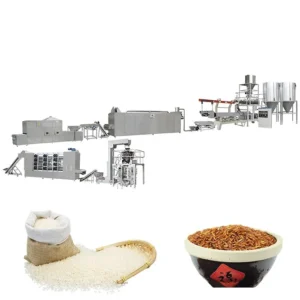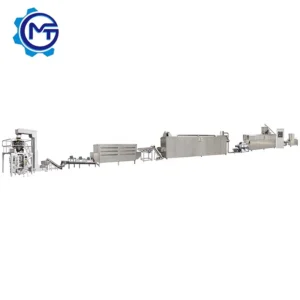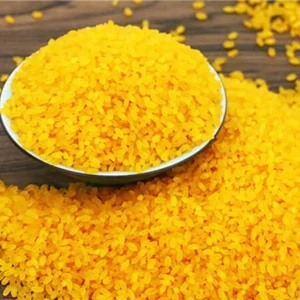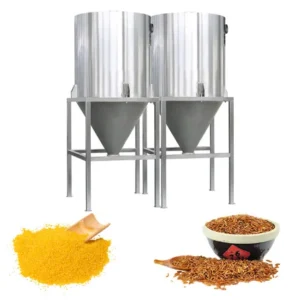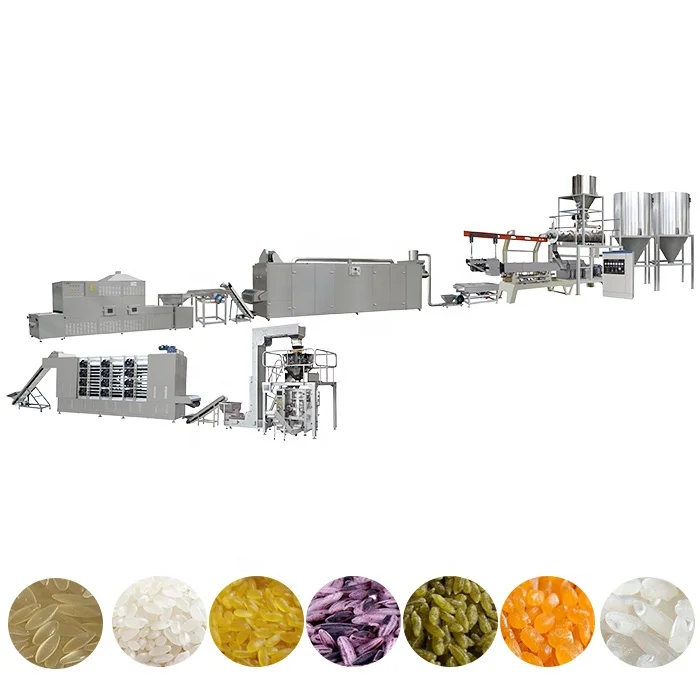
Integrated Line Station Matching — throughput across mixing, extruding, drying and polishing is calculated together, preventing any single unit from constraining the nutritional artificial rice processing line equipment.
Technical Specifications
| Parameter | Value |
|---|---|
| Product Type | Nutritional Artificial Rice Processing Line |
| Line Configuration | Double screw extruder production line |
| Extruder Type | Twin-screw |
| Contact Material | Food grade stainless steel 201/304 |
| Control System | Dedicated control cabinet with PLC/inverter (Siemens or China top brand motor, Delixi or Delta inverter) |
| Energy Source Options | Electricity / Gas / Diesel / Steam |
| Power (electric heating) | ~100 kW (basis not stated in source — confirm line capacity / model) |
| Power (gas/diesel heating) | 50–60 kW (basis not stated in source — confirm line capacity / model) |
| Line Stations | Mixing → Screw Conveying → Extruding → Vibrating Screen → Air Conveying → Multi-layer Oven → Cooling Conveyor → Polisher |
| Drying Equipment | Seven-layer, 8-meter dryer (source value — verify against manufacturer catalog) |
| Oven Temperature Range | 0–200 °C, adjustable via control cabinet |
| Oven Interior | Stainless steel double-layer mesh belt |
| Standards | CE, ISO |
Application Suitability
| Application | Material or Output |
|---|---|
| Fortified artificial rice production | Rice flour blended with vitamins, minerals and trace elements |
| Instant rice porridge manufacturing | Pre-gelatinised rice flour for hot-water reconstitution |
| Broken rice and rice bran valorisation | Reconstituted into uniform rice-shaped extruded pellets |
| Multi-grain rice shaping | Black rice, buckwheat and alternative grain blends |
| Institutional nutrition programmes | Calorie-dense, micronutrient-fortified rice for food aid distribution |
What Happens When Extruder and Dryer Capacity Are Mismatched
A nutritional artificial rice processing line equipment that quotes an impressive extruder output means little when the downstream oven cannot keep up. Every station must be throughput-matched to the actual raw material formulation, not just the nameplate rating.
I once saw a line where the twin-screw extruder was pushing out rice pellets faster than the multi-layer dryer could reduce their moisture content. The result was sticky, deformed granules accumulating on the cooling conveyor and a moisture level that invited mould during storage. The buyer had specified the extruder on standard white rice flour, but their local grain blend contained more bran and fibre, changing the extrusion behaviour entirely [NEED_CITE: effect of fibre content on extrusion moisture and gelatinisation behaviour]. That is why running a trial on the buyer’s actual raw material before shipment is not optional — it is the only way to confirm that every station in the line handles the same real-world throughput.
How the Station Sequence Handles Rice Pellet Formation
The line begins with mixing, where rice flour, broken rice powder or alternative grain blends are combined with any added micronutrients. The screw conveyor then feeds the twin-screw extruder at a controlled rate. Inside the barrel, starch gelatinisation occurs under heat and shear, and the die plate shapes the melt into rice-granule forms. The vibrating screen removes undersized or misshapen pieces before air conveying carries the pellets to the oven. Each transition point is sized so that material flow remains continuous without pooling or starvation at any stage.
Drying Profile and Moisture Control in Rice Pellet Production
The seven-layer, 8-meter dryer is configured with a stainless steel double-layer mesh belt that carries the rice pellets through a controlled temperature gradient. The 0–200 °C adjustable range allows the operator to set zone temperatures that first drive surface moisture off quickly, then reduce internal moisture gradually without case-hardening the pellet exterior. Energy source flexibility — electric, gas, diesel or steam — means the dryer can be matched to whatever utility is available at the installation site [NEED_CITE: industrial dryer energy source selection for food processing facilities]. Getting this drying curve right determines whether the final artificial rice rehydrates properly in hot water or turns mushy.
Reading the Specifications That Actually Matter
The twin-screw extruder is the core of this nutritional artificial rice processing line equipment, and its screw configuration must be matched to the specific grain blend. A high-fibre buckwheat mix requires different screw element spacing and compression ratio than a pure white rice flour formulation. The food grade stainless steel 201/304 contact materials ensure compliance with food safety requirements while resisting the mildly acidic environment that some fortified premixes create during extrusion. The dedicated control cabinet with PLC or inverter drive (Siemens, Delixi or Delta options) gives the operator repeatable control over screw speed, barrel temperature zones and feeder rate — the three variables that together determine pellet density and gelatinisation degree. When the voltage and frequency are confirmed for the target market before production begins, the motor and inverter are wound and programmed accordingly, avoiding commissioning delays that arise from mismatched electrical supply [NEED_CITE: voltage and frequency standards by export market].
The Hidden Cost of Skipping a Raw Material Trial
Buyers who approve a line based on a standard rice flour trial run often discover problems only after installation. Local grain varieties differ in starch content, amylose-to-amylopectin ratio and particle size distribution. These differences alter how the material behaves inside the extruder barrel — changing expansion, affecting die pressure and shifting the moisture content entering the dryer. I have seen production lines lose weeks of output while technicians adjusted screw configurations and oven temperatures on-site, work that could have been completed in a testing workshop before the machines ever left the factory [NEED_CITE: importance of pre-shipment factory acceptance testing for food extrusion lines]. The cost is not just in wasted raw material; it is in delayed market launch and unfulfilled supply contracts.
Why Source This Line From a Single Equipment Supplier
Procuring the extruder from one vendor, the dryer from another and the polisher from a third creates integration gaps that no single party owns. Here, the complete nutritional artificial rice processing line equipment is designed as a system. Throughput calculations cover every station from the mixer to the polisher, so the seven-layer dryer is specified to handle the actual output of the twin-screw extruder running the buyer’s grain formulation. The screw and die configuration is documented against the specific raw material rather than copied from a generic build. An in-house testing workshop allows trial runs on the buyer’s actual flour blend before dispatch. Electrical schematics and control language are confirmed to the destination market. And post-installation support covers the entire line rather than leaving the buyer to coordinate between multiple equipment vendors.
Documentation & Verification
- Line layout and capacity calculation showing throughput match across all eight stations
- Screw and die configuration record tied to your specific grain blend
- Electrical schematic with voltage and frequency confirmed for your facility
- Trial run report on your actual raw material conducted before shipment
- CE declaration of conformity and ISO certificate for the complete line
- Operation and maintenance manual covering every station in sequence
Installation, Commissioning & Support
- Foundation and floor space plan reflecting the full eight-station line footprint
- Dedicated electrical circuit sized for the connected load of extruder and dryer combined
- Modular station delivery allowing phased assembly in facilities with limited access
- On-site commissioning with parameter tuning on your grain formulation
- Operator training covering PLC interface navigation and screw speed adjustment
- Wear parts list for extruder screws, die plates and mesh belt sections
What to Include With Your Inquiry
To configure the right nutritional artificial rice processing line equipment for your production target, share your grain formulation or the specific rice variety you intend to process, along with any micronutrient premix details. Confirm the electrical supply at your facility — voltage, phase and frequency — so that motors and inverters can be specified correctly. Let us know your available energy source for the dryer and whether steam, gas, diesel or electric heating suits your utility infrastructure. If possible, send a sample of your raw material so that a trial run in the testing workshop can validate screw configuration, die selection and drying parameters before quotation.
Frequently Asked Questions
Q: What is the output capacity of the line, and on which raw material formulation is it based?
A: Output capacity depends on the specific grain blend, moisture content and target pellet density. A line rated on standard white rice flour may perform differently on high-fibre buckwheat or broken rice formulations. We calculate capacity based on your actual raw material during a pre-shipment trial run, not on generic benchmarks.
Q: Which energy source is recommended for the dryer, and how does it affect total connected load?
A: The seven-layer dryer supports electric, gas, diesel or steam heating. Electric heating draws higher connected power from the mains, while gas or diesel shifts the energy load off the electrical supply. The choice depends on your facility’s utility availability and local energy costs. We confirm the total connected load once the heating method is selected.
Q: How are the extruder, dryer and cooling conveyor throughput-matched?
A: Each station is sized based on the line capacity calculation that accounts for your raw material’s behaviour through extrusion and drying. The dryer length, mesh belt speed and cooling conveyor length are all specified so that material flows continuously without bottlenecking at any transition point.
Q: What screw and die configuration is specified for my grain blend?
A: Screw element arrangement, compression ratio and die aperture are selected based on your raw material’s starch content, fibre level and target rice granule shape. This configuration is documented in the specification record and validated during the in-house trial run before the line ships.
Q: Which electrical components are included, and can the control language be customised?
A: The control cabinet includes motors from Siemens or a top Chinese brand, with Delixi or Delta inverters. The PLC interface language can be set to match your operators’ requirements. Voltage and frequency are confirmed to your local supply standard before production begins.