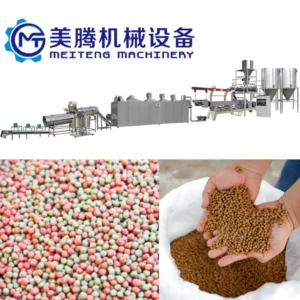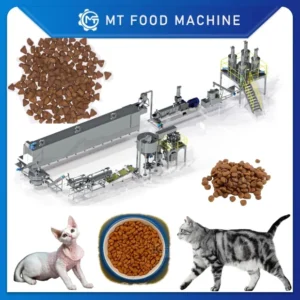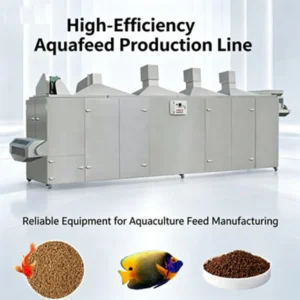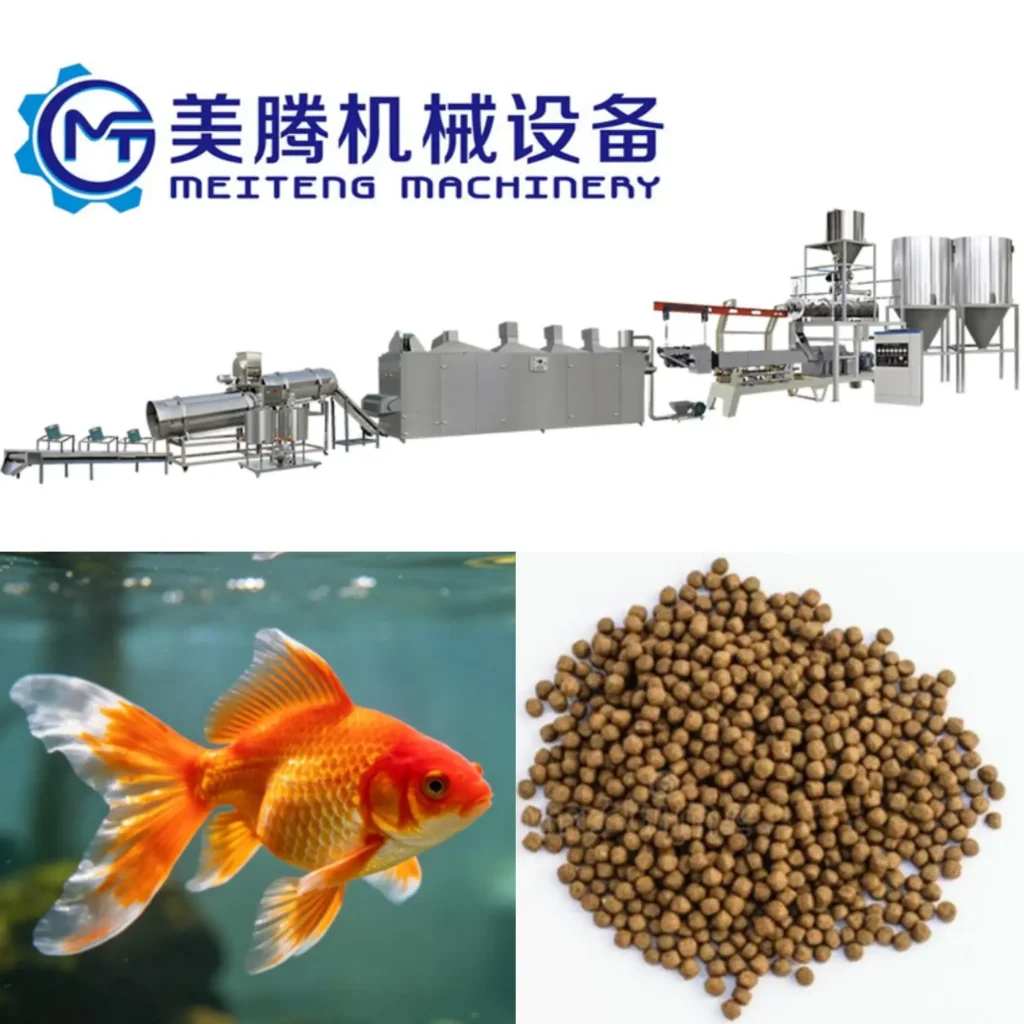
Turnkey integration across every station — every conveyor, dryer and coating drum in this fish feed extrusion line is throughput-matched so the rated extruder capacity holds steady on your actual formulation.
Technical Specifications
| Parameter | Value |
|---|---|
| Product Type | Fish Feed Extrusion Production Line |
| Output Capacity | 300–600 kg/h (basis not stated in source — confirm raw material formulation, moisture content, pellet size & sinking/floating type) |
| Screw Type | Twin-screw extruder |
| Construction Material | 304 stainless steel (food-grade contact parts) |
| Control System | PLC & MCC |
| Line Stations | Batching → Mixing → Extrusion → Drying → Flavouring / Coating → Cooling → Packing |
| Die Configuration | Matched to target pellet size and density (floating / sinking) |
| Voltage & Frequency | To be confirmed per destination market |
| Assembly State | Complete line, pre-shipment trial run available |
| Certification | CE, ISO 9001 |
Application Suitability
| Application | Material or Output |
|---|---|
| Floating pellets for surface-feeding species | Trout, salmon, tilapia feed from fish meal, soy protein and starch binders |
| Sinking pellets for bottom-feeding species | Catfish and shrimp feed with higher density formulations |
| Pet food manufacturers diversifying product range | Kibble-style aquatic formats for retail and export markets |
| Aquaculture operations scaling production | Species-specific pellet sizes from 1 mm to 8 mm diameter |
What "300–600 kg/h" Actually Means on Your Raw Material
A rated capacity number is meaningless until it is verified on the exact formulation you will run in production.
Most fish feed processing line manufacturer catalogues quote an output range that assumes an ideal, low-moisture starch recipe. In practice, aquaculture formulations carry high protein loads — fish meal, shrimp meal, soy concentrate — and these behave differently inside the barrel. The material generates less expansion, demands higher shear, and exits the die at a different density. I have seen lines stall at half their quoted throughput because the screw profile was copied from a corn snack build rather than specified for a 45% protein aquatic formula. Before the purchase order is signed, the sensible step is a trial run on the buyer’s own raw material, not a promise written on a brochure [NEED_CITE: twin-screw extrusion behaviour on high-protein aquatic feed formulations].
How Screw and Die Selection Shapes Pellet Density
Every fish feed processing line manufacturer works from the same mechanical principle: the screw configuration governs shear, residence time and melt temperature, while the die geometry controls expansion ratio at the moment the material exits under pressure. For floating pellets, the screw profile must generate sufficient gelatinisation and gas retention so the pellet traps air cells and stays buoyant. For sinking pellets, the same extruder needs a different compression ratio and a tighter die land to produce a denser, more compact structure. The die plate itself is matched to the target diameter — a 2 mm shrimp pellet requires a completely different die face layout than a 6 mm tilapia pellet, and changing between them is a routine swap when the configuration is documented from the start.
Barrel Temperature Zones and Moisture Control
The barrel is divided into independently heated and cooled zones, and the temperature profile across these zones determines how thoroughly starch gelatinises before the material reaches the die. In aquaculture feed, incomplete gelatinisation shows up as poor water stability — the pellet breaks apart in the pond within minutes instead of holding long enough for the fish to consume it. The PLC control system on this line maintains set-point temperature at each zone and adjusts screw speed in response, giving the operator a repeatable process window from the first batch of the shift to the last. Moisture is introduced through preconditioning steam and barrel injection, and the ratio is tuned during the in-house trial so the recipe documentation travels with the machine [NEED_CITE: starch gelatinisation and water stability in extruded aqua feed].
Reading the Specifications That Matter Most
The twin-screw extruder at the heart of this line handles high-protein, high-fat formulations that a single-screw design would struggle to convey consistently — the intermeshing screw flights provide positive displacement, which is essential when the recipe includes sticky ingredients like fish oil and molasses. The 304 stainless steel contact surfaces resist the corrosive salts present in marine-based raw materials and meet food-grade hygiene expectations for both aquaculture and pet food markets. The PLC and MCC control architecture separates logic-level automation from motor-level power distribution, so a fault in one zone does not cascade across the entire line. The capacity range of 300–600 kg/h must be confirmed against the buyer’s specific formulation, pellet diameter, and whether the target product is floating or sinking — each of these variables shifts the actual output within or sometimes outside the quoted band.
The Hidden Cost of Mismatched Station Capacity
When the extruder is quoted at a certain throughput but the downstream dryer is sized for a lower volume, wet pellets accumulate at the dryer infeed, cool below the temperature needed for effective moisture removal, and arrive at the coating drum in a condition that causes fat and flavourant to pool rather than distribute. The result is a batch of pellets that look acceptable at the packing station but develop mould or rancidity weeks later in the warehouse. This bottleneck problem rarely appears during a short factory test because the line is only run for minutes, not hours. Matching every station — dryer length, drum diameter, cooler airflow — to the sustained output of the extruder is the only way to prevent it, and it requires a line layout that was calculated as a system rather than assembled from individual catalogue pages [NEED_CITE: downstream bottleneck effects in continuous extrusion lines].
Why Procure This Line From a Single Source
The complete station sequence — batching, mixing, extrusion, drying, flavouring, coating, cooling and packing — is designed and supplied under one responsibility, so throughput calculations account for every transfer point. Screw configuration and die design are specified against the buyer’s raw material and target pellet density rather than pulled from a generic build library. The in-house testing workshop allows trial runs on customer-supplied formulation before the equipment leaves the factory, meaning product development work happens before installation rather than after. The PLC and MCC control systems are programmed and documented together, so the electrical schematic matches the actual cabinet wiring when the line is commissioned on site. Wear parts — screws, die plates, barrel liners — are catalogued against the specific build, so replacements are available when the first changeover is due.
Documentation & Verification
- Line layout and capacity calculation showing throughput matching across batching, extrusion, drying and packing stations
- Screw and die configuration record tied to your raw material formulation and target pellet density
- Trial run report on customer-supplied raw material from in-house testing workshop before dispatch
- Electrical schematic with voltage, frequency and PLC language confirmed for destination market
- CE declaration of conformity and ISO 9001 certificate for the complete line
- Operation and maintenance manual with wear parts list specific to your build configuration
Installation, Commissioning & Support
- Foundation plan provided with station-by-station weight and footprint data for the complete line layout
- Dedicated power circuit specified per station motor rating with voltage and frequency confirmed before build
- Extruder barrel sections and screw elements arrive segmented for site assembly with alignment tooling included
- First production run supervised on site with barrel temperature profile and screw speed tuned to your formulation
- Operator training covers PLC navigation, die changeover procedure and routine screw wear measurement
- Wear parts inventory list supplied at handover with reorder codes for screws, dies and barrel liners
What to Include in Your Inquiry
To receive a line layout that reflects your actual production conditions, provide the raw material formulation — including protein source, fat percentage and binder type — along with the target pellet diameter, whether the product is floating or sinking, and the daily output volume you need to sustain. Confirm the local voltage, frequency and preferred PLC language so the control system is configured before shipment. If you have existing upstream milling or downstream bagging equipment, share the interface specifications so the new line connects without modification.
Frequently Asked Questions
Q: How is the 300–600 kg/h capacity verified, and on which raw material formula?
A: The output range is a starting estimate. Before shipment, we run your actual raw material in our in-house testing workshop and document the sustained throughput on your specific formulation, pellet size and density target. The trial run report becomes part of the delivery package so you know exactly what to expect at commissioning.
Q: How do you ensure floating pellets actually float and sinking pellets stay down?
A: Pellet buoyancy is controlled through screw configuration, barrel temperature profile and die design — all matched to your formulation during the trial run. We measure pellet density and water stability during the test, adjusting the process parameters until the results meet your market specification.
Q: Will the voltage, frequency and PLC language match our facility before the line ships?
A: Yes. Electrical specifications and control language are confirmed during the quotation stage and documented in the electrical schematic. The PLC interface and MCC labelling are set to your local requirements before the control cabinets are wired, so there are no surprises at commissioning.
Q: Can we send our raw material for a trial run before committing to the line?
A: The in-house testing workshop is available for trial runs on customer-supplied raw material. You send a representative sample of your formulation, and we run it through the extruder and downstream stations, recording output rate, pellet quality and process parameters in a formal report.
Q: What spare wear parts come with the line, and how are replacements supplied?
A: A wear parts list specific to your build is included at delivery, identifying screws, die plates and barrel liners with reorder codes. Initial spare sets can be included in the shipment, and subsequent orders are fulfilled against the documented configuration so replacements match your line exactly.