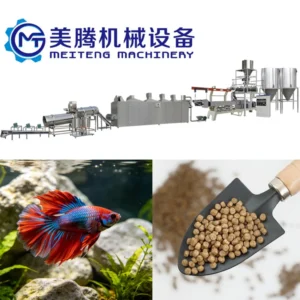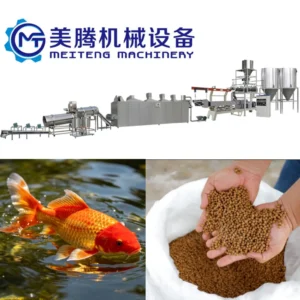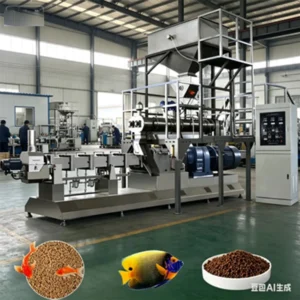
Integrated Equipment Matching — every station from mixer to dryer is throughput-balanced to your aquatic feed formula rather than assembled from separate vendors with mismatched speeds.
Technical Specifications
| Parameter | Value |
|---|---|
| Product Type | Twin Screw Aquatic Feed Pellet Production Line |
| Screw Type | Twin-screw |
| Control System | Intelligent PLC automatic control system |
| Material Contact Parts | Food-grade 304 stainless steel |
| Output Capacity | Basis to be confirmed with raw material formulation, moisture content, and pellet diameter |
| Pellet Types | Floating and sinking fish feed pellets |
| Pellet Adjustability | Size, hardness, and buoyancy adjustable per breeding requirements |
| Line Stations | Raw material mixer, extruder, dryer, seasoning/coating machine, vibrating sieve, conveyor equipment |
| Automation Level | Full continuous automatic production from mixing to finished product discharging |
| Heating System | Optimized energy-saving transmission structure and heating system |
| Assembly State | Complete matched production configuration |
| Voltage & Frequency | To be confirmed per destination market |
| Certification | CE, ISO |
Application Suitability
| Application | Material or Output |
|---|---|
| Commercial floating feed for koi and goldfish | Fish meal, soybean meal, corn powder, compound additives |
| Sinking pellet production for tropical freshwater species | High-protein formulations with controlled density extrusion |
| Multi-species feed factories switching pellet formats | Variable raw material blends requiring adjustable screw and die configuration |
| Medium to large scale continuous aquatic feed processing | Uninterrupted industrial batches with PLC-managed throughput |
Why "Rated Capacity" Means Nothing Without Your Formula
Every fish feed production line manufacturer quotes a number, but that number almost always assumes a generic corn-starch recipe running under ideal conditions. Your actual output depends entirely on how your specific raw material behaves inside the barrel. I have seen lines rated for substantial hourly throughput drop noticeably once the buyer’s local formulation — higher tapioca starch, different protein ratios, or unusual moisture levels — hits the screw. The extruder stalls, the pellet density drifts, and the dryer cannot keep up because it was sized for a capacity the line never actually reaches. That mismatch cascades through every downstream station [NEED_CITE: twin-screw extrusion capacity factors in aquatic feed processing].
How the Barrel Profile Shapes Pellet Buoyancy
The twin-screw extrusion process relies on a precise temperature and pressure gradient across multiple barrel zones to control starch gelatinisation. For floating pellets, the formulation must reach a degree of expansion that traps air cells uniformly throughout the matrix. The intelligent PLC automatic control system manages barrel zone temperatures and screw speed together, so operators can shift from a floating koi feed run to a sinking catfish pellet run without manual recalibration of each heating zone. This repeatability is what makes the fish feed production line manufacturer confident in specifying the same line for both pellet formats.
What Happens When Stations Are Sourced Separately
A common failure mode in aquatic feed plants is a bottleneck between extrusion and drying. The extruder pushes output at a certain rate, but the dryer was purchased from a different vendor who sized it for a lighter product or a lower moisture removal target. Pellets pile up on the conveyor, surface moisture remains too high, and mould develops before the product reaches the packing station. On this line, the dryer capacity and the seasoning drum cycle time are calculated against the extruder’s verified throughput on the buyer’s formula, so the entire fish feed production line runs as one continuous sequence without accumulation points [NEED_CITE: equipment throughput matching in continuous feed manufacturing].
Reading the Specs That Actually Matter
The twin-screw configuration is chosen here because aquatic feed formulations often contain high proportions of protein meals and fats that require intense mixing and shear — a single-screw design struggles with those ingredients at production scale. Food-grade 304 stainless steel on all material contact surfaces is not merely a hygiene choice; fish meal and compound additives are corrosive over long production runs, and carbon steel contact parts degrade quickly in humid feed mill environments. The PLC control system stores recipes for different pellet diameters and buoyancy targets, meaning a changeover from 3 mm sinking shrimp feed to 6 mm floating tilapia feed is handled through parameter recall rather than mechanical adjustment of each barrel zone. The vibrating sieve downstream removes undersized fines before the seasoning coating stage, keeping the final product within the size specification the aquaculture market expects.
The Cost of Skipping the Trial Run
Buyers who approve a line on paper specifications alone often discover problems only after installation. The screw pitch that works on the factory’s test material may not generate enough shear on the buyer’s high-fiber formulation, resulting in under-expanded pellets that sink when they should float. The die plate may produce pellets outside the diameter tolerance the buyer’s market demands. Resolving these issues on-site, thousands of kilometres from the manufacturing workshop, turns a planned commissioning week into a prolonged troubleshooting period that delays production start and frustrates the buyer’s own customers [NEED_CITE: pre-shipment trial run practices in food extrusion equipment].
Why Procurement Starts Here
Every station on this aquatic feed line is sourced and matched under one supplier, eliminating the finger-pointing that occurs when a mixer vendor blames the extruder vendor for throughput shortfalls. Screw configuration and die design are specified to the buyer’s raw material formulation and target pellet buoyancy before production begins, not copied from a generic build. An in-house testing workshop runs the buyer’s actual material through the extruder before shipment, verifying pellet density, expansion, and surface finish. The twin-screw expertise behind this line extends across pet food, aquatic feed, and snack applications, so the engineering team understands how different protein and starch ratios behave under extrusion. Documentation covers the full chain from electrical schematics through trial run reports, giving the buyer traceability at every handover point.
Documentation & Verification
- Line layout and capacity calculation matched to your aquatic feed formula and target pellet buoyancy
- Screw and die configuration record specifying pitch, flight depth, and die hole diameter for your product
- Trial run report on your raw material documenting pellet density, expansion ratio, and surface quality
- Electrical schematic and voltage confirmation aligned to your destination market before production
- Complete wear parts list covering screws, dies, and barrel liners with availability at order
- CE declaration of conformity and ISO certificate for customs and regulatory clearance
Installation, Commissioning & Support
- Foundation and floor plan provided to match the full line footprint from mixer through packing station
- Dedicated power circuit sizing confirmed against the PLC-controlled extruder and dryer combined load
- Modular station delivery allowing phased installation when workshop access is constrained
- On-site screw and die parameter tuning to replicate trial run results on your production floor
- Operator training covering PLC recipe recall, barrel temperature adjustment, and buoyancy testing
- Wear parts supply schedule established for screws, dies, and barrel liners before first replacement cycle
What We Need to Quote Accurately
Send your raw material formulation including protein source, starch type, fat percentage, and expected moisture content at the mixer discharge. Specify target pellet diameter range, buoyancy requirement, and daily production target in finished weight. Confirm your workshop voltage, frequency, and preferred PLC display language so the electrical build matches your local grid and operator requirements.
Frequently Asked Questions
Q: How is the output capacity of each line station verified and matched to my raw material formulation?
A: Capacity is not quoted from a generic chart. We request your formulation, run it through the extruder in our testing workshop, and measure actual throughput along with pellet quality. The mixer, dryer, and seasoning drum are then sized to that verified output, so no station becomes a bottleneck during continuous production.
Q: What screw and die configuration options are available for different pellet diameters and buoyancy targets?
A: Screw pitch, flight depth, and kneading block arrangement are selected based on your formula’s starch and protein behaviour. Die plates are machined to the pellet diameter you specify, with multiple options available for switching between floating and sinking formats on the same twin-screw extruder.
Q: How are the mixer throughput, dryer capacity, and seasoning drum cycle balanced to avoid line bottlenecks?
A: Each station’s capacity is calculated from the extruder’s verified output on your material. The dryer’s residence time is set to remove the specific moisture differential your pellets carry at discharge, and the seasoning drum rotation speed is matched to coating volume per batch.
Q: What voltage, frequency, and PLC language options are confirmed before the line is built?
A: We confirm your destination market’s electrical standard before production begins. The PLC interface language, motor ratings, and heating element specifications are all built to your local grid, preventing commissioning delays caused by voltage mismatch or control panels your operators cannot read.
Q: Is a trial run on my actual raw material performed before shipment, and what does the report cover?
A: Yes. Your material is processed through the configured extruder, and the trial run report documents pellet density, expansion ratio, surface finish, and dimensional accuracy against your target specification, giving you documented proof of line performance before the equipment leaves the workshop.