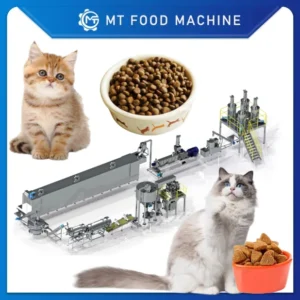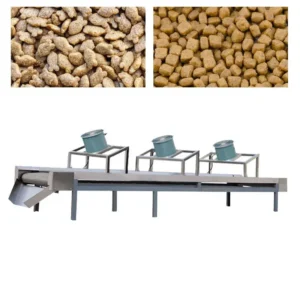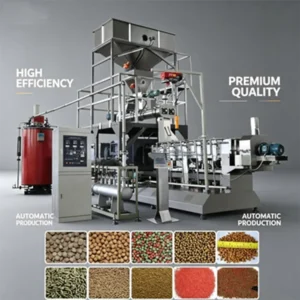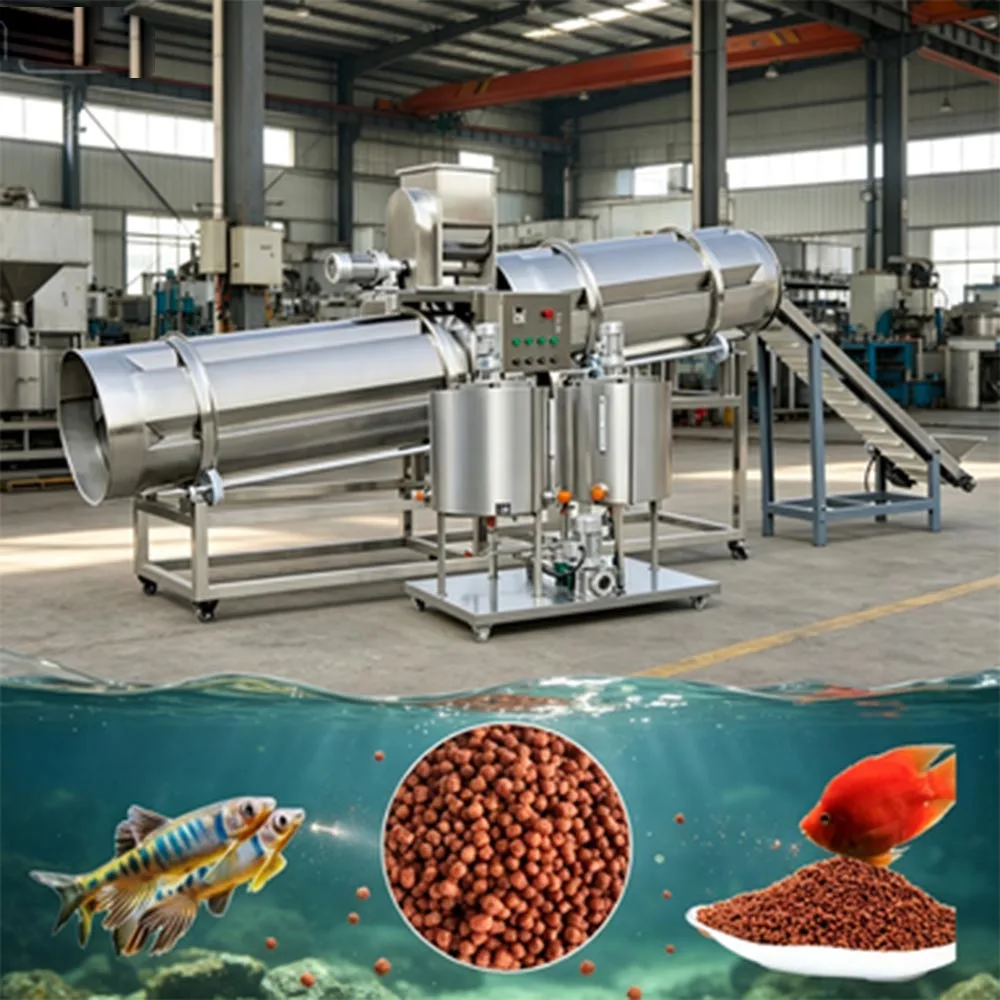
Throughput-Matched Line Design — every station from mixing to packing is sized to your raw material and target pellet density, eliminating bottlenecks that generic configurations create.
Technical Specifications
| Parameter | Value |
|---|---|
| Product Type | Twin Screw Aquatic Fish Feed Extruder Production Line |
| Extruder Type | Wet twin screw |
| Control System | PLC automatic control |
| Construction Material | Food-grade 304 stainless steel (machine body and material contact parts) |
| Pellet Adjustability | Size, hardness, buoyancy (floating and sinking) |
| Line Stations | Raw material mixer, extruder, dryer, seasoning coating machine, vibrating sieve, conveyor equipment |
| Output Capacity | Large stable processing capacity for medium to large scale industrial production (basis to be confirmed) |
| Operation Mode | Full continuous automatic production |
| Energy Feature | Optimized energy-saving transmission structure and heating system |
| Maintenance Design | Humanized operation interface, quick replacement of vulnerable parts |
| Standards Compliance | Meets international food hygiene standards (certifications to be confirmed with manufacturer) |
Application Suitability
| Application | Material or Output |
|---|---|
| Floating pellet production for catfish and tilapia | Fish meal, soybean meal, corn powder, compound additives |
| Sinking pellet production for bottom-feeding species | High-protein formulations with adjusted starch ratios |
| Ornamental fish feed for koi and goldfish | Pigmented compound feeds with color-enhancing additives |
| Tropical fish feed in varied pellet diameters | Fine-graded formulations requiring precise die configuration |
| Commercial aquaculture feed at scale | Compound formulations processed through continuous automatic production |
Why Generic Screw Configurations Sink Your Floating Pellets
The extruder screw and die must be calculated from your actual raw material formulation, not copied from a catalogue standard.
I once supplied a fish feed extruder production line manufacturer configuration based on a standard build. The customer ran a high-fiber formulation that behaved nothing like the test material we had on file. The pellets came out dense, sank immediately, and the entire first batch was rejected by the farm. Floating feed that sinks is not a minor defect — it is a product failure that costs the buyer their market reputation [NEED_CITE: pellet buoyancy requirements in commercial aquaculture markets]. When the screw profile and die geometry are not matched to the buyer’s specific formulation, density control becomes impossible regardless of how advanced the PLC automation is.
Matching Barrel Temperature Profiles to Starch Gelatinisation
The wet twin screw extruder in this line relies on controlled moisture injection and barrel heating zones to achieve the starch gelatinisation needed for pellet expansion. Different raw materials — corn flour, rice bran, soybean meal — each demand a distinct temperature ramp across the barrel sections. The PLC automatic control system allows operators to set and hold these profiles per recipe, which is essential when switching between floating and sinking pellet runs within the same shift. A fish feed extruder production line manufacturer that understands these thermal profiles will configure the heating zones before the machine leaves the factory, not leave it to trial and error on the buyer’s floor.
Die Geometry and the Buoyancy Question
Pellet buoyancy is determined largely by the die aperture, land length, and the expansion that occurs as the extrudate exits under pressure [NEED_CITE: die design principles for extruded aquatic feed]. Floating pellets require a die that allows rapid expansion and low density, while sinking pellets need restricted expansion and higher compression at the die face. This line offers adjustable pellet size, hardness, and buoyancy settings, but those adjustments only deliver results when the die plate itself is specified to the buyer’s target species and formulation. The difference between a koi feed that holds color integrity and one that disintegrates in water often traces back to the die land length chosen at the configuration stage.
What the Specification Sheet Does Not Tell You About L/D Ratio
The length-to-diameter ratio of the twin screw assembly determines how long the material stays inside the barrel, which directly affects gelatinisation completeness and final pellet texture. A longer residence time allows more thorough starch cooking, critical for formulations heavy in complex carbohydrates. However, excessive residence time can degrade heat-sensitive additives like vitamins and amino acids commonly included in aquaculture feeds. The screw configuration must balance these competing demands based on the buyer’s exact ingredient list. Food-grade 304 stainless steel contact parts resist the corrosive effects of fish meal and mineral premixes over extended production runs, maintaining surface finish and preventing contamination between formulation changes.
The Cost of Skipping the Trial Run
When a fish feed extruder production line manufacturer ships equipment without first running the buyer’s raw material through an in-house test, the buyer becomes the test site. Commissioning delays stretch into weeks as screw elements are swapped, die plates are re-ordered, and barrel temperatures are adjusted one variable at a time. I have seen this scenario add significant unplanned downtime to projects where the buyer had a fixed launch date committed to their distribution network [NEED_CITE: commissioning delays caused by untested extrusion configurations]. The vibrating sieve and seasoning coating machine downstream also need to be matched to the actual pellet output characteristics — size distribution, surface texture, moisture content after drying — none of which can be confirmed without a physical trial.
Why Procurement From One Line Builder Matters
This aquatic feed processing line is configured so that every station — raw material mixer, extruder, dryer, seasoning coating machine, vibrating sieve, and conveyors — is throughput-matched under a single supplier responsibility. When stations are sourced from separate vendors, the dryer often becomes the bottleneck because it was specified for a nominal capacity that does not account for the actual moisture load coming from the extruder. The PLC control system integrates the entire line, allowing synchronized start-up, shutdown, and recipe changes from one humanized operation interface. Screw and die configurations are documented per project, so re-orders of wear parts match the original specification without guesswork. Factory testing on the buyer’s raw material is conducted before shipment, producing a trial run report that becomes the baseline for on-site commissioning. The energy-saving transmission and heating design reduces utility load during continuous operation, which matters when the line runs multiple shifts [NEED_CITE: energy consumption benchmarks for industrial twin screw extrusion lines].
Documentation & Verification
- Line layout showing throughput calculation across mixer, extruder, dryer, and coating stations
- Screw and die configuration record matched to your target pellet buoyancy
- Electrical schematic with voltage and frequency confirmation for your facility
- Trial run report on your raw material formulation before dispatch
- CE declaration of conformity and ISO certificate upon request
- Wear parts list with recommended first replacement intervals
Installation, Commissioning & Support
- Foundation requirements based on the full line footprint and wet twin screw operating weight
- Dedicated power circuit sized to the PLC-controlled extruder motor and dryer heating load
- Modular station delivery allowing phased assembly in facilities with limited access
- First-run parameter setting using the trial run report as the commissioning baseline
- Operator training covering recipe changes between floating and sinking pellet production
- Vulnerable parts supply plan with lead times for screws, dies, and barrel liners
What to Prepare Before Requesting a Quotation
To configure this fish feed extruder production line accurately, we need your raw material formulation including protein, starch, and fiber percentages, the target pellet diameter range, and whether you require floating, sinking, or both buoyancy types. Share your facility voltage and frequency, available floor space with ceiling height, and the language your operators need for the PLC interface. If you have existing upstream batching or downstream packing equipment, provide the model and throughput so the line can be matched at the connection points.
Frequently Asked Questions
Q: How is output capacity verified, and what formulation is it based on?
A: Capacity is confirmed through a trial run using your specific raw material formulation, pellet size, and target moisture content. We document the results in a test report that becomes part of your shipment documentation. Nominal figures quoted without raw material context are not reliable for production planning, so we avoid publishing them until your formulation has been physically tested.
Q: How is screw and die configuration matched for floating or sinking buoyancy?
A: We calculate the screw profile, die aperture, and land length based on your formulation’s starch content, protein ratio, and target pellet density. The trial run in our testing workshop validates buoyancy before shipment. If adjustments are needed, screw elements and die plates are reconfigured and retested until the pellets meet your specification.
Q: What voltage, frequency, and PLC language options are confirmed before production?
A: We confirm your facility’s electrical supply specifications and the operator language for the PLC interface before the electrical schematic is finalized. This ensures the control panels, motor ratings, and heating elements match your local grid without requiring on-site modification after delivery.
Q: Is a trial run on my raw material conducted before shipment?
A: Yes. We require a sample of your actual production formulation and run it through the configured extruder in our testing workshop. The trial run report covers pellet dimensions, buoyancy test results, surface texture, and moisture content after drying, giving you a verified baseline before the line arrives at your facility.
Q: What wear parts are supplied, and what is the lead time for replacements?
A: The initial shipment includes a documented wear parts list covering screws, dies, and barrel liners specific to your configuration. First replacement orders are planned based on the trial run wear data, and we provide estimated lead times so you can schedule reorders before production interruption occurs.