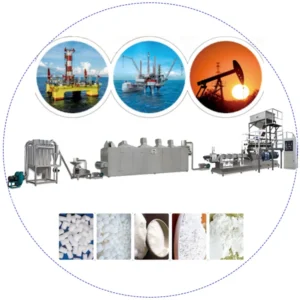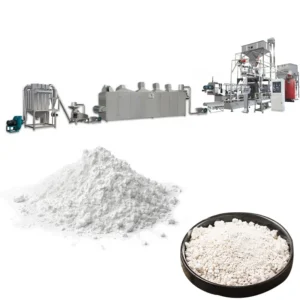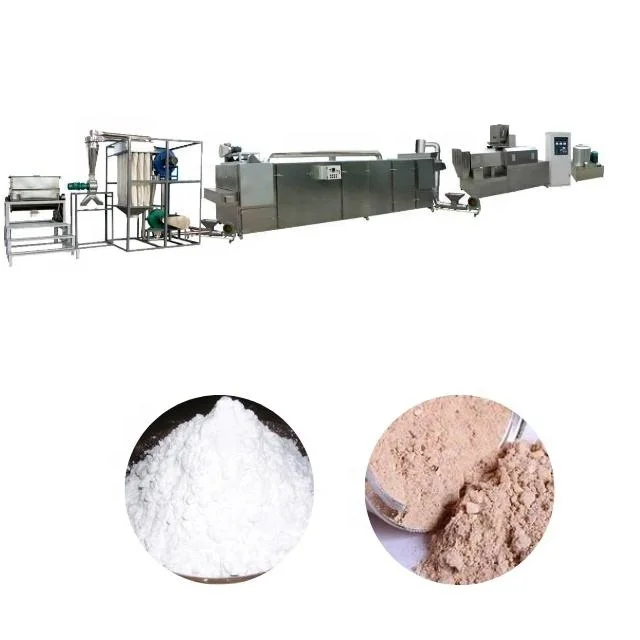
Throughput-Matched Complete Line — every station from batching to packing is sized together so the modified starch processing line equipment never bottlenecks at the dryer or cooler.
Technical Specifications
| Parameter | Value |
|---|---|
| Product Type | Modified Starch Extrusion Production Line |
| Model | MT70 |
| Screw Configuration | Twin-screw, 70 mm diameter, 1520 mm length |
| Screw Material | 38 CrMo alloy steel |
| Main Motor Power | 30 kW |
| Installed Power (Full Line) | 160 kW |
| Operating Power Consumption | 120 kW |
| Output Capacity | 150–200 kg/h (basis not stated in source — confirm raw material type / moisture content) |
| Heating Zones | 7 zones × 2 kW (14 kW total) |
| Feeding System Power | 0.75 kW |
| Cutting System Power | 0.75 kW |
| Oil Pump Power | 0.37 kW |
| Overall Line Dimensions | 41000 × 1500 × 2200 mm |
| Single Extruder Dimensions | 2900 × 900 × 1820 mm |
| Voltage & Frequency | 380 V, 50 Hz, Three Phase (configurable) |
| Cooling System | Equipped on barrel zones |
| Assembly State | Complete line with downstream drying and cooling stations |
| Certifications | CE, ISO |
Application Suitability
| Application | Material or Output |
|---|---|
| Food-grade modified starch | Native corn, waxy maize, or tapioca starch for thickeners, stabilisers, and gelling agents in sauces, soups, and baked goods |
| Textile warp sizing starch | Hydrolysed and denatured starch with controlled viscosity for yarn sizing on looms |
| Paper coating and surface sizing | Modified starch with targeted molecular weight and viscosity for paper machine applicators |
| Industrial adhesive starch | Saccharified and cross-linked starch for corrugated board and carton sealing |
Why "200 kg/h" Can Mean Half That on Your Raw Material
A capacity figure only matters when paired with the exact starch source and moisture content it was measured on.
When buyers evaluate modified starch processing line equipment, the first number they see is the output rating — yet that number almost always assumes a standard native corn starch at a specific moisture level. Switch to waxy maize or high-amylose corn, and the gelatinisation temperature shifts, the residence time requirement changes, and the expansion behaviour at the die face can collapse entirely. I once watched a three-day trial where everything ran smoothly on standard corn starch, then the customer shipped in their actual waxy maize and the product density went completely out of spec. We had to reconfigure barrel zones and screw pitch before the line produced anything usable [NEED_CITE: gelatinisation temperature variance across starch sources].
Barrel Temperature Profiling for Starch Denaturation
Starch modification depends on holding the material within a narrow thermal window across multiple barrel zones. This modified starch processing line equipment carries seven independently controlled heating zones, each rated at 2 kW, combined with a barrel cooling system that pulls heat away when exothermic gelatinisation pushes temperatures past the setpoint. The balance between heating and cooling determines whether the starch granules fully disrupt without scorching, which directly affects the viscosity profile that your end customer measures on a Brabender viscoamylograph.
Screw Geometry and Residence Time Matching
The 70 mm screw diameter and 1520 mm length define the available residence time for hydrolysis, saccharification, and denaturation reactions to complete inside the barrel. For starch targets that require longer reaction windows — such as cross-linking for paper coating grades — the screw pitch and kneading block arrangement must be reconfigured to slow material transport. Our in-house testing workshop runs customer-supplied raw material through these configurations before the line ships, so the screw profile record matches the actual feedstock rather than a generic assumption [NEED_CITE: screw configuration impact on starch modification degree].
Reading the Power and Dimension Figures
The 30 kW main motor on the MT70 extruder drives the twin-screw set through the full barrel length, providing the shear energy needed to break down starch granule structure. The overall installed line power of 160 kW and actual consumption of 120 kW tell a different story — the remaining capacity is distributed across the feeding system, cutting mechanism, heating rings, oil pump, and every downstream station including dryers and coolers. The 41-metre overall line footprint confirms that drying, cooling, and conveying sections are included and physically sized to handle the extruder’s throughput without material pile-up between stations.
What Happens When Stations Are Mismatched
A common failure mode in starch processing lines is specifying an extruder that can produce a certain hourly weight, then connecting it to a dryer that cannot remove moisture fast enough to keep up. The result is wet product accumulating at the dryer inlet, inconsistent final moisture, and a real throughput that falls well below the extruder’s rated figure. This mismatch happens when equipment is sourced from separate vendors who each quote their station in isolation [NEED_CITE: throughput bottlenecking in multi-vendor processing lines].
Why Sourcing the Full Range Matters Here
The modified starch processing line equipment from our catalogue is configured as a single project, meaning the mixer output, extruder throughput, dryer capacity, and cooler conveyor speed are all calculated against the same production target. Screw configuration and die design are specified to the buyer’s actual starch source and modification target rather than pulled from a standard build. The in-house testing workshop validates the recipe before shipment, reducing the commissioning period on site. Electrical schematics and voltage confirmation are completed before production starts, preventing the delay that occurs when a 380 V 50 Hz machine arrives at a facility running 415 V 60 Hz. Documentation packages include screw configuration records, trial run reports, and wear parts lists specific to the shipped line.
Documentation & Verification
- Line layout drawing with station-by-station capacity calculation for your starch modification target
- Screw and die configuration record matched to your specific raw material sample
- Trial run report from our testing workshop conducted on your supplied starch before dispatch
- Electrical schematic with voltage and frequency confirmation for your facility supply
- CE declaration of conformity and ISO certificate for customs and regulatory clearance
- Wear parts list with part numbers for screws, dies, and heating rings
Installation, Commissioning & Support
- Foundation plan based on the 41000 × 1500 × 2200 mm line footprint and station load points
- Dedicated 160 kW three-phase circuit with voltage confirmation before electrical panel build
- Extruder and downstream stations shipped in labelled modules for sequenced on-site assembly
- First-run parameter setting covering barrel zone temperatures, screw speed, and feed rate on your starch
- Operator training covering screw changeover, die cleaning, and dryer belt tension adjustment
- Spare screw elements and die plates from 38 CrMo alloy stock with lead time confirmed at order
Before You Request a Quote
To configure the modified starch processing line equipment correctly, we need to know the specific starch source you will be processing — whether native corn, waxy maize, tapioca, or another variety — along with the target modification type such as hydrolysis, cross-linking, or pregelatinisation. Share your daily production target in kilograms, your facility’s available floor length and ceiling height, and the local voltage and frequency standard. If you have existing upstream mixers or downstream packaging equipment that the line must integrate with, include those specifications as well.
Frequently Asked Questions
Q: How is the screw configuration specified for different starch modification targets?
A: The screw element arrangement — kneading blocks, conveying sections, and reverse elements — is selected based on the residence time and shear profile your target modification requires. We run your actual raw material in our testing workshop and document the final configuration so it ships matched to your feedstock, not a generic template.
Q: What downstream drying and cooling stations are included in the line?
A: The 41-metre line footprint includes drying and cooling stations sized to match the extruder’s output capacity. Throughput at each station is calculated against the same production target, so wet product does not accumulate between the extruder die face and the dryer inlet.
Q: Can the line voltage be configured for non-standard site power supplies?
A: Yes. While the standard configuration is 380 V 50 Hz three-phase, the electrical system can be built for other voltage and frequency combinations. We confirm your site supply specifications before the control panel is assembled to prevent commissioning delays.
Q: Is a trial run on our raw material available before shipment?
A: Our in-house testing workshop conducts production trials using the buyer’s supplied starch. The resulting trial run report covers screw configuration, barrel temperature settings, product density, and final moisture — all validated before the line is packed for dispatch.