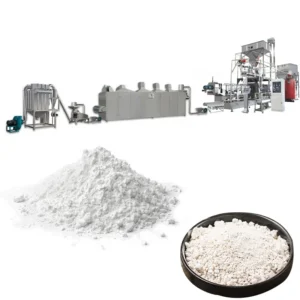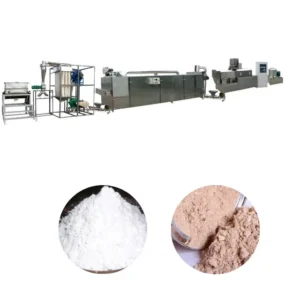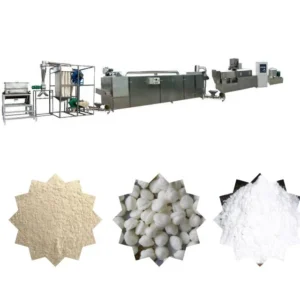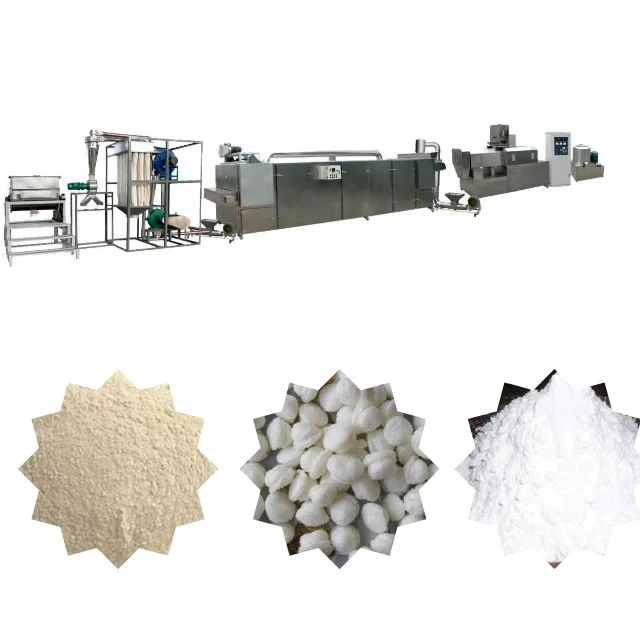
Complete Line Matched — Every station from mixing through twin-screw extrusion to baking and packing is sized to the same throughput target before quotation, preventing the dryer or cooler bottleneck that stalls single-vendor extruder purchases.
Technical Specifications
| Parameter | Value |
|---|---|
| Model | MT-65 / MT-70 / MT-85 / MT-95 |
| Product Type | Modified Starch Twin Screw Extruder Line |
| Screw Type | Twin Screw (Double Screw) |
| Screw Phases | 3 phases — conveying, smelting, inflated |
| Screw Material | Carbon Steel |
| Barrel Material | Carbon Steel |
| Control System | PLC and MCC control |
| Raw Materials Accepted | Potato starch, maize starch, cassava starch |
| Power Source | 380V / 220V / 430V configurable |
| Assembly State | Complete production line (mixing → extruding → baking) |
| MT-65 Motor Power | 45 kW |
| MT-65 Dimension | 2 × 3 × 5 m |
| MT-70 Motor Power | 55 kW |
| MT-70 Dimension | 2 × 3 × 6 m |
| MT-85 Motor Power | 75 kW |
| MT-85 Dimension | 2.5 × 5 × 8 m |
| MT-95 Motor Power | 90 kW |
| MT-95 Dimension | 2.8 × 6 × 10 m |
| Capacity (MT-65) | 300 kg/h (basis not stated in source — confirm raw material / moisture) |
| Capacity (MT-70) | 500 kg/h (basis not stated in source — confirm raw material / moisture) |
| Capacity (MT-85) | 800 kg/h (basis not stated in source — confirm raw material / moisture) |
| Capacity (MT-95) | 15000 kg/h (source value — verify against manufacturer catalog) |
| Lead Time | 40–45 days for large-scale machines |
| Warranty | 1 year for auger and cylinder |
| Certification | CE (since 2014), ISO |
Application Suitability
| Application | Material or Output |
|---|---|
| Modified starch for food industry | Maize starch with controlled gelatinisation and viscosity modification |
| Pregelatinised starch for instant foods | Potato starch processed through thermochemical cooking extrusion |
| Industrial starch for paper and textile sizing | Cassava starch with tailored swelling and solubility profiles |
| Fortified starch-based nutritional powders | Blended starch with vitamin and mineral premix for nutrition programmes |
| Cold-water-swelling starch products | Maize or potato starch modified for instant reconstitution in cold liquid |
Why "Rated Capacity" Means Nothing Without the Raw Material
A modified starch processing line equipment for sale listing that quotes a single output figure tells you almost nothing about what the line will actually produce on your feedstock. Capacity is always a function of the starch source, moisture content, and target modification level.
I learned this the hard way on a cassava starch project last year. The standard maize-starch trial ran clean, but when the buyer switched to their actual cassava feedstock, the screw combination was completely wrong — different gelatinisation temperature, different shear requirement, different expansion behaviour. On-site commissioning dragged on while we reconfigured the screw profile. Now we run every buyer’s real material in the testing workshop before the extruder leaves Jinan [NEED_CITE: starch gelatinisation temperature differences across maize, potato, and cassava sources]. Without that step, you are paying for commissioning days that should have been spent in the factory.
Three-Phase Screw Design and Raw Material Matching
The twin-screw configuration on the MT series divides the barrel into three functional zones: conveying, smelting, and inflated. Each zone’s screw element geometry and pitch are specified after reviewing the buyer’s starch source. Maize starch, potato starch, and cassava starch gelatinise at different temperatures and respond differently to shear, so the smelting phase screw profile changes depending on which one enters the hopper. This is where a generic build falls short — a screw distance and barrel gap copied from a standard snack-food setup will produce inconsistent modification levels when the feedstock changes.
How the Full Equipment Range Removes Line Bottlenecks
A modified starch processing line equipment for sale from a single-vendor extruder supplier often arrives with no matching dryer, cooler, or packing station. The extruder runs at its rated output while the downstream dryer chokes, and overall throughput drops to whatever the weakest station allows. The MT series approach sources every station — mixing, conveying, extrusion, baking, cooling, packing — from one manufacturer, with each unit sized to the same target throughput before the quotation is issued [NEED_CITE: throughput matching principles in continuous food processing lines]. Utility planning also simplifies when one supplier provides electrical loads, steam requirements, and compressed air consumption for the entire line rather than forcing the buyer to reconcile separate vendor datasheets.
Reading the Spec Sheet: What the Numbers Actually Mean
Motor power across the MT-65 through MT-95 range spans 45 kW to 90 kW, and this figure matters more than it first appears. In twin-screw extrusion of modified starch, motor power determines how much mechanical energy can be converted into shear and heat inside the barrel. A higher kW rating gives the process engineer more headroom to adjust moisture levels and screw speed without stalling the drive under viscous cassava starch loads. The three-phase screw design means the conveying section must push material forward while the smelting section simultaneously cooks and shears it — insufficient motor power forces a compromise between throughput and degree of modification. The multi-voltage availability (380V / 220V / 430V) ensures the motor and control panel match the buyer’s local grid, avoiding transformer additions or commissioning delays that arise when a machine arrives wired for the wrong frequency [NEED_CITE: industrial voltage and frequency standards by region]. Carbon-steel screws and barrels in a modular design allow individual wear-part replacement rather than full assembly swaps when abrasion from starch processing gradually erodes the screw flights.
The Hidden Cost of Skipping the Trial Run
Buyers who accept shipment without a factory trial on their actual raw material absorb the full cost of process development at their own facility. On-site reconfiguration of screw elements, die geometry, and barrel temperature profiles requires extended engineer visits, additional raw material for test batches, and production downtime that was not budgeted. The PLC and MCC control system stores parameter sets, but those sets need to be established on the correct feedstock first. When a modified starch processing line equipment for sale is dispatched without verification, the buyer essentially funds a second commissioning phase that the testing workshop could have completed before crating [NEED_CITE: cost of on-site commissioning delays versus factory pre-testing].
What Makes Procurement from This Line Different
Every supporting station from batching through packing is built and matched in-house, so throughput calculations hold across the entire line rather than breaking at the dryer or cooler. Screw configuration and die design are specified to the buyer’s starch source and target modification degree, not copied from a generic extrusion template. The in-house testing workshop runs the buyer’s actual maize, potato, or cassava starch before shipment, producing a trial report that locks in screw profile, barrel temperature, and moisture settings. Twin-screw expertise covers the specific thermochemical demands of starch modification — gelatinisation control, viscosity targeting, and cold-water swelling — rather than treating starch as just another puffed snack. Pre-sales consultation covers line layout and utility planning, with on-site installation, commissioning, and operator training included in the project scope.
Documentation & Verification
- Line layout drawing with throughput matched across mixing, extrusion, baking, and packing stations
- Screw and die configuration record specified to your maize, potato, or cassava starch
- Trial run report on your raw material produced in the testing workshop before shipment
- Electrical schematic with voltage, frequency, and control language confirmed per destination market
- CE declaration of conformity and ISO certificate for customs and regulatory clearance
- Operation and maintenance manual covering PLC parameter sets and modular screw replacement
Installation, Commissioning & Support
- Foundation and floor space planning based on the selected model footprint from 2×3×5 m to 2.8×6×10 m
- Dedicated electrical circuit sized to the motor rating from 45 kW to 90 kW with confirmed voltage and frequency
- Modular screw and barrel assembly arrives in matched sections for on-site sequencing during the 2–3 week installation
- PLC and MCC control commissioning with parameter sets loaded from the factory trial run on your starch
- Operator training covering screw configuration changes, barrel temperature profiles, and die adjustment procedures
- Carbon-steel wear parts list with replacement intervals for screw flights, barrel liners, and die plates
What We Need to Configure Your Line
To move from inquiry to line configuration, share your target starch source (maize, potato, cassava, or a blend), the specific modification you need (pregelatinised, cold-water-swelling, cross-linked, or other), and your target daily output. Let us know your facility voltage and frequency, available floor space and ceiling height, and whether you need the line to integrate with existing upstream mixing or downstream packing equipment. If you can send a raw material sample, we will run it in the testing workshop and include the trial report with the quotation.
Frequently Asked Questions
Q: How is capacity verified against my specific starch raw material and moisture level?
A: We run your actual starch sample in the in-house testing workshop before shipment. The trial records throughput, barrel temperature, screw speed, and moisture settings on your feedstock, not on a generic reference material. This data becomes part of the PLC parameter set loaded at commissioning, so the line starts production at verified output rather than requiring weeks of on-site experimentation.
Q: Which model from MT-65 to MT-95 fits my production target and factory space?
A: Selection depends on your target output after we confirm it on your raw material, not on a generic catalog figure. Floor space ranges from compact 2×3 m footprints to 2.8×6×10 m for the largest model. We provide a line layout drawing showing every station’s footprint and utility connections so you can verify fit against your facility dimensions before committing.
Q: Is the screw configuration adjusted for maize, potato, or cassava starch?
A: Yes. The three-phase screw profile — conveying, smelting, inflated — is specified after reviewing your starch source. Each starch type gelatinises at a different temperature and responds differently to mechanical shear, so screw element geometry, pitch, and barrel gap are matched accordingly. The configuration record shipped with the machine documents every element position.
Q: What voltage and control language options are confirmed before shipment?
A: The electrical system is configurable for 380V, 220V, or 430V supply. Voltage, frequency, and PLC interface language are confirmed during the specification stage and documented in the electrical schematic before production begins. This prevents the common delay of rewiring or reprogramming a machine after it arrives at the buyer’s facility.
Q: Which supporting stations are included and how is throughput matched?
A: The complete line covers mixing and batching, conveying, twin-screw extrusion, baking, cooling, and packing. Every station is sized to the same throughput target calculated from your raw material trial, so no single unit becomes a bottleneck. Utility loads for each station are consolidated into one planning document for your facility engineering team.