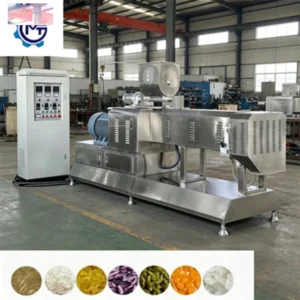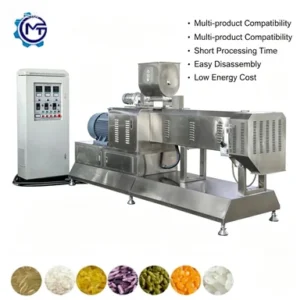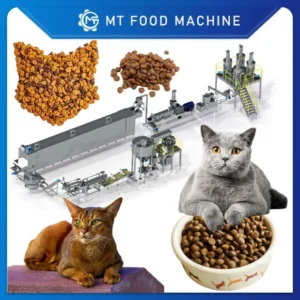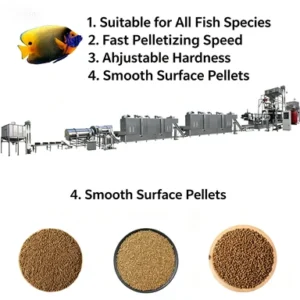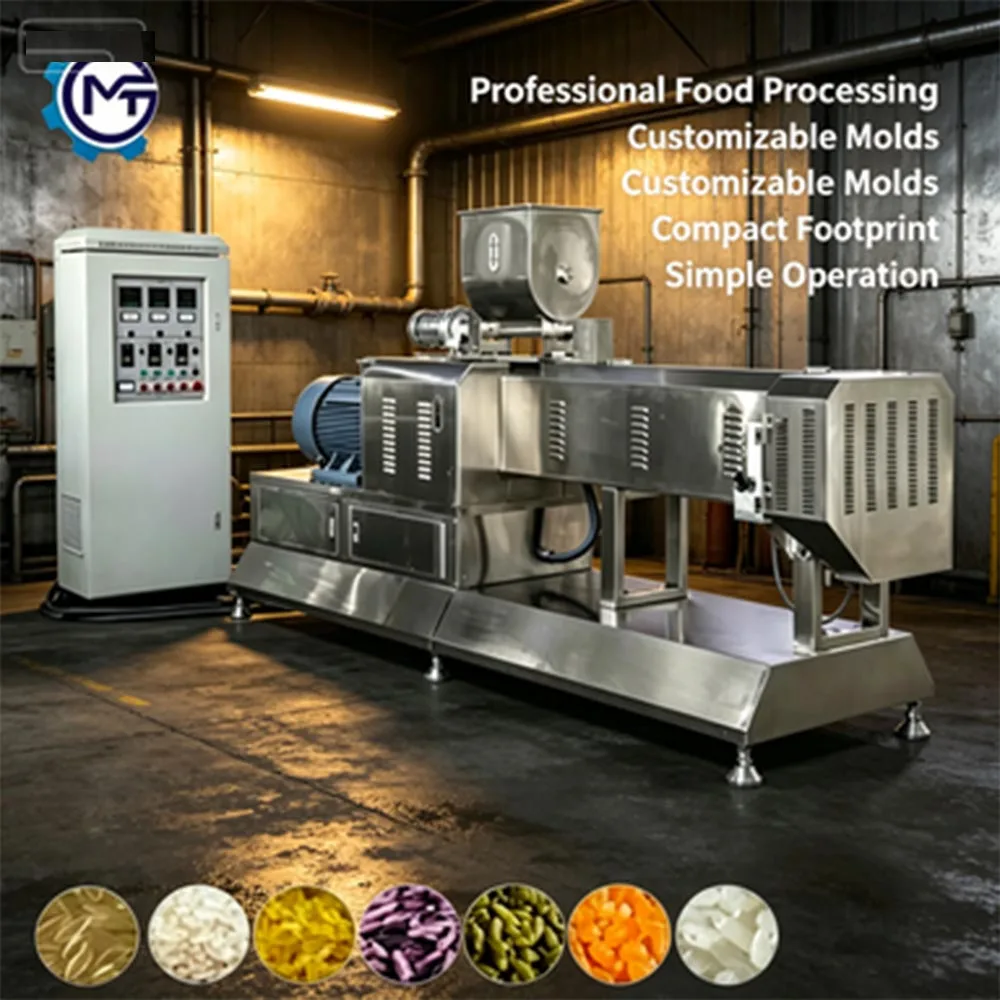
Throughput-Matched Line Design — Every station from raw material batching to screening is engineered to keep pace with the twin-screw extruder, preventing bottlenecks across the entire aquatic feed production line manufacturer workflow.
Technical Specifications
| Parameter | Value |
|---|---|
| Product Type | Aquatic Feed Extrusion Production Line |
| Extruder Configuration | Twin Screw |
| Control System | PLC (intelligent automatic control) |
| Material Contact Parts | Food-grade 304 stainless steel |
| Line Stations | Mixer, extruder, dryer, seasoning/coating machine, vibrating sieve, conveyor equipment |
| Automation Level | Full continuous automatic production (mixing → extrusion → drying → seasoning → screening → discharging) |
| Pellet Adjustment | Size, hardness, and buoyancy adjustable |
| Output Capacity | Large stable processing capacity for medium-to-large scale industrial production (basis to be confirmed) |
| Operating Interface | Humanized operation interface |
| Assembly State | Complete matched production configuration |
| Certification | CE, ISO |
Application Suitability
| Application | Material or Output |
|---|---|
| Commercial aquaculture feed manufacturing | Fish meal, soybean meal, corn powder, compound additives |
| Floating fish feed pellet production | Formulations requiring specific buoyancy and expansion |
| Sinking aquatic feed production | High-density formulations for bottom-feeding species |
| Medium-to-large scale industrial feed milling | Continuous mass production of koi, goldfish, and tropical fish diets |
Why the Upstream and Downstream Equipment Must Match the Extruder
A floating fish feed extruder is only as productive as the slowest station connected to it.
When an aquatic feed production line manufacturer quotes a nominal output, that figure often reflects only the extruder barrel capacity. I have walked onto factory floors where high-moisture pellets piled up directly after the die plate because the dryer could not evaporate water fast enough. The extruder kept running, but the wet product spoiled on the conveyor, forcing the operator to halt the entire system. True line capacity depends on matching the mixing batch size, the drying residence time, and the cooling airflow to the actual extrusion rate [NEED_CITE: continuous line throughput balancing principles].
Sizing the Extruder Within the Full Equipment Catalogue
Selecting the right twin-screw extruder requires looking past the motor rating and barrel diameter. The screw configuration and die geometry must align with the specific starch and protein ratios in the buyer’s formulation. For aquatic feed, the shear profile inside the barrel determines whether the pellet expands enough to float or remains dense enough to sink. An aquatic feed production line manufacturer must specify these internals based on the target species and raw material behavior, rather than relying on a generic build.
Matching Dryer and Coating Capacity to Prevent Bottlenecks
The drying stage dictates the final moisture content and shelf stability of the pellet. If the extruder pushes product faster than the dryer can reduce moisture to the required threshold, the downstream seasoning drum receives a product that rejects coating powder. This mismatch creates waste and forces manual intervention. Balancing these stations ensures the complete line runs continuously without material backing up at any transfer point [NEED_CITE: thermal drying efficiency in feed processing].
Decoding the Screw, Barrel, and Control Parameters
The twin-screw design provides the necessary mechanical shear to gelatinize starches and denature proteins uniformly, which is critical for achieving consistent pellet buoyancy. Food-grade 304 stainless steel on all contact parts prevents corrosion from the salts and minerals common in aquatic formulations. The PLC control system manages barrel temperature zones and screw speed simultaneously, maintaining batch-to-batch consistency that manual overrides cannot achieve. The humanized operating interface allows line supervisors to monitor every station from a single screen, reducing the chance of a miscommunication between the mixing and extrusion zones.
The Hidden Cost of Generic Line Configurations
Purchasing individual machines from different vendors often results in incompatible transfer heights and mismatched conveyor speeds. When the seasoning drum rotates too slowly for the extruder output, pellets accumulate and break apart before coating is applied. This degradation lowers the market value of the final product and increases the volume of fines that must be recycled or discarded [NEED_CITE: material degradation in unmatched feed lines].
Why Source the Full Line from One Equipment Catalogue
Sourcing the mixer, extruder, dryer, and screening equipment from a single supplier guarantees that the physical footprint and utility requirements are calculated together. The electrical schematics confirm voltage and frequency for every motor before production begins. Factory trial runs on the buyer’s actual raw material verify that the screw configuration produces the correct pellet density. This approach eliminates the finger-pointing that occurs when separate vendors blame each other for a line that fails to meet its rated capacity.
Documentation & Verification
- Line layout and capacity calculation confirming throughput matching between all stations
- Screw and die configuration record specified to your raw material formulation
- Trial run report on your actual aquatic feed ingredients before dispatch
- Electrical schematic with voltage, frequency, and PLC language confirmed
- CE declaration of conformity and ISO certificate for the complete line
- Operation and maintenance manual covering every station in the sequence
Installation, Commissioning & Support
- Foundation requirements mapped to the total footprint and weight of the matched line
- Dedicated electrical circuits sized for the combined load of the extruder and dryer
- Assembly sequence planned to fit the twin-screw extruder through standard facility doors
- First-run parameter setting for barrel temperature and screw speed on your formulation
- Operator training on the PLC interface covering all stations from mixing to screening
- Wear parts list specifying replacement intervals for screws, dies, and dryer belts
- Maintenance schedule aligned with the continuous production cycle of the full line
What We Need to Configure Your Line
To specify the correct equipment catalogue for your facility, provide the target pellet diameter, the desired buoyancy profile, and the primary protein sources in your formulation. Include your local voltage and frequency standards, along with the available floor space and ceiling height. Let us know if you require a trial run on your specific raw material blend before the line is cleared for shipment.
Frequently Asked Questions
Q: How is the line output capacity verified before shipment?
A: We conduct a trial run in our testing workshop using your specific raw material formulation and target pellet size. The resulting trial run report documents the actual throughput, moisture content, and pellet density achieved, ensuring the aquatic feed production line manufacturer rating reflects your real production conditions rather than a generic benchmark.
Q: Can the same line produce both floating and sinking pellets?
A: Yes, the twin-screw extruder can produce both types by adjusting the screw configuration, die geometry, and barrel temperature profile. The PLC control system stores these parameters, allowing operators to switch between floating and sinking formulations while maintaining consistent pellet quality across the entire production run.
Q: How do you ensure the dryer matches the extruder output?
A: We calculate the required thermal capacity and residence time based on the extruder’s actual output rate and the target moisture reduction. The dryer is then sized to handle the maximum volume of wet pellets, preventing bottlenecks and ensuring the seasoning drum receives product at the correct moisture level for optimal coating adhesion.
Q: What happens if our local voltage differs from standard configurations?
A: We confirm your facility’s exact voltage, frequency, and phase requirements before production begins. The electrical schematic and PLC interface are configured to match your local standards, and all motors and heating elements are specified accordingly to prevent commissioning delays or equipment damage upon arrival.
Q: Is a trial run on our raw material performed before shipment?
A: Yes, we run your actual ingredients through the complete line in our factory testing workshop. This verifies that the screw configuration, die design, and drying parameters produce pellets that meet your buoyancy, size, and density specifications, and the full results are documented in the trial run report.