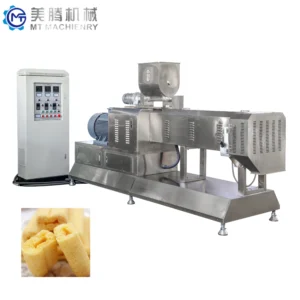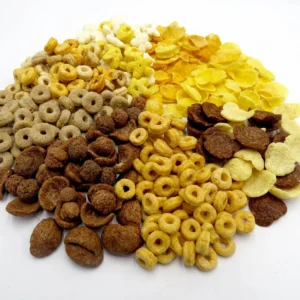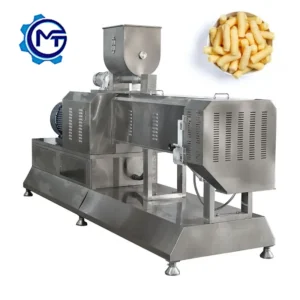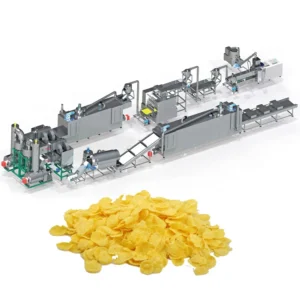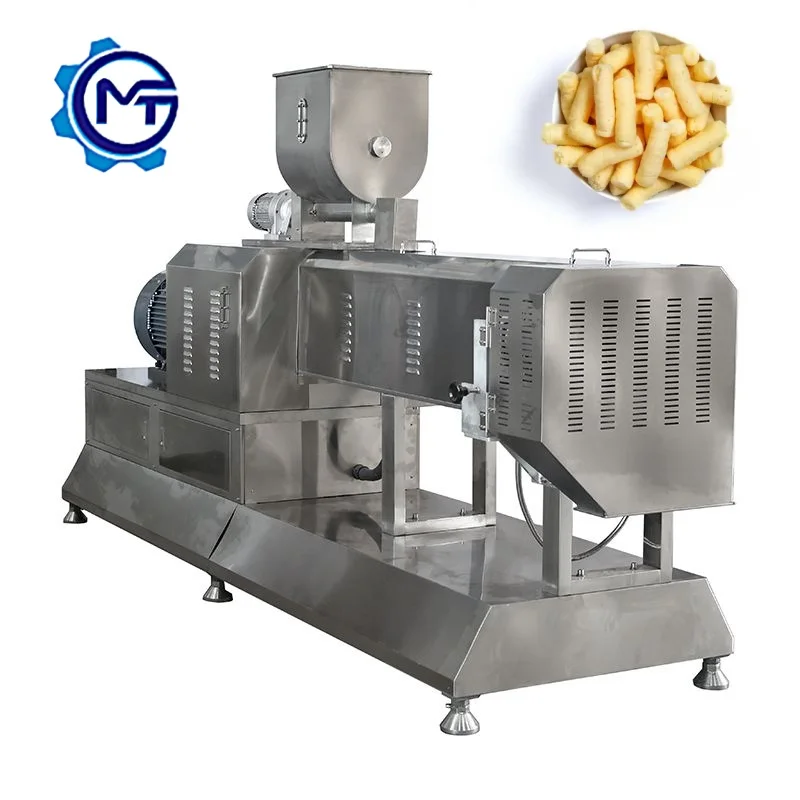
Matched Throughput Across All Stations — every unit from batching to packing is sized against the extruder’s real output on your grain blend, preventing downstream bottlenecks common when stations are sourced separately.
Technical Specifications
| Parameter | Value |
|---|---|
| Product Type | Twin Screw Puffed Snack Food Extrusion Line |
| Model Options | MT65 / MT70 / MT85 / MT100 |
| Screw Type | Twin-screw |
| Installed Power | 130 kW (MT65) / 180 kW (MT70) / 220 kW (MT85) / 240 kW (MT100) |
| Real Consumption | 95 kW (MT65) / 120 kW (MT70) / 130 kW (MT85) / 160 kW (MT100) |
| Output Capacity | 120–150 kg/h (MT65) / 200–300 kg/h (MT70) / 300–500 kg/h (MT85) / 600–800 kg/h (MT100) (basis not stated in source — confirm raw material type, moisture content and die configuration) |
| Control System | Frequency speed controlling system, high automation |
| Line Stations | Materials preparation, batching, extruding, drying, coating/flavoring, cooling, packing, stacking |
| Die Configuration | Interchangeable dies for cheese ball, tube, stick, ring, fruit loop, star, wheel, flower, heart shapes |
| Core Filling Option | Available with added core filling machine and cutting machine |
| Drying Heat Source | Electric / Steam / Gas (configured to local utility conditions) |
| Flavoring System | Double drum with sugar melting, spraying nozzle, elevator; handles oil, melt sugar, liquid, flour flavor |
| Packing Machine | Automatic weighing, sealing, marking, coding; vibration feeding with electronic pad weighing |
| Lubrication | Automatic lubricating and cooling system |
Application Suitability
| Application | Material or Output |
|---|---|
| Cheese balls and shaped puffed snacks | Corn flour, rice flour, wheat flour |
| Tubes, sticks, and rings | Oat flour, barley flour, multi-grain blends |
| Fruit loops and breakfast cereal shapes | Corn and rice flour blends at controlled moisture |
| Core-filled puffed snacks | Grain flour base with cream, chocolate, or fruit paste filling |
| Stars, wheels, flowers, heart shapes | Interchangeable die plates on the same extruder platform |
Why Nominal Capacity Numbers Mislead Snack Producers
A twin screw puffed snack food extrusion line complete equipment set quoted at a single output figure rarely tells you what happens when your flour blend, moisture level, and die geometry differ from the factory test conditions.
Capacity only means something when the raw material, moisture percentage, and die opening are stated alongside it.
I learned this the hard way early in my career. A Middle Eastern buyer ordered a line rated for corn flour throughput, but his facility ran chickpea flour with different gelatinisation behaviour. The screw configuration we shipped was wrong for that material, and actual output dropped sharply. Since then, every line I configure starts with a raw material sample and a test run before the machines leave the workshop. When buyers compare quotes, the ones who ask "on what material and at what moisture?" separate realistic proposals from optimistic ones [NEED_CITE: raw material variability effects on extrusion throughput].
Station Matching Prevents the Dryer Bottleneck
An extruder running at full output means little if the dryer cannot remove moisture fast enough to keep pace. On this twin screw puffed snack food extrusion line complete equipment setup, dryer capacity is calculated against the extruder’s real throughput on your specific grain blend, and the heat source — electric, steam, or gas — is selected based on your facility’s utility costs and local availability. A mismatched dryer forces the extruder to idle, cutting effective output without reducing power draw.
The Flavoring Drum Must Match Line Speed
Uneven coating is one of the most common complaints from snack producers running lines assembled from separate vendors. The double drum flavoring system here includes a sugar melting unit, spraying nozzles, and an elevator that handles oil, liquid sugar, and dry flour seasoning. Drum rotation speed and spray rate are synchronised to the upstream extruder and dryer output, so each piece receives a consistent coating weight before reaching the cooling conveyor [NEED_CITE: flavoring uniformity standards in puffed snack production].
Reading the Power and Capacity Data
The gap between installed power and real consumption across the MT65 through MT100 range reflects how extruder motors are sized for peak torque during startup and high-moisture batches, while steady-state running draws less. Twin-screw extrusion relies on shear and friction inside the barrel to gelatinise starch; different grain blends shift that balance. A corn-dominant recipe typically runs closer to the lower consumption figure, while oat or barley blends with higher fibre content demand more torque. The interchangeable die system controls expansion ratio — a smaller die opening increases back pressure, raises barrel temperature, and produces a denser puff, while a larger opening yields a lighter, more expanded snack. Frequency speed control lets operators adjust screw RPM in real time to hold consistent product density across batches, which matters when you switch between cheese ball and fruit loop dies on the same shift.
What Mismatched Voltage Costs at Commissioning
Arriving at a facility to find the local supply is 440V at 60Hz when the motors were wound for 380V at 50Hz means weeks of delay while replacement motors ship. Frequency speed controllers can compensate within a range, but motors and heating elements have fixed ratings. Confirming electrical specifications before production begins avoids rewiring the control cabinet on-site and re-testing every safety circuit under time pressure [NEED_CITE: industrial voltage and frequency standards by export market].
Why Sourcing the Full Line from One Supplier Matters
The twin screw puffed snack food extrusion line complete equipment package comes from a single manufacturing source, meaning throughput calculations between the extruder, dryer, flavoring drums, and packing station are done together rather than assumed. Screw and die configurations are specified to your raw material sample after test runs in the workshop, not copied from a generic build. The control system language, voltage, and frequency are confirmed against your facility’s supply before the electrical cabinets are wired. Factory test records on your actual grain blend ship with the line, so your operators start commissioning with known-good parameters instead of guessing. Wear parts lists identify screw segments, die plates, and dryer belts by part number, so replacements are available when the first changeover is due [NEED_CITE: extruder screw wear intervals in grain-based snack production].
Documentation & Verification
- Line layout drawing showing throughput matching across every station
- Screw and die configuration record specific to your grain blend
- Electrical schematic with voltage and frequency confirmed for your market
- Factory test run report on your raw material before dispatch
- Machine specification sheet with installed and real consumption figures
- CE declaration of conformity for the complete line
Installation, Commissioning & Support
- Floor plan and utility connection points matched to your factory dimensions
- Dedicated circuit sizing based on the MT model’s real consumption rating
- Modular station delivery allowing phased installation in constrained spaces
- First-run parameter setting on your grain blend during on-site commissioning
- Operator training covering die changeover and screw speed adjustment
- Wear parts list with part numbers for screw segments and die plates
What to Include in Your Inquiry
Send a sample of your primary flour blend along with target snack shapes and daily output requirements so the extruder model and die set can be matched before quotation. Include your facility’s voltage, phase, and frequency specifications, plus the control language your operators need. If you plan to run core-filled variants, note the filling type so the optional core filling and cutting modules can be sized to the base line.
Frequently Asked Questions
Q: How is output capacity verified for each MT model, and what conditions are assumed?
A: Output figures are established during factory test runs using specific raw material blends at defined moisture levels with a given die configuration. Because capacity shifts with grain type and recipe, we run your actual material sample in the testing workshop before shipment and document the verified throughput in the test report that accompanies your line.
Q: Which dryer heat source suits my facility best?
A: The choice between electric, steam, and gas heating depends on your local utility costs and existing boiler infrastructure. Facilities with on-site steam generation often find steam-heated dryers economical, while gas-fired units suit locations with low natural gas tariffs. We calculate dryer capacity against your extruder’s verified output to ensure moisture removal keeps pace.
Q: How do I select the right die configuration for my target shape and density?
A: Die plate geometry controls expansion ratio and final product density. Smaller openings increase back pressure and produce denser puffs, while larger openings yield lighter, more expanded snacks. We match die selection to your target shape — cheese ball, tube, ring, fruit loop, or other profiles — and confirm the result during the pre-shipment test run on your grain blend.
Q: What separates installed power from real consumption across the MT65 to MT100 range?
A: Installed power reflects peak motor capacity needed for startup torque and high-moisture or high-fibre batches. Real consumption represents steady-state running draw under typical conditions. The difference varies with your recipe: corn-dominant blends run closer to the lower figure, while oat or barley blends demand more sustained torque from the screw drive.
Q: Can the packing machine handle varying bulk density across different snack shapes?
A: The packing station uses vibration feeding with electronic pad weighing and automatic sealing, marking, and coding. Because puffed snacks vary in bulk density depending on shape and expansion ratio, the weighing system is calibrated to your specific product during commissioning so bag weights stay within tolerance across shape changeovers.