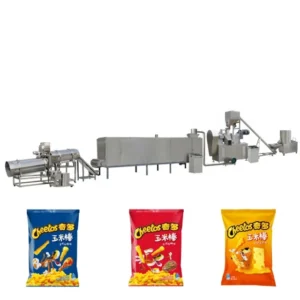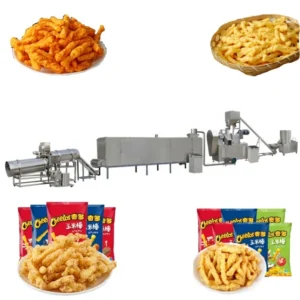
Complete Station Catalogue — Every unit from the extruder barrel to the packing conveyor is specified as one matched line, so Kurkure and Cheetos throughput stays balanced from mixing to final bagging.
Technical Specifications
| Parameter | Value |
|---|---|
| Product Type | Kurkure / Cheetos / Nik Naks Extruder Making Machine |
| Output Capacity | Up to 250 kg/h (basis not stated in source — confirm raw material, moisture, and snack format) |
| Construction Material | 304 Stainless Steel and Carbon Steel |
| Voltage Options | 220V / 380V (frequency to be confirmed per market: 50Hz or 60Hz) |
| Adjustable Rack | Yes, accommodates different cooking pot sizes |
| Suitable Snack Formats | Kurkure, Cheetos, Nik Naks, and similar corn-based extruded snacks |
| Control System | Available with PLC, MCC, or manual control (confirm before order) |
| Screw Type | Single-screw or twin-screw configuration (confirm based on product) |
| Line Stations | Mixing, extruding, frying or baking, flavouring, cooling, packing (scope to confirm) |
| Certification | CE and ISO availability to be confirmed per model |
Application Suitability
| Application | Material or Output |
|---|---|
| Kurkure and Nik Naks production | Corn grits or corn flour, fried and seasoned |
| Cheetos-style puffed snacks | Corn meal with cheese or spice coating |
| Baked extruded corn snacks | Corn-based dough, oven-finished for lower oil content |
| Pellet-to-fry snack formats | Intermediate pellet extrusion, secondary frying and flavouring |
What "250 kg/h" Leaves Out About Kurkure Output
Capacity numbers only matter when tied to your exact corn variety and moisture content.
I once watched a snack line stall because the quoted capacity assumed one corn grits grade, while the buyer was sourcing a local variety with different starch behaviour. The extruder barrel filled unevenly, the die pressure dropped, and the finished Kurkure pieces came out dense instead of crunchy. A kurkure cheetos making machine manufacturer should always ask what corn you run before confirming throughput [NEED_CITE: starch gelatinisation variation across corn cultivars]. When the raw material shifts even slightly in moisture or particle size, the screw speed, barrel temperature profile, and die opening all need to be re-evaluated. Without a trial run on your actual corn supply, any capacity figure is just a starting point.
Every Station in the Corn Snack Catalogue
A kurkure cheetos making machine is not one unit but a sequence of stations where each machine must pass product to the next at the same rate. The mixing station meters corn grits and water into a consistent feed. The extruder shapes the dough through a die that defines the curl or ball geometry. From there, product moves to either a continuous fryer or a baking oven, then through a cooling conveyor and into a rotating flavouring drum. If any station is undersized, the entire line backs up.
Matching Frying, Coating, and Packing to Extruder Output
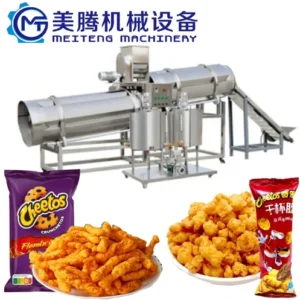
The frying stage determines final texture and oil absorption, and its belt speed must align with extruder discharge rate. A flavouring drum that is too small will leave seasoning unevenly distributed, while one that is too large lets product cool before coating adheres. The packing station needs a weigh-scale feeder calibrated to the finished piece weight, which changes with frying time and moisture loss. When sourcing a kurkure cheetos making machine manufacturer, buyers should verify that every downstream station is calculated against the extruder’s real discharge, not a catalogue maximum [NEED_CITE: throughput matching in snack food line design].
Reading the Specification Sheet for Corn Snack Extrusion
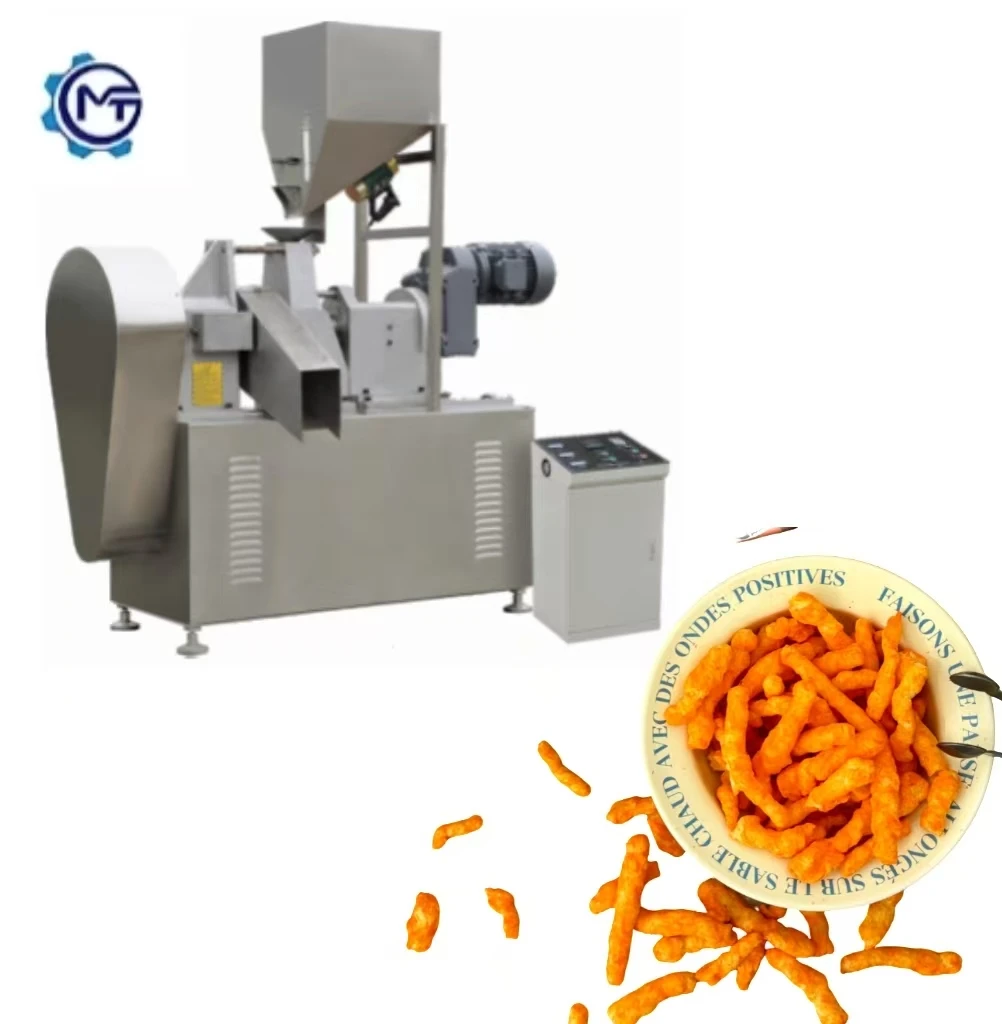
The screw configuration determines how much shear and residence time the corn dough receives inside the barrel. A single-screw design is simpler and suits straightforward Kurkure curls, while a twin-screw setup offers better mixing for recipes with added protein or fibre. The barrel length-to-diameter ratio controls how long the material stays under heat and pressure; a longer barrel gives more gelatinisation but requires more motor power. Die aperture and shape directly set the snack cross-section — a small round die produces Nik Naks-style curls, while a slit die can make flat ribbon snacks. Voltage selection must match the factory supply before the motor and heating elements are built, since rewinding a motor after arrival is costly and delays commissioning.
When Stations Are Mismatched Across Vendors
A common failure on snack lines is buying the extruder from one supplier and the fryer from another, only to discover the fryer belt cannot handle the extruder’s discharge rate. Product piles up, oil temperature drops, and the snacks absorb excess oil or emerge undercooked. Similarly, a flavouring drum sized for a smaller output will bottleneck the line, forcing operators to slow the extruder and lose the capacity they paid for. These mismatches are hard to spot on paper because each vendor quotes their own machine in isolation [NEED_CITE: integration risks in multi-vendor food processing lines].
Why Source the Full Range from One Supplier
Every station in this catalogue — mixer, extruder, fryer or oven, cooler, flavouring drum, and packing conveyor — is selected so that discharge rates align from start to finish. The screw and die configuration is chosen after reviewing your corn source and target snack shape, not copied from a generic template. Before dispatch, the extruder runs on your actual raw material in the testing workshop, producing samples you can evaluate for crunch, density, and seasoning adhesion. Electrical schematics, voltage, and control language are confirmed in writing so the panel matches your factory supply and operator preference. Documentation covers the full line rather than individual machines, making customs clearance and installation scheduling simpler.
Documentation & Verification
- Line layout showing throughput matching across every station from mixer to packer
- Screw and die configuration record matched to your corn variety and target snack shape
- Voltage, frequency, and control language confirmation sheet signed before production
- Trial run report on your raw material with product density and texture measurements
- CE declaration of conformity and ISO certificate for the complete line scope
- Wear parts list with screw, die, and fryer belt specifications for first reorder
Installation, Commissioning & Support
- Foundation plan accounts for extruder weight and fryer or oven footprint on your floor
- Dedicated electrical circuit sized for the confirmed voltage and total connected load
- Extruder and fryer shipped in modular sections for container loading and on-site assembly
- First-run parameter setting includes screw speed, barrel zones, and fryer temperature on your corn
- Operator training covers die changeover, flavouring drum adjustment, and daily cleaning routines
- Spare screw elements, dies, and fryer belt links stocked for immediate dispatch after commissioning
What to Include in Your Inquiry
Tell us the corn variety or flour you source locally, the snack shape you want to produce, and the daily output target for your shift plan. Share your factory voltage, frequency, and preferred control language so the electrical panel is built correctly from the start. If you already have upstream mixers or downstream packing machines, list their throughput so we can match the new stations to your existing equipment.
Frequently Asked Questions
Q: What stations are included in a complete kurkure or cheetos production line?
A: A full line covers mixing, extrusion, frying or baking, cooling, flavouring, and packing. Each station is sized so product flows without bottlenecks. The exact scope depends on whether you choose fried or baked format and the seasoning application method.
Q: How do I confirm the correct voltage and frequency for my factory?
A: Provide your local supply specifications — voltage, phase, and frequency — before production begins. The motor, heating elements, and control panel are then built to match. Changing these after the machine is built causes delays and extra cost.
Q: How is output capacity verified before shipment?
A: We run a trial using your actual corn material in the testing workshop. The report records screw speed, barrel temperatures, product density, and expansion. This confirms the line produces the texture and shape you expect before it leaves the factory.
Q: What construction materials are used in food-contact zones?
A: Food-contact surfaces use 304 stainless steel to meet hygiene requirements and resist corrosion from frying oil and seasoning acids. Structural frames and non-contact parts may use carbon steel for strength and cost balance.
Q: Can I source the extruder and all supporting stations from one catalogue?
A: Yes. Sourcing every station from a kurkure cheetos making machine manufacturer ensures throughput is calculated across the full line. This avoids the common problem where one vendor’s machine cannot keep pace with another’s, creating bottlenecks on your factory floor.