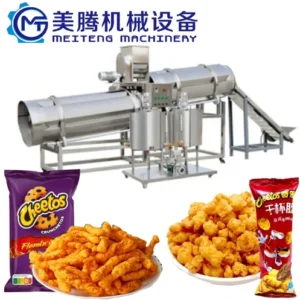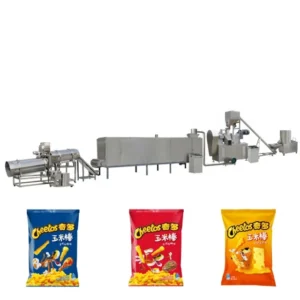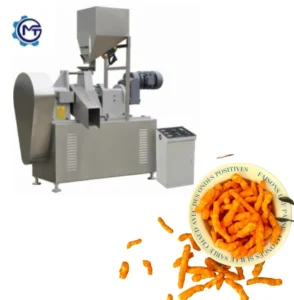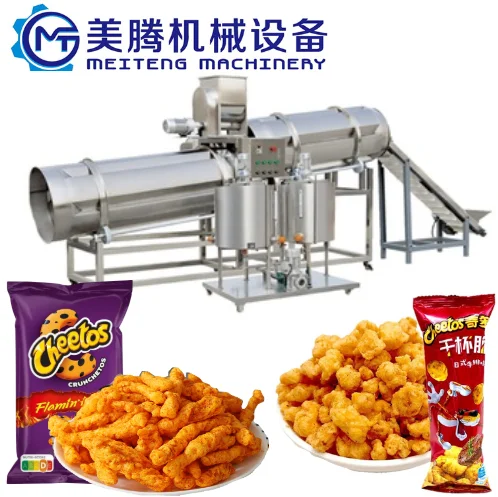
Full Line Throughput Matching — every station from mixing through flavouring is specified so that the extruder, dryer and coating drum each handle the same output rather than creating a bottleneck at any single point.
Technical Specifications
| Parameter | Value |
|---|---|
| Product Type | Kurkure / Cheetos Type Snack Extrusion Processing Line |
| Output Capacity | 120–350 kg/h (basis not stated in source — confirm raw material type, moisture content and product format) |
| Heat Source | Electric |
| Contact Material | 304 Stainless Steel |
| Screw Type | Twin-screw (based on Meiteng standard range) |
| Control System | PLC (based on Meiteng standard offering) |
| Line Stations | Mixing, Extrusion, Drying, Flavouring |
| Net Weight | 80 kg (source value — verify against full line configuration) |
| Certification | CE (per manufacturer profile) |
Application Suitability
| Application | Material or Output |
|---|---|
| Kurkure-style extruded snack production | Corn grits, corn flour, rice-based blends |
| Cheetos-style puffed snack production | Corn meal, grain-based composite flours |
| Co-extruded or twisted snack formats | Multi-grain blends with adjustable moisture |
| Seasoned and coated snack finishing | Oil-based or dry-powder flavouring media |
Why Capacity Claims on a Kurkure Cheetos Making Machine for Sale Often Mislead Buyers
A quoted throughput number means nothing unless it is tied to the exact raw material, moisture level and product density you intend to run.
When snack producers receive a line proposal that simply states a capacity range, they often discover during commissioning that the extruder runs at the advertised rate while the dryer cannot keep up, or the flavouring drum overflows. The mismatch is not a defect — it is the consequence of sourcing each station from a different supplier who sized their equipment independently. I have walked through facilities where the extruder sat idle for minutes at a time waiting for the downstream dryer to clear its belt [NEED_CITE: common throughput mismatch causes in multi-vendor snack lines]. A properly configured Kurkure Cheetos making machine for sale should present a balanced line where every station is calculated against the same throughput target.
How Station-by-Station Sizing Prevents Line Bottlenecks
A complete Kurkure Cheetos making machine for sale is only as productive as its slowest station. The mixing system must replenish the extruder hopper at a rate that matches the screw feed capacity, while the dryer belt length and temperature zones must be calculated against the moisture reduction required by the specific product format. If the flavouring drum is undersized, the line must be throttled back, negating the extruder’s rated output. Meiteng specifies every station in the line as a matched set, so throughput figures hold across the entire production sequence rather than at a single point.
The Role of Screw Configuration in Texture and Density Control
The twin-screw setup used in this line is not a one-size-fits-all arrangement. Screw element sequencing — the order and pitch of conveying, kneading and reverse elements — directly determines the shear history the dough experiences inside the barrel. For Kurkure-style snacks, a higher-shear configuration produces the characteristic irregular surface and dense crunch, while Cheetos-style puffs require a gentler profile that preserves expansion at the die. The die geometry further controls the cross-section and expansion ratio of the extrudate. Getting these two variables wrong results in a product that looks correct but fails on texture or bulk density when it reaches the packaging station [NEED_CITE: twin-screw element sequencing principles for extruded snack textures].
Reading the Spec Sheet Beyond the Headline Numbers
The 304 stainless steel contact surfaces are specified for hygiene compliance in food processing environments, where corrosion from salt-laden seasoning blends can degrade lesser alloys over time. Electric heating delivers zone-by-zone barrel temperature control without the combustion infrastructure that gas-fired systems demand, simplifying utility planning in facilities that lack a gas main. The PLC control system allows recipe storage for different product formats, so operators switching between Kurkure and Cheetos profiles can recall screw speed, barrel temperature and feeder rate presets rather than adjusting each parameter manually. A line running 120–350 kg/h requires that the electrical supply be confirmed for voltage and frequency before the control cabinet is wired, since a 50 Hz motor on a 60 Hz supply will run at the wrong speed and overheat.
What Happens When the Wrong Die and Dryer Combination Ships
If the die orifice diameter and land length are not matched to the target product, the extrudate may expand too much or too little, producing snacks that are either hollow and fragile or dense and undercooked. Pairing this with a dryer that has insufficient belt area means the product enters the flavouring station with residual moisture, causing seasoning to clump rather than coat evenly. Snack producers who accept a generic build without requesting a trial run report on their specific raw material often face weeks of adjustment after installation [NEED_CITE: impact of die land length on extrudate expansion in snack processing]. The cost is not just wasted material — it is the production time lost while the line is tuned from scratch.
Why Procuring the Complete Line From One Source Matters
Every station on this line — mixing, extrusion, drying, flavouring — is specified and supplied under a single engineering responsibility, eliminating the finger-pointing that occurs when separate vendors each blame the other’s equipment for throughput shortfalls. The screw configuration and die design are selected against the buyer’s raw material data sheet and target product specification, not copied from a generic template. An in-house testing workshop allows trial runs on the buyer’s actual ingredients before the line ships, so product development is not deferred to post-installation. Electrical schematics and voltage confirmation are completed during the order stage, preventing commissioning delays caused by incompatible power supplies. Food-grade 304 stainless steel is used throughout all product-contact surfaces, meeting hygiene expectations in export markets governed by CE machinery directives.
Documentation & Verification
- Line layout drawing with throughput calculation for each station matched to your target output
- Screw and die configuration record specific to your raw material and Kurkure or Cheetos format
- Factory trial run report produced on your supplied raw material before dispatch
- Electrical schematic confirming voltage, frequency and control language for your destination market
- CE declaration of conformity covering the complete processing line
- Operation and maintenance manual with wear parts list and replacement intervals
Installation, Commissioning & Support
- Foundation plan specifying floor loading for the twin-screw extruder and dryer assembly
- Dedicated electrical circuit sized for the full line’s electric heating and motor load
- Modular shipping configuration allowing container loading and on-site reassembly
- PLC parameter commissioning with recipe setup for Kurkure and Cheetos product profiles
- Operator training covering screw speed, barrel temperature and feeder rate adjustment
- Wear parts kit including spare screw elements and die plates for the first replacement cycle
What to Include in Your Inquiry
To receive a line configuration that matches your actual production conditions, provide the specific grain or flour blend you intend to process, along with typical moisture content and any pre-treatment steps. Specify your target daily output and the shift pattern you plan to run, so that the line capacity can be sized with realistic operating hours. Confirm the local voltage, frequency and preferred control language at your facility, as these determine the motor rating and PLC interface before the cabinet is built. If you have existing upstream batching or downstream packing equipment, share the connection point specifications so the line can be integrated without interface gaps.
Frequently Asked Questions
Q: How is the 120–350 kg/h output capacity verified, and on what raw material basis?
A: The stated range is provided by the manufacturer but the raw material type, moisture content and product format that define actual throughput are not specified in the source data. Before ordering, request a capacity confirmation based on your exact flour blend and target product density, verified through a trial run in the testing workshop using your supplied ingredients.
Q: What screw and die configuration is matched to Kurkure versus Cheetos format?
A: Kurkure-style snacks typically require a higher-shear screw sequence and a restrictive die to produce their dense, irregular crunch, while Cheetos-style puffs need a gentler profile and larger die orifice for maximum expansion. The exact element arrangement and die geometry are selected after reviewing your raw material specification and target texture during the proposal stage.
Q: Are the dryer and flavouring stations capacity-matched to the extruder output?
A: On this line, every downstream station is specified against the same throughput target as the extruder, so the dryer belt area and flavouring drum volume are calculated to handle the extruder’s full output without creating a bottleneck. The line layout drawing provided with your quotation documents the matched capacity at each station.
Q: Is a trial run on my raw material performed before shipment?
A: Meiteng operates an in-house machine testing workshop where trial runs can be conducted using your supplied raw material before the line ships. This allows the screw configuration, barrel temperature profile and die selection to be validated, and a trial run report is issued so product development begins from a known baseline rather than from scratch after installation.
Q: What voltage, frequency and control language options are available for my market?
A: The PLC control system and all line motors are configured to the voltage, frequency and phase standard of your destination market. Control interface language is confirmed during the order stage. These parameters must be finalised before the electrical cabinet is assembled to avoid rewiring or component replacement during commissioning.