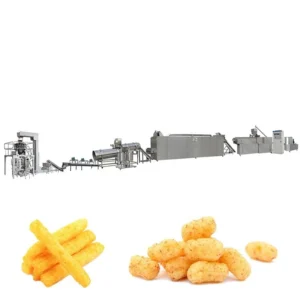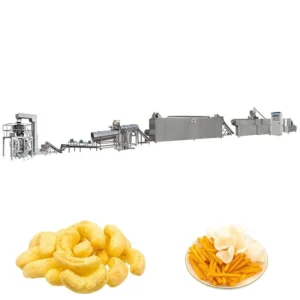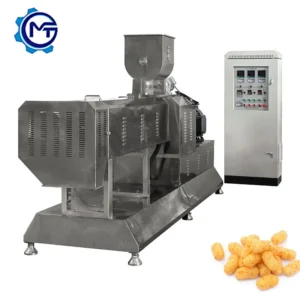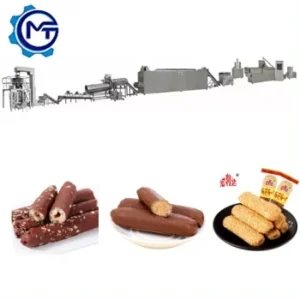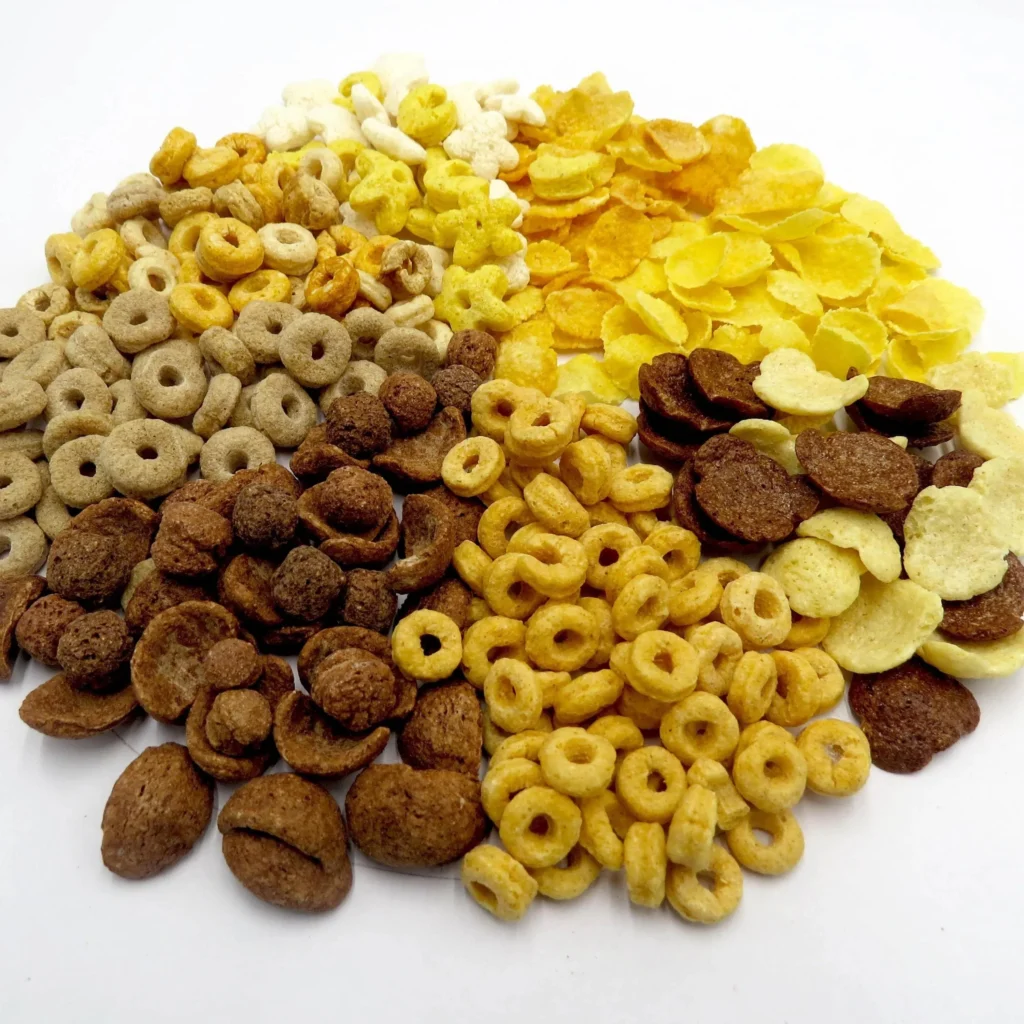
Integrated Line Balance — every station from batching to packaging is engineered and matched under one supplier, preventing throughput mismatches across the corn flakes breakfast cereals processing line.
Technical Specifications
| Parameter | Value |
|---|---|
| Product Type | Corn Flakes Breakfast Cereals Processing Production Line |
| Screw Type | Twin-screw extruder |
| Control System | PLC with configurable interface language |
| Line Stations | Mixing, extrusion, flaking, drying, roasting, coating, packaging |
| Coating System | Chocolate and sugar coating device |
| Construction Material | Food-grade stainless steel on all food-contact parts |
| Drying & Roasting Method | Hot air circulation system |
| Parameter Adjustability | Flaking thickness, drying temperature, extrusion speed, coating volume |
| Assembly State | Fully automatic integrated continuous line |
| Output Capacity | Basis to be confirmed — depends on raw material formulation, flake thickness and target bulk density |
| Voltage & Frequency | Basis to be confirmed — depends on target market electrical standard |
| Overall Dimensions | Basis to be confirmed — depends on final line layout and station count |
| Net Weight | Basis to be confirmed — depends on final configuration |
| Standards | CE, ISO |
Application Suitability
| Application | Material or Output |
|---|---|
| Crispy corn flakes production | Maize grits, corn flour blends with varying moisture content |
| Maize chocos and cocoa cereals | Corn-based dough with cocoa powder incorporation |
| Sugar-coated breakfast cereals | Extruded cereal pellets before flaking and roasting |
| Chocolate-coated cereal formats | Roasted flakes passing through chocolate enrobing station |
| Fortified breakfast cereal lines | Grain blends with added vitamin and mineral premix |
What "Nominal Capacity" Leaves Out About Your Cereal Line
The real throughput of a corn flakes breakfast cereals processing line equipment for sale depends entirely on your grain formulation, not the nameplate.
I once worked with a buyer who specified a line based on a published capacity figure. His recipe included a high proportion of oat bran with coarse fiber content. The extruder barrel couldn’t maintain consistent pressure, the flaking rolls jammed repeatedly, and the actual output fell far below what the brochure promised. The problem wasn’t the machine — it was the assumption that capacity is a fixed number regardless of what you feed into it. Every grain blend behaves differently under shear and heat, and the screw configuration must match your specific formulation to deliver consistent gelatinization. [NEED_CITE: starch gelatinization behavior varies with fiber content and moisture in twin-screw extrusion]
Station-by-Station Throughput Matching
A corn flakes breakfast cereals processing line equipment for sale is only as productive as its slowest station. When the extruder pushes material faster than the dryer can handle, moisture stays trapped inside the flakes, causing sogginess and uneven roasting downstream. This integrated line addresses that by sizing the hot air circulation dryer and roasting oven to match the extruder’s actual output on your specific grain blend, so material flows continuously without queuing at any point.
Coating Consistency Across Product Formats
The chocolate and sugar coating device applies finishing layers with adjustable volume control. For maize chocos, the coating must penetrate the surface texture evenly without pooling in crevices. For sugar-dusted corn flakes, the drum rotation speed and syrup spray rate are tuned so each flake receives a uniform shell. Switching between coating types does not require hardware changes — the PLC stores separate recipes for each product format.
Reading the Specs That Actually Matter
The twin-screw configuration gives this line an advantage in handling variable grain recipes compared to single-screw alternatives. Twin screws create a self-wiping action that prevents starch buildup inside the barrel, which is critical when switching between high-sugar and plain corn formulations. The adjustable flaking thickness directly controls the final crispness — thinner flakes roast faster and shatter more easily in milk, while thicker flakes hold their structure longer. The PLC control system stores temperature profiles for each barrel zone, allowing operators to recall exact settings for repeat batches without manual recalibration. [NEED_CITE: twin-screw self-wiping action reduces cross-contamination between product runs]
The Cost of Skipping Pre-Shipment Validation
Buyers who skip trial runs on their own raw material often discover formulation problems only after the line is bolted to their factory floor. A grain blend that works in a laboratory mixer can behave completely differently at production scale inside an extrusion barrel. When the screw configuration hasn’t been matched to the actual fiber, fat and moisture content of your recipe, the result is inconsistent expansion, variable flake density and frequent line stoppages. Retrofitting a new screw profile after installation costs both downtime and replacement parts that could have been addressed before the machine left the workshop. [NEED_CITE: pre-shipment trial runs reduce on-site commissioning time for food extrusion lines]
Why Source the Complete Range Here
Every station on this corn flakes breakfast cereals processing line equipment for sale — from the initial mixing system through extrusion, flaking, drying, roasting, coating and packaging — comes from a single supplier, meaning throughput calculations are done across the entire chain rather than station by station. The screw and die configuration is specified to your grain formulation, not copied from a generic build. An in-house testing workshop allows trial runs on your actual raw material before shipment, so product development begins before installation rather than after. Food-grade stainless steel is used throughout all food-contact surfaces, meeting hygiene expectations in regulated markets. CE and ISO certification documentation supports customs clearance and compliance audits in most import jurisdictions.
Documentation & Verification
- Line layout drawing with throughput calculation matched to your grain blend and target flake specification
- Screw and die configuration record specifying barrel zones and die geometry for your recipe
- Trial run report from the in-house testing workshop using your raw material sample
- Electrical schematic with confirmed voltage, frequency and control language for your factory
- Operation and maintenance manual covering every station from mixer to packaging unit
- Wear parts list identifying screws, dies and flaking roll surfaces with replacement intervals
Installation, Commissioning & Support
- Foundation plan specifying load points for the extruder, flaking press and hot air dryer units
- Electrical supply requirements confirmed for your local voltage and frequency before shipment
- Modular station delivery allowing phased installation starting with mixing and extrusion sections
- First-run parameter setting by commissioning engineers covering all PLC recipe configurations
- Operator training on recipe switching between corn flakes and chocolate-coated chocos formats
- Spare screw and die sets identified for first replacement cycle based on your grain abrasiveness
Before You Request a Quote
To size a corn flakes breakfast cereals processing line equipment for sale correctly, share your grain formulation including the proportion of corn, oat or other cereals, the target flake thickness and bulk density, and your daily production target. Confirm the electrical standard at your facility and the preferred language for the PLC interface. If you have existing upstream milling or downstream packing equipment, provide connection point details so the line layout accounts for integration.
Frequently Asked Questions
Q: How is output capacity verified against my specific grain formulation and target flake thickness?
A: Capacity depends on raw material behavior under extrusion, not a fixed number. A trial run is conducted in the testing workshop using your actual grain sample, measuring throughput at your specified flake thickness and bulk density. The result is documented in a trial run report before the quotation is finalized.
Q: What voltage, frequency and control language options are confirmed before commissioning?
A: The electrical schematic is prepared after confirming your factory’s supply standard. The PLC interface language is set to your operator preference before shipment, so the control panel is readable from day one without translation delays during commissioning.
Q: How are flaking, drying and coating stations matched to prevent line bottlenecks?
A: Each station is sized based on the extruder’s verified output on your grain blend. The dryer and roaster capacity is calculated to handle peak material flow, and the coating drum volume is matched so no station queues or starves during continuous operation.
Q: Can the screw and die configuration be customized to my raw material and target cereal texture?
A: Yes. The screw profile and die geometry are specified to your grain formulation, fiber content and desired flake density. This configuration is recorded and can be replicated for future replacement parts orders.
Q: What wear parts and spare screws or dies are available for long-term maintenance?
A: A wear parts list is provided identifying screws, dies and flaking roll contact surfaces. Replacement intervals depend on your grain abrasiveness, and spare sets can be included with the initial shipment or ordered separately.