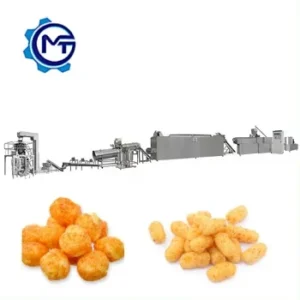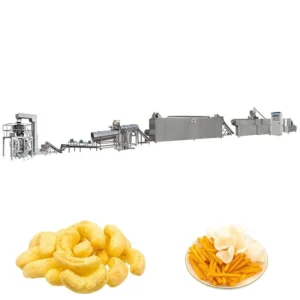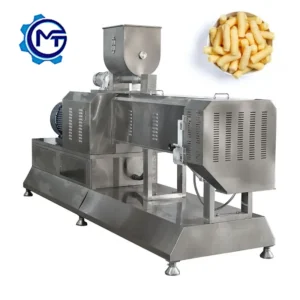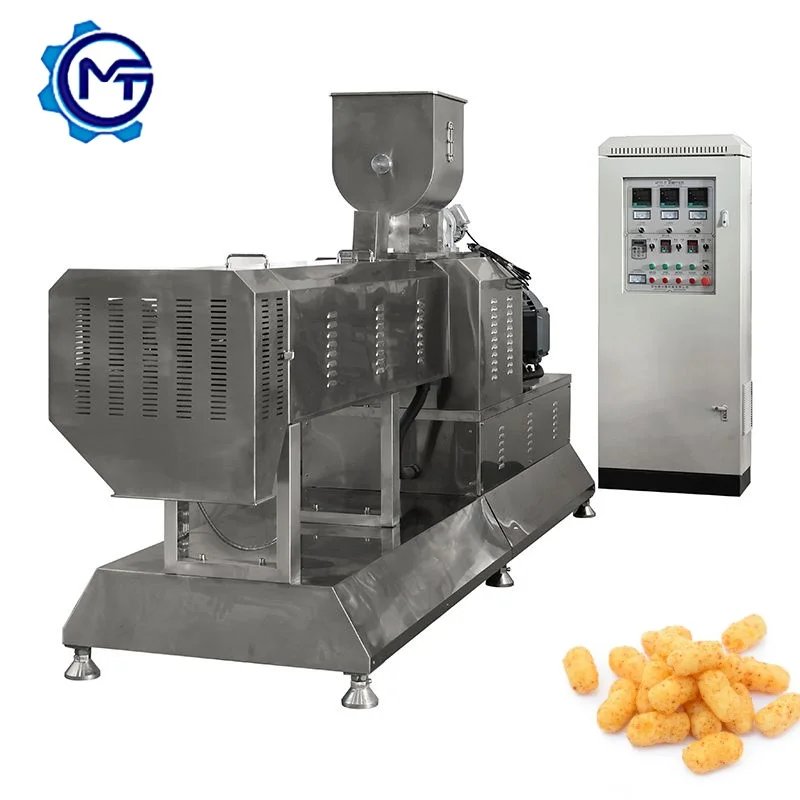
Integrated Line Matching — Every station from batching to packing is capacity-balanced under one equipment catalogue, preventing the throughput bottlenecks that occur when extruders, dryers, and flavoring drums are sourced from separate vendors.
Technical Specifications
| Parameter | Value |
|---|---|
| Model | MT65 / MT70 / MT85 / MT100 |
| Product Type | Twin Screw Extruder for Puffed Snack Food Production Line |
| Screw Type | Twin-screw |
| Installed Power | MT65 — 130 kW; MT70 — 180 kW; MT85 — 220 kW; MT100 — 240 kW |
| Real Power Consumption | MT65 — 95 kW; MT70 — 120 kW; MT85 — 130 kW; MT100 — 160 kW |
| Output Capacity | MT65 — 120–150 kg/h; MT70 — 200–300 kg/h; MT85 — 300–500 kg/h; MT100 — 600–800 kg/h (basis not stated in source) |
| Control System | Frequency speed controlling system (PLC / MCC not specified in source) |
| Raw Materials | Corn, rice, wheat, oat, barley flour |
| Die Configuration | Interchangeable dies for cheese ball, tube, stick, ring, fruit loop, star, wheel, flower, heart shape |
| Heating Source Options (Dryer) | Electric, steam, or gas (customizable to local conditions) |
| Flavoring System | Double drum flavoring line with sugar melting, oil spraying, liquid/flour flavor coating |
| Lubrication & Cooling | Automatic lubricating and cooling system |
| Core Filling Option | Available with additional core filling machine and cutting machine |
| Warranty | 1 year |
| Delivery Time | Approximately 20 working days for extrusion line; approximately 35 working days with packing and stacking machines |
Application Suitability
| Application | Material or Output |
|---|---|
| Cheese puffs and corn puffs | Corn flour, rice flour formulations |
| Extruded rings, sticks, and tubes | Wheat, oat, and barley flour blends |
| Fruit loops and star-shaped snacks | Multi-grain flour mixtures with moisture conditioning |
| Core-filled snacks (with optional module) | Corn or rice base with cream or chocolate center filling |
| Breakfast cereal pieces | Fortified grain blends requiring controlled expansion |
Why Rated Capacity Means Nothing Without the Full Line Context
A puffed snack food extrusion machine full equipment range only performs as well as its slowest station.
I spent years watching buyers focus exclusively on extruder output, only to discover during commissioning that their dryer could not keep pace or their flavoring drum created a backlog that cooled the product before seasoning could adhere properly. One Scandinavian producer flew me in to troubleshoot a cheese puff line where product was literally piling up at the extruder discharge because the downstream cooling conveyor had been spec’d for a lower throughput tier. The extruder was doing its job perfectly — the problem lived everywhere else. When evaluating a puffed snack food extrusion machine full equipment range, the capacity number on the nameplate tells you what the extruder can push, not what the finished goods warehouse will receive [NEED_CITE: throughput balancing across extrusion line stations].
Matching Every Station to the Extruder Output Tier
Selecting an MT65 at 120–150 kg/h means the dryer, flavoring drums, and cooling conveyor must each be rated to handle that volume continuously, not at peak bursts. The double drum flavoring system on this line is configured so that sugar melting, oil spraying, and dry flour seasoning each occur in sequence without product accumulation between stages. If you are surveying a puffed snack food extrusion machine full equipment range for the first time, pay as much attention to the flavoring drum diameter and residence time as you do to the extruder screw speed.
How Die Interchangeability Shapes Line Flexibility
The interchangeable die system on the MT series allows a single extruder platform to produce cheese balls, tubes, sticks, rings, fruit loops, stars, wheels, flowers, and heart shapes. For a producer planning to rotate seasonal SKUs or test new geometries with retail buyers, this means one extruder footprint covers formats that would otherwise require dedicated machines. Die changes are a mechanical swap at the barrel end — no downstream reconfiguration needed beyond adjusting dryer belt speed and flavoring drum rotation to match the new product density and surface area [NEED_CITE: die geometry impact on drying and coating parameters].
Reading the Power and Capacity Relationship Across Models
The gap between installed power and real consumption reveals how much thermal and mechanical energy the extruder actually draws during steady-state operation. On the MT85, installed power is 220 kW but real consumption sits at 130 kW — that difference accounts for heater cycling, motor load variation during startup versus continuous run, and the fact that barrel zone heaters do not all fire simultaneously. For facility electrical planning, always use the real consumption figure for continuous load calculation and the installed figure for peak demand and breaker sizing. The twin-screw configuration generates shear and friction heat internally, reducing reliance on external barrel heating compared to single-screw designs, which is why the real-to-installed ratio on these models stays well below unity. Moisture content in the raw material batch directly affects how much mechanical energy converts to expansion versus how much must come from barrel heaters.
The Hidden Cost of Spec’ing Stations in Isolation
When a dryer is undersized relative to extruder output, product exits with residual moisture that causes sogginess within hours of packing — a defect that often gets blamed on the extruder when the real failure lives two stations downstream. I have walked into facilities where the flavoring drum was a holdover from a previous, lower-capacity line, creating a bottleneck that forced the extruder to run at partial feed rate just to avoid product pile-up. These mismatches are invisible in individual equipment quotations and only surface during live production, when the cost of reconfiguration has already multiplied [NEED_CITE: extrusion line bottleneck diagnosis from station mismatch].
What This Catalogue Approach Covers
Every station — batching, extruding, drying, coating, cooling, packing, stacking — is listed with capacity alignment to the selected MT model, so throughput matching happens at the proposal stage rather than during commissioning. The dryer heating source is configurable to electric, steam, or gas depending on facility infrastructure, eliminating the situation where a steam-only dryer arrives at a site with no boiler capacity. Screw and die configuration is documented against the buyer’s specific raw material formulation and target snack geometry before production begins. An in-house testing workshop runs the buyer’s actual raw material through the extruder before shipment, generating a trial report that establishes baseline parameters rather than leaving all process development for on-site commissioning. The optional core filling module and cutting machine integrate into the same line architecture, allowing producers to expand into filled snack formats without replacing the extruder platform.
Documentation & Verification
- Line layout drawing showing station placement and throughput calculation for selected MT model
- Screw and die configuration record matched to your raw material and target snack shape
- Electrical schematic confirming voltage, frequency, and control wiring before production
- Trial run report from testing workshop on your supplied raw material before shipment
- CE declaration of conformity and ISO certificate for customs and regulatory clearance
- Wear parts list with screw elements, die inserts, and nozzle specifications for reorder planning
Installation, Commissioning & Support
- Foundation and floor space planning based on selected model footprint and dryer length
- Dedicated electrical circuit sized to the installed power rating of your specific MT model
- Frequency speed control system commissioning with parameter setting for each barrel zone
- Operator training covering die changeover, screw cleaning, and automatic lubrication system checks
- Initial production run supervision with real-time adjustment of dryer temperature and flavoring drum speed
- Spare screw elements and interchangeable dies available for reorder against the documented configuration
Before You Request a Quotation
To configure a balanced line, share your target snack format, raw material formulation with moisture content, and daily production volume so the correct MT model and downstream stations can be matched. Confirm your facility voltage, frequency, and preferred control language, and specify whether your site supports electric, steam, or gas heating for the dryer. If you are adding this line alongside existing equipment, note any upstream or downstream machines that must interface with the new installation.
Frequently Asked Questions
Q: How is output capacity verified before the line ships?
A: Capacity figures listed for each MT model are based on specific raw material and moisture conditions that must be confirmed for your formulation. Before shipment, a trial run is conducted in the testing workshop using your supplied raw material, generating a report that documents actual throughput, expansion behavior, and product density under controlled conditions. This baseline becomes the reference for on-site commissioning.
Q: What electrical specifications need to be confirmed before production starts?
A: Voltage, frequency, and control language must match your facility before the electrical panel is built. An electrical schematic is provided for your review and approval during the specification confirmation stage. This prevents commissioning delays caused by incompatible power supply or control interface language, which are among the most common on-site issues during international equipment installation.
Q: How are dryer and flavoring drum capacities matched to the extruder?
A: Each downstream station is selected based on the output tier of your chosen MT model so that no single station creates a bottleneck. The dryer residence time and flavoring drum volume are calculated to handle continuous output from the extruder at its verified capacity. This matching is documented in the line layout and capacity calculation provided with your proposal.
Q: Can the core filling module be added to an existing line later?
A: The core filling machine and cutting machine are available as an optional addition that integrates with the same extruder platform. If you plan to add this capability in the future, specifying the extruder with core filling compatibility during initial procurement avoids mechanical and control modifications later. The additional station requires its own space allocation in the line layout.
Q: What spare wear parts should be ordered with the initial line?
A: Screw elements, die inserts, and flavoring nozzles are the primary wear items. A documented wear parts list is provided with each line, identifying the specific part numbers for your configuration. Reorder lead times should be confirmed at the time of initial purchase so that replacement inventory is available before the first scheduled changeout.