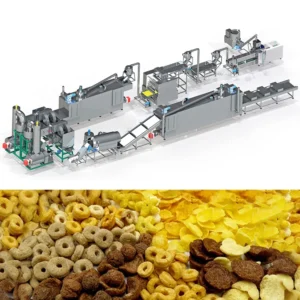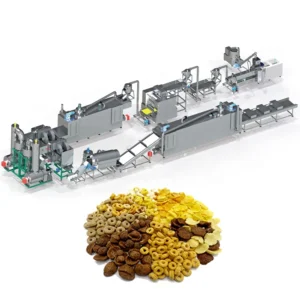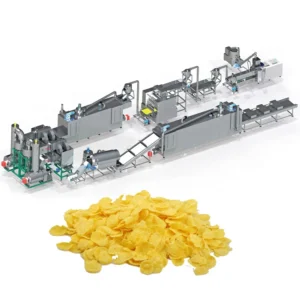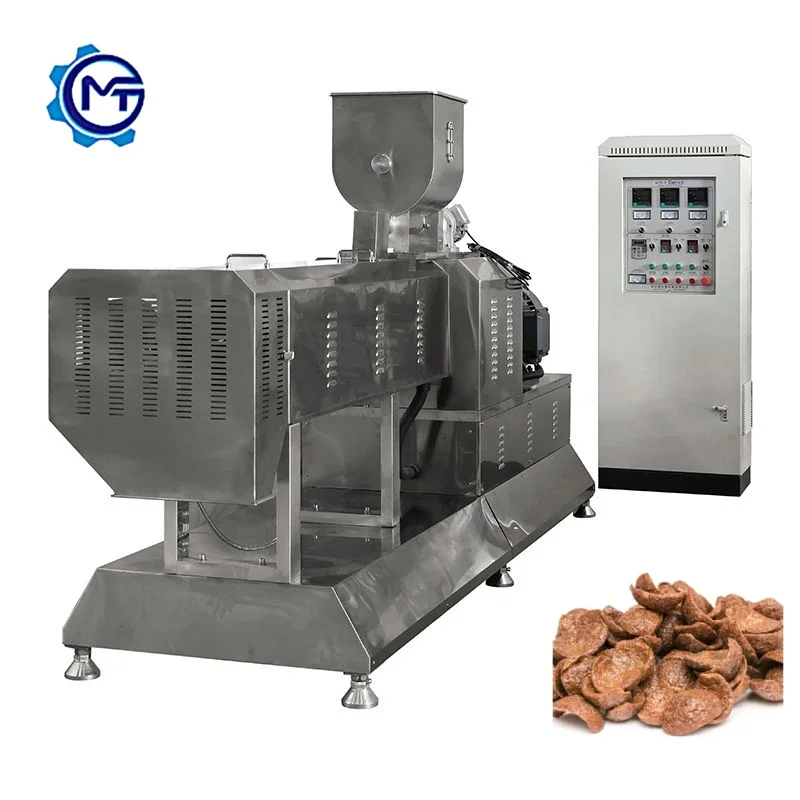
Coordinated Line Stations — every mixer, extruder, flaker, dryer, roaster, coater, cooler and packer in this corn flakes breakfast cereal machine full equipment range is specified as a matched system, preventing throughput mismatches that commonly occur when stations are sourced separately.
Technical Specifications
| Parameter | Value |
|---|---|
| Product Type | Corn Flakes Breakfast Cereal Production Line |
| Model | MT70 / MT85 / MT75 |
| Screw Type | Twin Screw |
| Installed Power | MT70 — 160 kW; MT85 — 190 kW; MT75 — 210 kW |
| Power Consumption | MT70 — 120 kW; MT85 — 140 kW; MT75 — 150 kW |
| Output Capacity | MT70 — 150–200 kg/h (basis not stated in source); MT85 — 300–400 kg/h (basis not stated in source); MT75 — 300–500 kg/h (basis not stated in source) |
| Overall Dimensions (L×W×H) | MT70 — 41 × 1.5 × 2.2 m; MT85 — 43 × 1.5 × 3.2 m; MT75 — 45 × 1.5 × 3.5 m |
| Control System | PLC for flaking machinery; MCC/PLC for line control |
| Flaking Machinery | Hydraulic double-roller system, double motors for separate roller driving, infrared sensor temperature control |
| Dryer Heating Source | Multi-fuel configurable: steam / gas / electric |
| Hot Air Roasting Oven | Vibrating pan, high-temperature spraying tubes, reconciliation burner, dual circulating fans, cyclone dust removal |
| Coating System | Double tumble sugar melting, elevator, coating drum, spraying nozzle |
| Extruder Feature | Automatic lubrication, cooling function, wear-resistant screw technology |
| Raw Materials | Corn, rice, wheat, oat, barley powder |
| Final Product Formats | Natural corn flakes, sugar-coated corn flakes, shaped cereals (ball, tube, stick, ring, fruit loop, star, wheel, flower, heart) |
| Standards | CE, ISO |
Application Suitability
| Application | Material or Output |
|---|---|
| Natural corn flakes production | Corn grits and corn flour |
| Sugar-coated breakfast cereal | Corn, rice, wheat base with sugar spray coating |
| Multi-grain flaked cereal | Blends of oat, barley, wheat, rice and corn powder |
| Shaped puffed cereal snacks | Corn and rice flour in ball, ring, star, wheel and heart formats |
What a Nominal Capacity Rating Actually Means for Your Cereal Line
A rated throughput only matters when the dryer, roaster and coater downstream can handle the same volume without becoming the bottleneck.
Buyers regularly see corn flakes lines quoted on extruder capacity alone. The flaker runs at full speed, but the dryer cannot reduce moisture fast enough, or the roasting oven cannot deliver uniform surface bubbling across the pan. The line stalls at a fraction of the number on the quotation. I once configured a breakfast cereal line for a Southeast Asian plant where the extruder was correctly sized, but the sugar coating drum was specified one tier below the roaster output. The plant spent weeks adjusting batch timing to compensate, and the coating consistency never matched what the market expected [NEED_CITE: typical line throughput mismatch patterns in breakfast cereal production]. Matching every station in this corn flakes breakfast cereal machine full equipment range to the same calculated throughput removes that problem before the line is built.
Extruder Range and Continuous Operation
The MT70, MT85 and MT75 models span three capacity tiers, each built around a twin-screw configuration with automatic lubrication and barrel cooling. Continuous operation matters in cereal production because start-up and shutdown cycles affect starch gelatinisation consistency. The screw elements use a wear-resistant manufacturing process, reducing the frequency of element replacement during long production runs of abrasive corn and multi-grain formulations. Selecting the correct model depends on the raw material blend, target moisture at the die, and the downstream drying capacity available in your facility.
Flaking and Roasting Precision
The hydraulic flaking station uses double motors driving each roller independently, with infrared sensors monitoring roller surface temperature in real time. Consistent flake thickness depends on maintaining even pressure and temperature across the roller width — a deviation causes uneven roasting downstream. The hot air roasting oven pairs a reconciliation burner with dual circulating fans and a cyclone dust removal device, controlling both the degree of surface blistering and the final moisture content. These two stations together determine whether the finished corn flake delivers the crunch and bowl-life that retail and food-service buyers expect [NEED_CITE: corn flake texture standards for retail breakfast cereal].
Specifying the Line by Raw Material and Product Format
Twin-screw extrusion behaviour changes significantly when raw materials shift from pure corn grits to blends containing oat or barley flour. The starch gelatinisation temperature, dough viscosity inside the barrel, and expansion ratio at the die all respond differently to each grain. Screw configuration and die geometry must therefore be selected against the buyer’s actual formulation, not a generic recipe. A line running primarily wheat-heavy multi-grain cereal will need a different screw profile and barrel temperature map than one producing standard corn flakes, even if the target output capacity is identical. This is where the corn flakes breakfast cereal machine full equipment range earns its value — each model’s screw and die set can be matched to the specific flour blend before the extruder leaves the factory.
The Cost of Sourcing Stations from Separate Vendors
When the extruder, dryer, roaster and coater arrive from different manufacturers, integration gaps appear during commissioning. Control systems do not communicate, conveyor heights require on-site modification, and the utility connections — steam pressure, electrical load, exhaust ducting — fall outside one supplier’s responsibility. I have seen cereal plants delay first production by weeks while contractors resolved interface issues between mismatched stations. The dryer ran fine alone, but could not receive the correct feed rate from the upstream flaker. Those delays compound: raw material expires, packaging inventory sits idle, and launch commitments to retail buyers slip [NEED_CITE: commissioning delays from multi-vendor food line integration].
Why Procure the Full Equipment Range Here
Every station from the batching mixer through the packing conveyor is designed within one engineering team, so throughput calculations are validated across the entire line before quotation. The flaking machinery, roasting oven and coating drum are each sized relative to the extruder model you select, not pulled from an independent catalogue. Screw and die configuration records are generated against your raw material sample, not copied from a standard build. The in-house testing workshop runs your actual flour blend through the extruder before shipment, so expansion rate and flake density are confirmed in advance. Electrical schematics and voltage specifications are locked in during the order stage, matching your plant’s local power supply rather than a default factory setting.
Documentation & Verification
- Line layout showing throughput matching between extruder, flaker, dryer and roaster
- Screw and die configuration record specific to your corn or multi-grain blend
- Electrical schematic with voltage and frequency confirmed for your market
- Factory test record from trial runs on your supplied raw material
- Operation and maintenance manual covering each station in the line
- Wear parts list with replacement intervals for screws, dies and roller surfaces
Installation, Commissioning & Support
- Foundation plan accounting for the full 41–45 m line length and hydraulic flaker load
- Power distribution schedule for 120–150 kW consumption across extruder, dryer and roaster circuits
- Station-by-station assembly sequence from individual transport modules to connected line
- First-run parameter setting for barrel temperature profile and flaker roller gap on your material
- Operator training covering PLC interface navigation and MCC panel sequence control
- Scheduled wear part replacement guidance for twin-screw elements and hydraulic roller surfaces
Preparing Your Equipment Enquiry
To specify the right corn flakes breakfast cereal machine full equipment range for your plant, share the raw material formulation you intend to run, including any non-standard additions such as cocoa powder, protein concentrates or fibre blends. Confirm the local voltage, frequency and available heating fuel — steam, gas or electric — so the dryer and roaster are configured before production begins. Provide your workshop dimensions and ceiling height so the line layout accounts for the roaster’s vertical clearance and the cooler’s footprint. If you have existing upstream or downstream equipment that the new line must connect to, include those interface specifications with your enquiry.
Frequently Asked Questions
Q: How is each station’s capacity matched across the full line to prevent bottlenecks?
A: Throughput is calculated from the extruder model forward, and every downstream station — flaker, dryer, roaster, coater, cooler — is sized to handle the same continuous output. The line layout document shows the rated capacity at each station so you can verify balance before the order is confirmed.
Q: What supporting equipment is included beyond the extruder?
A: The range covers mixing and batching systems, conveying equipment, the hydraulic flaking machine, multi-fuel dryer, hot air roasting oven with cyclone dust removal, sugar coating drum with double tumble melting, cooling conveyor and packing station. Each is selected to match the extruder’s output tier.
Q: Can the dryer and roaster heating source be configured for local utility availability?
A: Yes. The dryer supports steam, gas or electric heating based on what your plant has available. The roasting oven uses a reconciliation burner system. Confirming the heating source during the specification stage avoids costly retrofitting after installation.
Q: How do I choose between MT70, MT85 and MT75 extruder models?
A: Selection depends on your target output, raw material formulation and available floor space. The MT70 suits smaller production runs, while the MT85 and MT75 handle higher volumes. A trial run on your actual material in the testing workshop confirms which model delivers the correct expansion and flake density.
Q: What documentation accompanies each machine station?
A: Each station ships with a machine specification sheet, electrical schematic, operation and maintenance manual, and wear parts list. The line as a whole includes a layout drawing, capacity calculation, screw and die configuration record, and factory test report from the pre-shipment trial run.