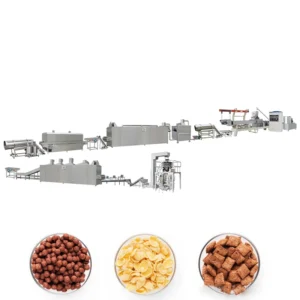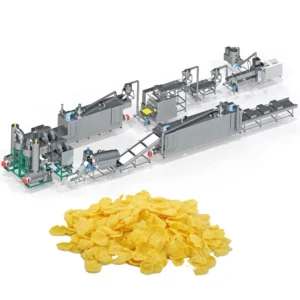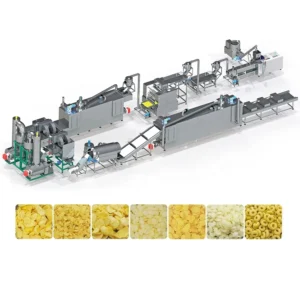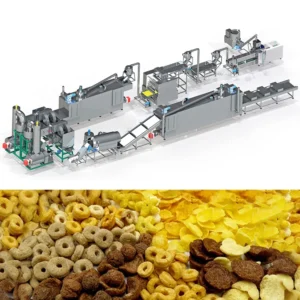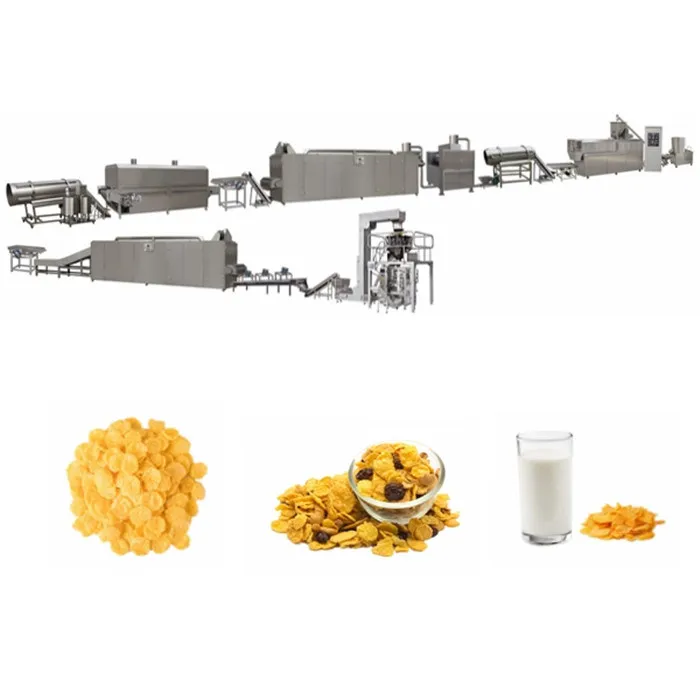
Throughput-Matched Stations — Every extruder, flaker, dryer, and roasting oven in this line is sized to hold its rated output together, preventing the silent capacity loss that occurs when one station chokes the rest of the sequence.
Technical Specifications
| Parameter | Value |
|---|---|
| Product Type | Corn Flakes Extrusion Production Line |
| Models Available | MT70, MT85, MT75 |
| Screw Type | Twin-screw |
| Installed Power (MT70) | 160 kW |
| Power Consumption (MT70) | 120 kW |
| Output Capacity (MT70) | 150–200 kg/hr (basis not stated in source — confirm raw material, moisture content, flake thickness) |
| Overall Dimensions (MT70) | 41 × 1.5 × 2.2 m |
| Installed Power (MT85) | 190 kW |
| Power Consumption (MT85) | 140 kW |
| Output Capacity (MT85) | 300–400 kg/hr (basis not stated in source — confirm raw material, moisture content, flake thickness) |
| Overall Dimensions (MT85) | 43 × 1.5 × 3.2 m |
| Installed Power (MT75) | 210 kW |
| Power Consumption (MT75) | 150 kW |
| Output Capacity (MT75) | 300–500 kg/hr (basis not stated in source — confirm raw material, moisture content, flake thickness) |
| Overall Dimensions (MT75) | 45 × 1.5 × 3.5 m |
| Flaking Machine Control | PLC control system |
| Flaking Machine Roller Drive | Double motors, separate roller driving; hydraulic system for double rollers |
| Flaking Machine Temperature Control | Infrared sensor for even temperature pipe control |
| Dryer Heating Source | Gas, Electric |
| Roasting Oven Type | Hot air roasting oven with conciliation burner, dual circulating fans, cyclone dust removal |
| Coating System | Double tumble for sugar melting, elevator, coating drum, spraying nozzle |
| Basic Raw Materials | Powder of corn, rice, wheat, oat, barley |
| Control System | PLC and MCC |
| Assembly State | Complete production line |
| Formula Support | Basic recipe and machine setting parameters supplied |
Application Suitability
| Application | Material or Output |
|---|---|
| Natural corn flakes production | Corn powder processed through mixing, extruding, flaking, drying, hot air roasting, cooling, and packing |
| Sugar-coated corn flakes production | Corn powder with sugar spraying and coating stage added after hot air roasting |
| Shaped breakfast cereal production | Corn, rice, wheat, oat, or barley powder formed into ball, tube, stick, ring, fruit loop, star, wheel, flower, or heart shapes by adjusting extruder mould |
| Mixed-grain cereal lines | Multi-grain flour blends requiring specific screw configuration and barrel temperature profiles |
What "Rated Capacity" Means When Stations Are Mismatched
A line only produces as much as its weakest station allows, and the extruder is rarely the real bottleneck.
When buyers evaluate a corn flakes extrusion machine full equipment range, the first number they check is the extruder output. But if the dryer downstream cannot handle that volume, or the roasting oven cannot hold temperature at that throughput, the line settles at a lower real capacity than the spec sheet suggests. I have seen installations where the flaking stage could not keep pace because the roller pressure was set for a different grain density, and the entire upstream extruder had to be throttled back. That silent capacity loss is expensive [NEED_CITE: industrial line throughput matching principles for food extrusion].
The three models in this range — MT70, MT85, and MT75 — each pair with dryers, roasters, and coating drums sized to the same throughput band, so the corn flakes extrusion machine full equipment range is specified as a system rather than a collection of standalone units.
Every Station Catalogued for Your Line Build
This catalogue covers the complete sequence from batching through packing. The mixing system feeds the twin-screw extruder, which cooks and shapes the dough under controlled barrel temperature zones. The extrudate passes to the flaking machine, where hydraulic double rollers with independent motor drives compress the cooked material into consistent flakes. From there, the flakes move through drying, hot air roasting, and — for sugar-coated variants — a dedicated coating loop with double tumble melting and spray nozzles. Each station is documented with its own installed power, footprint, and utility requirement so that floor planning and electrical layout can proceed from a single equipment list.
How the Stations Connect and Where Gaps Appear
Between extrusion and flaking, the material must arrive at the roller nip at the correct temperature and moisture window. If the conveyor between these two stations is too long or unenclosed, the flakes lose surface moisture and the roller cannot flatten them evenly, producing cracked or uneven pieces. The hot air roasting oven downstream uses a vibrating pan with high-temperature spraying tubes and two separate circulating fans to maintain an even roast across the full pan width. Cyclone dust removal keeps fines from recirculating into the product stream. When any station in this chain is substituted with a unit from a different vendor, the interface points — belt speed, discharge height, material temperature at handoff — must be confirmed before the line is assembled [NEED_CITE: food processing line integration standards for extruded cereals].
Reading the Extruder Specs Against Your Raw Material
The twin-screw configuration is chosen for corn flakes because the dough is high-moisture and requires thorough mixing and cooking inside the barrel before it reaches the die. The MT70, at 160 kW installed power, suits smaller runs or product-development batches where flexibility matters more than volume. The MT85 and MT75 scale up installed power and barrel volume to handle sustained production shifts. Screw configuration and die design are matched to the specific grain flour — corn behaves differently from oat or barley at the same moisture level, and the compression ratio inside the barrel must be adjusted accordingly. The PLC and MCC control system stores temperature profiles per recipe, so operators can switch between natural flakes and sugar-coated variants without recalibrating from scratch.
When the Wrong Flaker or Dryer Cracks Your Output
A flaking machine set with incorrect roller gap or insufficient hydraulic pressure will produce flakes that are too thick to roast evenly, leaving a hard center that consumers reject. If the dryer heating source is undersized for the line speed, flakes enter the roasting oven with residual moisture that prevents proper browning and crispness. I have watched a production run where the sugar coating drum was too small for the upstream volume — the flakes tumbled too long waiting for the spray cycle, breaking into fragments that could not be sold as whole-flake cereal. These downstream failures trace back to a line that was assembled station by station without confirming that each unit could hold the same throughput under real operating conditions [NEED_CITE: flake thickness and roasting uniformity in breakfast cereal production].
Why Source the Full Range From One Equipment Supplier
Matching throughput across stations is the baseline. Beyond that, having one supplier responsible for every machine in the line means a single point of accountability when something does not perform. The screw and die configuration is specified against your actual flour — not a generic build copied from a different application. Before shipment, the line runs in our testing workshop with your raw material so that gelatinisation, flake texture, and roast color are confirmed while adjustments are still cheap. Voltage, frequency, and control language are locked in before production starts, not discovered during commissioning. The same engineering team that lays out the floor plan also handles installation and operator training, so the people who designed the sequence are the ones standing beside the machines when they first run.
Documentation & Verification
- Line layout and capacity calculation confirming throughput at every station for your target output
- Machine specification sheet per station with installed power, dimensions, and utility connections
- Screw and die configuration record matched to your grain flour and target flake shape
- Electrical schematic with voltage and frequency confirmed against your local supply standard
- Factory test record from trial runs on your raw material before dispatch
- Operation and maintenance manual covering every station from mixer to packing interface
Installation, Commissioning & Support
- Floor space planning based on the selected model’s overall dimensions and conveyor run lengths
- Dedicated electrical circuits sized for the extruder’s installed power draw and dryer heating source
- On-site assembly of flaking machine hydraulic system and roller alignment before first production run
- Barrel temperature profile tuning and PLC parameter setting during commissioning with your material
- Operator training on recipe switching between natural and sugar-coated corn flakes production
- Wear parts list for screws, dies, and flaking rollers with recommended replacement intervals
What to Share Before Requesting a Quote
To size the right model and configure every supporting station, share your primary grain flour and any secondary ingredients, the flake thickness your market expects, and whether you plan to run natural, sugar-coated, or both product types. Include your available floor space and ceiling height, your local voltage and frequency, and your preferred control language. If you have existing upstream or downstream equipment that must interface with this line, note the discharge heights and belt speeds so the connection points can be designed in advance.
Frequently Asked Questions
Q: How is output capacity verified for each model, and what raw material assumptions apply?
A: The rated capacities for the MT70, MT85, and MT75 are listed with a note that raw material type, moisture content, and flake thickness all affect real throughput. Before quoting, we request your specific flour blend and target flake dimensions, then confirm achievable output through trial runs in our testing workshop rather than relying on catalog numbers alone.
Q: Can I purchase individual stations like the flaker or roasting oven separately?
A: Yes, each station in the corn flakes extrusion machine full equipment range is available as a standalone unit. When replacing or adding a single machine, we need the upstream discharge rate, material temperature at the handoff point, and your existing conveyor dimensions to ensure the new station integrates without creating a bottleneck.
Q: How do I confirm voltage and control language before production begins?
A: Voltage, frequency, and control language are confirmed during the specification stage before the line enters production. The electrical schematic is issued for your review and approval, and the PLC interface language is set to match your operators. This prevents commissioning delays caused by mismatched power supply or unreadable control screens.
Q: How are the extruder, dryer, and coating drum throughput-matched?
A: Each supporting station is selected to handle the maximum output of the chosen extruder model under continuous operation. The dryer residence time, roasting oven pan load, and coating drum volume are all calculated against the extruder’s confirmed capacity on your material, so no single station limits the line below its rated output.
Q: Is the line layout customized to my factory floor plan?
A: Yes, the layout is drawn to your factory dimensions after the station list is finalized. The drawing shows conveyor routes, utility drop points, and maintenance access clearances for every station from the mixer through the packing interface, allowing your contractor to prepare foundations and electrical runs before the equipment arrives.