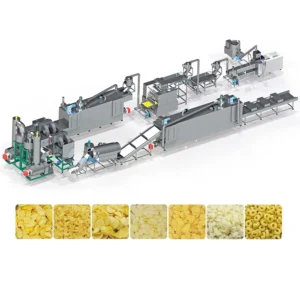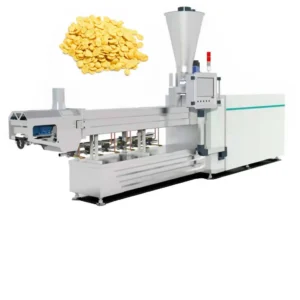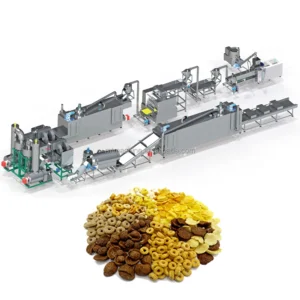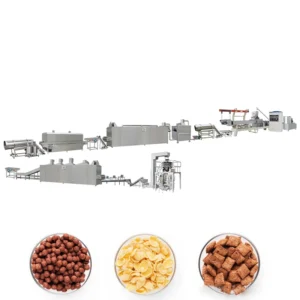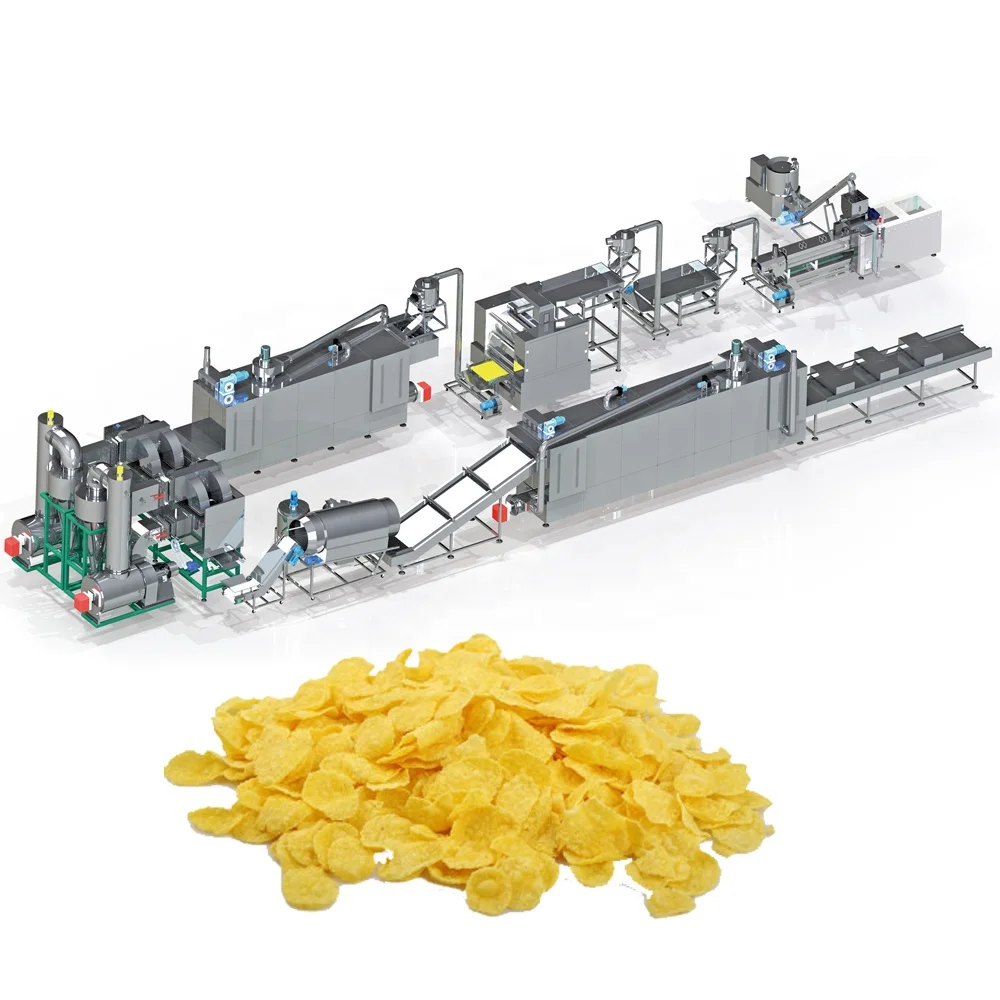
Integrated Equipment Sourcing — Every station from mixing through packing specified under one roof, ensuring throughput balance across the corn flakes production line instead of mismatched machines from separate vendors.
Technical Specifications
| Parameter | Value |
|---|---|
| Product Type | Corn Flakes Production Line |
| Output Capacity | Up to 750 kg/hr (basis not stated in source — confirm raw material formulation, moisture content, and finished product type) |
| Production Scope | Natural corn flakes, sugar-coated flakes, various shaped breakfast cereals |
| Raw Materials | Corn grits, corn flour, sugar, malt, salt, fortification additives |
| Control System | Available with PLC or MCC control |
| Motor | Robust drive (rated power, voltage, and frequency to be confirmed per target market) |
| Assembly State | Complete production line (individual station list to be confirmed) |
| Factory Layout | Engineered drawings tailored to specific factory floor plans |
| Certification | CE, ISO |
Application Suitability
| Application | Material or Output |
|---|---|
| Natural corn flakes for retail breakfast cereal market | Corn grits processed through extrusion, flaking, and drying |
| Sugar-coated flakes for sweetened cereal lines | Corn flakes base with sugar or honey coating in flavouring drums |
| Multi-grain breakfast cereals | Blended corn, wheat, rice, or oat formulations |
| Shaped cereal pieces | Extruded and cut formats beyond traditional flake geometry |
| Fortified cereal production | Corn base with added vitamin and mineral premixes |
What "Complete Line" Actually Means Before You Sign the Purchase Order
A corn flakes production line only performs as well as its weakest station, and most bottlenecks come from capacity mismatch between extrusion, drying, and coating.
I spent years on assembly floors before moving into equipment sourcing, and one pattern repeats across every breakfast cereal project: buyers focus on the extruder specification, sign the contract, and discover during commissioning that the dryer cannot keep pace with the output, or the coating drum creates a backlog that forces the entire line to slow down. A 750 kg/hr extruder paired with a dryer rated for half that throughput means your actual output is halved, regardless of what the sales proposal promised [NEED_CITE: throughput matching principles in multi-station food processing lines]. The corn flakes production line complete equipment range exists to let you audit every station — mixing, extrusion, drying, coating, cooling, packing — and confirm that capacity figures align across the board before a single machine is built.
Matching Every Station to Your Actual Raw Material
When a South Asian buyer came to us with a corn flakes project, the initial line configuration was based on standard corn flour particle size. During the trial run in our testing workshop, we discovered their local corn grits were noticeably coarser. The flaking roller gap had to be adjusted, and the dryer residence time needed recalculation because the thicker flakes retained moisture differently. Without that trial, the line would have arrived on-site producing uneven flakes with a high breakage rate. The corn flakes production line complete equipment range allows each station to be specified against your exact formulation rather than a generic benchmark.
Station-by-Station Throughput Verification
Every piece of equipment in this catalogue — the batching and mixing systems, the twin-screw extruders, the conveyor belts, the multi-layer dryers, the sugar coating drums, the cooling conveyors, and the packing stations — carries its own throughput rating. The engineering team calculates whether those ratings form a continuous chain or whether one station will constrain the others [NEED_CITE: bottleneck analysis in sequential food processing equipment]. When you survey the full corn flakes production line complete equipment range before committing to a configuration, you eliminate the scenario where a coating drum rated at 300 kg/hr holds back an extruder that was sold as a 500 kg/hr machine.
Screw Configuration, Die Geometry, and Flake Formation
Twin-screw extrusion for corn flakes depends heavily on screw element arrangement and die design. The length-to-diameter ratio of the screw barrel determines residence time inside the extruder, which directly controls starch gelatinisation — the process where corn starch granules absorb moisture and swell under heat and shear. Under-gelatinised dough produces flakes that crumble during drying; over-gelatinised dough creates a gummy mass that tears at the flaking rollers. The die geometry sets the shape and density of the extruded rope before it reaches the flaking station, so switching from natural flakes to a shaped cereal format may require a different die plate entirely. Moisture content at the barrel exit and the temperature profile across barrel zones both influence expansion ratio, and the PLC control system allows operators to store and recall these parameter sets for repeatable batch-to-batch consistency.
The Cost of Skipping the Equipment Survey Phase
Buyers who rush past the full equipment survey often encounter problems that surface only after installation. If the dryer is undersized, wet flakes accumulate and clump before they reach the moisture target, forcing operators to slow the entire line. If the coating drum volume does not match the extruder output, sugar-coated flakes sit too long in the drum and develop surface stickiness that ruins the final texture [NEED_CITE: coating drum residence time and surface quality in breakfast cereal manufacturing]. These are not defects in individual machines — they are consequences of treating the line as a collection of separate purchases rather than a single integrated system.
Why Buyers Source the Full Range Here
The corn flakes production line complete equipment range is backed by a dedicated machine testing workshop where trial runs on your actual raw material take place before shipment. Screw configuration and die design are matched to your specific corn grits or corn flour formulation, not copied from a generic template. Every station — mixing, extrusion, drying, coating, cooling, packing — is specified under one supplier so that throughput is calculated across the entire chain rather than assembled from disconnected vendor quotes. Factory layout drawings are engineered to your floor dimensions, and electrical schematics are confirmed against your local voltage and frequency before production begins. Documentation includes a trial run report generated on your raw material, not a generic performance certificate.
Documentation & Verification
- Line layout and capacity calculation showing throughput matched across every station
- Machine specification sheet for each individual station from mixer to packer
- Screw and die configuration record tied to your corn formulation and target flake format
- Electrical schematic with voltage and frequency confirmation for your target market
- Trial run report generated on your raw material in the testing workshop before dispatch
- CE declaration of conformity covering the line assembly
Installation, Commissioning & Support
- Engineered floor plan drawings matched to your factory dimensions before equipment fabrication begins
- Electrical connections verified against your local voltage and frequency, with dedicated circuits sized to each station’s motor rating
- Complete line arrives as individual stations for sequential assembly, from mixer through extruder to packing
- First-run commissioning includes parameter setting for barrel temperature zones, screw speed, and dryer residence time
- Operator training covers recipe storage in the PLC system and screw element replacement procedures
- Wear parts list provided with lead times for flaking rollers, screw elements, and die plates
What We Need to Configure Your Line Accurately
Before we propose a layout, share your raw material specifications — whether you run corn grits, corn flour, or a multi-grain blend — along with particle size and moisture content. Tell us your target daily output and the finished product format you need, including whether sugar coating or fortification is part of the process. Confirm your factory floor dimensions, ceiling height, and local voltage and frequency standards so that motor ratings and control panel specifications match your facility from day one.
Frequently Asked Questions
Q: What stations are included in a complete corn flakes production line and where does each fit?
A: A typical configuration includes a batching and mixing system, twin-screw extruder, vibrating conveyor, flaking rollers, multi-layer dryer, sugar coating drum, cooling conveyor, and packing station. Each station is positioned sequentially, and throughput is calculated across the entire chain so no single machine creates a bottleneck. The exact station list depends on your product format and coating requirements.
Q: How do I match dryer and coating drum capacity to the extruder output?
A: Each station carries its own throughput rating, and the engineering team verifies that dryer evaporation capacity and coating drum volume can handle the extruder’s output at your target moisture level. If the extruder produces a certain volume per hour, the dryer must reduce moisture within the required residence time, and the coating drum must tumble the full batch without overcrowding.
Q: What screw and die configuration is needed for natural versus sugar-coated corn flakes?
A: Natural flakes typically require a screw arrangement that achieves full starch gelatinisation with moderate shear, while sugar-coated formats may need slightly different die geometry to produce a denser rope that withstands coating drum tumbling. The configuration is determined during the trial run on your raw material and recorded in the screw and die configuration document provided before shipment.
Q: How is the factory layout engineered to fit my specific floor space?
A: We work from your factory floor plan, including ceiling height and utility connection points, to produce engineered layout drawings. Each station is positioned to allow material flow, operator access, and maintenance clearance. The drawings are confirmed before fabrication so the equipment arrives matched to your building rather than requiring structural modifications.
Q: What is the full equipment specification sheet for each station before I place an order?
A: Every station — extruder, dryer, coater, cooler, packer — comes with its own specification sheet listing motor rating, dimensions, throughput range, and control parameters. These sheets are part of the pre-sales documentation package and allow you to compare each machine on its individual merits before the line configuration is finalized and production begins.