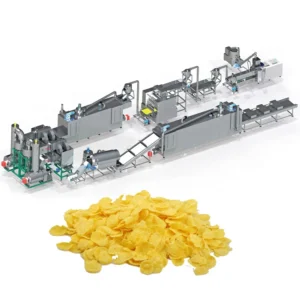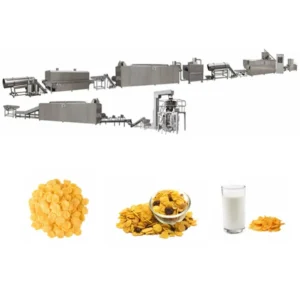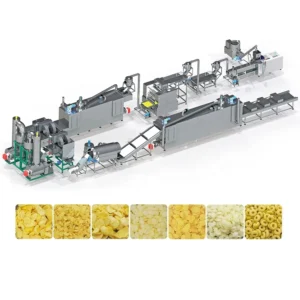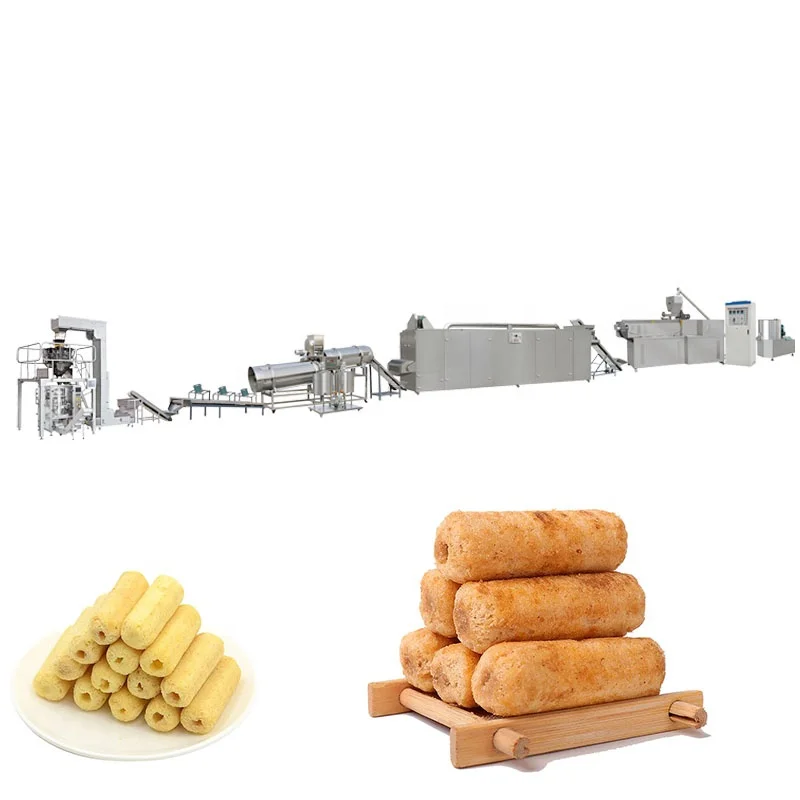
Complete Line Integration — Every station from mixing to packing is sourced under one supplier, ensuring throughput matches across extruder, flaking rollers, dryer, and roasting oven rather than leaving gaps between separate vendors.
Technical Specifications
| Parameter | Value |
|---|---|
| Product Type | Corn Flakes Making Machine |
| Model | MT70 / MT85 / MT75 |
| Installed Power | MT70: 160 kW; MT85: 190 kW; MT75: 210 kW |
| Power Consumption | MT70: 120 kW; MT85: 140 kW; MT75: 150 kW |
| Capacity Range | 100–500 kg/h (basis not stated in source — confirm raw material formulation and moisture content) |
| MT70 Capacity | 150–200 kg/h (basis to be confirmed) |
| MT85 Capacity | 300–400 kg/h (basis to be confirmed) |
| MT75 Capacity | 300–500 kg/h (basis to be confirmed) |
| MT75 Twin Screw Extruder Capacity | 200–300 kg/h (basis to be confirmed) |
| Overall Dimensions (L×W×H) | MT70: 41 × 1.5 × 2.2 m; MT85: 43 × 1.5 × 3.2 m; MT75: 45 × 1.5 × 3.5 m |
| Screw Type | Twin Screw |
| Control System | PLC and MCC available |
| Dryer Heating Source | Gas / Electric |
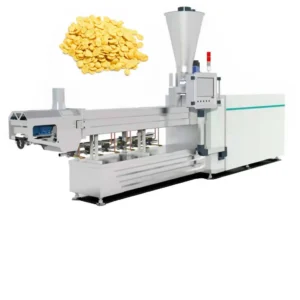
| Flaking Machinery | Hydraulic double rollers, separate motor drive, infrared temperature control |
| Hot Air Roasting Oven | Vibrating pan, dual circulating fans, cyclone dust removal |
| Coating System | Double tumble sugar melting, elevator, coating drum, spraying nozzle |
| Basic Material | Corn, rice, wheat, oat, barley powder |
| Standards | CE, ISO |
Application Suitability
| Application | Material or Output |
|---|---|
| Natural corn flakes breakfast cereal | Corn powder or corn grits, plain formulation |
| Sugar-coated corn flakes | Corn-based pellets with sugar syrup coating stage |
| Puffed cereal shapes for snack market | Rice, wheat, oat, and barley blends producing ball, tube, ring, star, and fruit loop formats |
| Fortified breakfast cereal programs | Grain powder blends with added nutritional premix |
What "Nominal Capacity" Leaves Out on a Corn Flakes Line
A machine plate may read 500 kg/h, but your corn formulation and moisture level decide the real output.
The most common frustration I see when visiting cereal plants is a Corn Flakes Making Machine full equipment range that simply cannot sustain the quoted throughput on the buyer’s actual recipe. The extruder runs fine on the factory test, but once your specific corn grits and moisture content hit the barrel, the output drops, the flaking rollers starve, and the roasting oven runs half-empty. You end up chasing bottlenecks instead of producing cereal [NEED_CITE: twin-screw extrusion throughput factors in breakfast cereal production]. The only way to prevent this is running your exact raw material through the line before it leaves the factory.
How Each Station Connects Across the Corn Flakes Line
A Corn Flakes Making Machine full equipment range begins with the mixing and batching station, where grain powders and any nutritional premix are blended to a uniform moisture level before entering the extruder. The twin-screw extruder then gelatinises the starch under controlled barrel temperature and shear, producing a continuous ribbon or cut pellet that feeds directly into the flaking machinery. If any upstream station delivers inconsistent moisture or feed rate, the flaking rollers will produce uneven thickness, and downstream roasting will yield mixed colour and texture.
Why Throughput Matching Matters More Than Individual Machine Size
The flaking machinery uses a hydraulic system with double rollers driven by separate motors, and its throughput must sit in balance with both the extruder output and the dryer capacity. I have walked into plants where the extruder was oversized for the flaking station, causing a backlog of hot extrudate that cooled and hardened before reaching the rollers [NEED_CITE: material handling bottlenecks in cereal flaking lines]. When every station in the Corn Flakes Making Machine full equipment range is specified together, the dryer, roasting oven, and coating drum all carry the same mass flow, so nothing sits idle and nothing overflows.
Reading the Specs That Actually Shape Your Output
The twin-screw design gives the extruder the self-wiping action needed to handle sticky, high-moisture corn dough without material building up on the screw flights — a single-screw would struggle here. Installed power across the MT70, MT85, and MT75 ranges from 160 kW to 210 kW, and actual consumption sits lower at 120 kW to 150 kW, which matters when you are sizing the dedicated circuit and calculating running cost. The PLC control system manages barrel temperature zones and screw speed together, so starch gelatinisation stays consistent from the first batch to the last. On the flaking side, the infrared sensor keeps roller temperature even, which directly controls how uniformly the flakes toast later in the hot air roasting oven. Line lengths reach up to 45 m for the MT75 configuration, so floor planning and utility routing need to be settled before the equipment arrives.
The Hidden Cost of Mismatched Stations
When a buyer sources the extruder from one vendor and the dryer or coating system from another, the gap between stations becomes the real expense. Flakes that enter an undersized dryer come out too moist for the roasting oven, producing a chewy texture the market rejects. Sugar coating applied to flakes that have not been roasted to the correct surface dryness leads to clumping in the packing stage [NEED_CITE: moisture migration issues in sugar-coated cereal products]. These are not warranty claims — they are line redesigns that happen after installation, when the cost of change is highest.
Why Procuring the Full Range from One Source Works
Every station is configured under a single line layout, so the extruder throughput, flaking roller feed rate, dryer belt speed, and roasting oven residence time are calculated together rather than guessed independently. Screw and die configuration is matched to your specific corn formulation and target flake thickness before the machine is built. The in-house testing workshop runs your actual raw material through the extruder and flaking rollers, generating a trial report you can review before shipment. Voltage, frequency, and PLC language are confirmed against your destination market standards during the specification stage, not discovered at commissioning. Wear parts such as screws, dies, and roller surfaces are catalogued and available from the same source that built the line.
Documentation & Verification
- Line layout and capacity calculation matched to your corn formulation and target flake weight
- Screw and die configuration record specifying geometry for your product density
- Trial run report on your raw material conducted in the testing workshop before dispatch
- Electrical schematic with voltage and frequency confirmed for your local grid
- Factory test record covering every station from mixer to packing conveyor
- Operation and maintenance manual with wear parts list and replacement intervals
Installation, Commissioning & Support
- Foundation and floor space planned around line lengths up to 45 m and 1.5 m working width
- Dedicated power circuit sized for installed loads up to 210 kW depending on model
- Equipment arrives in modular sections requiring on-site assembly and station-to-station alignment
- First-run commissioning includes barrel temperature profiling and flaking roller gap calibration
- Operator training covers PLC interface navigation, screw speed adjustment, and hydraulic pressure setting
- Wear parts supply includes replacement screws, dies, and flaking roller surfaces
What We Need to Configure Your Line
To move from a general inquiry to a line proposal, share your corn or grain formulation, target moisture content, and the flake thickness your market expects. Let us know your daily production target and the available floor space and ceiling height in your facility. Confirm the local voltage, frequency, and preferred control language so the electrical package is built correctly from the start.
Frequently Asked Questions
Q: What equipment stations are included, and can individual machines be ordered separately?
A: The full line covers mixing, extruding, flaking, drying, hot air roasting, cooling, and packing, with an optional sugar coating stage. Individual stations such as the flaking machinery or roasting oven can be supplied separately, but throughput matching is verified only when the complete line is configured together.
Q: How is capacity verified against my raw material before shipment?
A: Your specific corn formulation is run through the extruder and flaking station in the in-house testing workshop. A trial report documenting output rate, flake thickness, and product density is shared for your review before the equipment is cleared for dispatch.
Q: How do I choose between natural and sugar-coated corn flakes configurations?
A: Natural corn flakes follow mixing, extruding, flaking, drying, roasting, and cooling. Sugar-coated variants add a sugar spraying and coating drum stage between roasting and final drying. The base line is identical; the coating system is added or omitted based on your product range.
Q: What supporting equipment is matched to the extruder to avoid bottlenecks?
A: The dryer, flaking rollers, roasting oven, and cooling conveyor are all sized to carry the same mass flow as the extruder output. This prevents material backlog at any station and ensures the roasting oven receives flakes at the correct moisture level for even toasting.