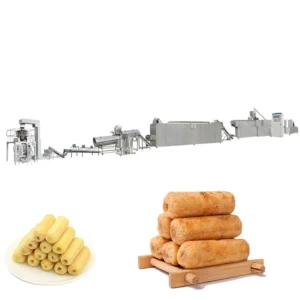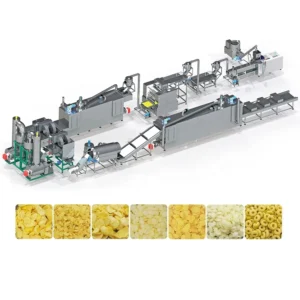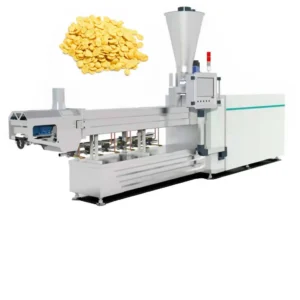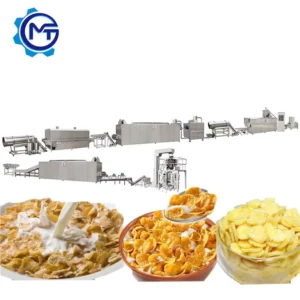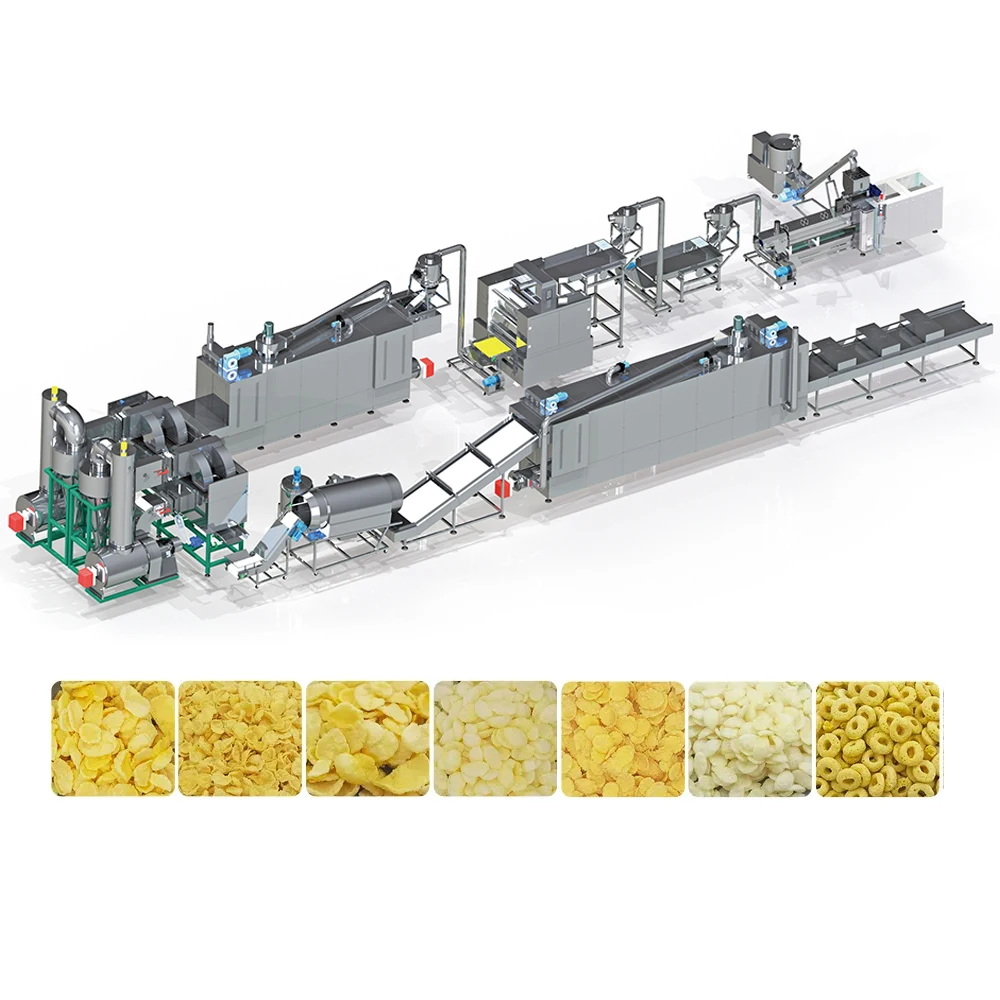
Station-to-station throughput matching — every unit from the mixer to the coating drum is specified as one integrated line, so the flaker never waits on the extruder and the roaster never starves the dryer.
Technical Specifications
| Parameter | Value |
|---|---|
| Model | MT75 |
| Product Type | Corn Flakes Production Line |
| Screw Type | Twin Screw |
| Available Configurations | MT70 / MT75 / MT85 |
| Installed Power | 210 kW (MT75) |
| Power Consumption | 150 kW (MT75) |
| Output Capacity | 300–500 kg/h (MT75, basis not stated in source — confirm raw material type, moisture content and product format) |
| MT-75 Extruder Capacity | 200–300 kg/h (basis not stated in source — confirm raw material and moisture) |
| Overall Dimensions | 45 × 1.5 × 3.5 m (MT75) |
| Control System | PLC (flaking machinery); MCC and PLC available across line |
| Heating Source (Dryer) | Gas / Electric |
| Flaking Drive | Double motors for separate roller driving; hydraulic system for double rollers |
| Flaking Temperature Control | Infrared sensor for even temperature pipe control |
| Hot Air Roasting Oven | Vibrating pan, conciliation burner, dual circulating fans, cyclone dust removal |
| Coating System | Double tumble sugar melter, elevator, coating drum, spraying nozzle |
| Basic Materials | Corn, rice, wheat, oat, barley powder |
| Certifications | CE; ISO |
Application Suitability
| Application | Material or Output |
|---|---|
| Natural corn flakes production | Corn grits or corn flour, toasted without sugar coating |
| Sugar-coated corn flakes | Corn, rice or multi-grain base with sugar syrup coating |
| Multi-grain breakfast cereals | Blends of wheat, oat and barley powder |
| Puffed cereal shapes | Rings, balls, tubes, stars, wheels via die changes on the same extrusion platform |
Why the Breakfast Cereals Corn Flakes Machine Full Equipment Range Matters More Than the Extruder Alone
A single vendor supplying every station eliminates the throughput gaps that silently kill daily output.
I once walked into a Southeast Asian plant where the extruder was rated for a certain hourly volume, but the flaker downstream was physically incapable of keeping up. The extruder operator spent half the shift idling the machine. Nobody had matched the stations during specification because the extruder came from one supplier and the flaking and drying equipment from two others [NEED_CITE: common line integration failures in breakfast cereal plants]. When the entire breakfast cereals corn flakes machine full equipment range arrives from one manufacturer, throughput calculations are done across every station before any steel is cut.
How Each Station Connects to the Next
The extruder cooks and shapes the dough, but the real texture of a corn flake is decided at the flaking rolls. The MT75 line uses a hydraulic double-roller system with independent motor drives, so roll gap and pressure are adjusted separately on each side. An infrared sensor monitors roller temperature continuously, preventing the dough sheet from sticking or tearing when ambient humidity shifts between seasons. Getting this station right means the flakes enter the dryer at a uniform thickness, which is the single largest factor in consistent roasting later.
The Roasting Oven Is Where Crispness Lives or Dies
After drying, flakes pass through the hot air roasting oven where surface blistering creates the characteristic toasted appearance and crunch. This oven uses a vibrating pan to keep flakes moving, a conciliation burner for even heat distribution, and two separate circulating fans that can be balanced independently. The cyclone dust removal device pulls fine particles out of the airstream so they do not scorch and contaminate the product [NEED_CITE: dust carryover effects on cereal roasting quality]. If the roaster is undersized relative to the extruder output, flakes pile up and over-toast in some areas while remaining pale in others.
Reading the Specs That Actually Affect Your Output
The twin-screw extruder in this line handles the full range of cereal grains — corn, rice, wheat, oat and barley — but each grain behaves differently under shear and heat. Corn grits require a specific screw profile and moisture preconditioning to gelatinise starch without destroying the half-kernel structure that flaking depends on. Oat and barley, being higher in fat, need different barrel temperature zones to prevent oil separation inside the barrel. The PLC control on the flaking machinery allows operators to store recipes for each grain type, so switching from a corn flake run to a multi-grain run does not require manual recalibration from scratch. Installed power at 210 kW for the MT75 configuration reflects the combined demand of the extruder main drive and auxiliary systems; actual power consumption sits around 150 kW under typical running conditions, though this varies with raw material density and moisture content.
What Happens When the Coating Drum Is an Afterthought
Sugar-coated corn flakes require the coating drum to apply syrup evenly before a second drying pass. If the drum volume is too small for the extruder output, flakes tumble too quickly and receive an uneven coat; too large, and they break from excessive tumbling time. The double tumble sugar melter on this line feeds syrup at a controlled rate matched to line speed. I have seen producers lose entire batches because the coating station was sourced separately and nobody verified that the syrup application rate could keep pace with upstream volume [NEED_CITE: sugar coating uniformity standards for breakfast cereals]. When the full line is specified together, the coating drum diameter, spray nozzle count and elevator speed are all calculated against the extruder’s actual throughput on the buyer’s formulation.
Why Sourcing the Full Range from One Builder Changes the Conversation
Every station in this breakfast cereals corn flakes machine full equipment range is designed with the adjacent station’s capacity in mind, so no single unit bottlenecks the line. The in-house testing workshop runs your specific raw material before shipment, producing a trial report that documents actual throughput, flake thickness and roast colour. Screw configuration and die design are recorded against your formulation, not pulled from a generic catalogue. Electrical schematics arrive with voltage and frequency already confirmed for your facility, so commissioning starts with power-on rather than rewiring. Pre-sales consultation covers layout against your actual factory footprint, and on-site installation includes operator training on the PLC interface and hydraulic flaking controls.
Documentation & Verification
- Line layout drawing showing station-by-station throughput match for your target cereal format
- Screw and die configuration record specific to your corn, rice or multi-grain formulation
- Trial run report documenting flake density and roast colour on your raw material before dispatch
- Electrical schematic with voltage, frequency and control language confirmed for your plant
- Operation manual covering PLC recipe storage and hydraulic roller gap adjustment procedures
Installation, Commissioning & Support
- Floor plan layout customised to your factory dimensions against the 45 × 1.5 × 3.5 m MT75 footprint
- Dedicated power circuit sized for 210 kW installed load with local voltage and frequency verification
- Gas or electric dryer heating source selected and piped before the line is energised
- Hydraulic flaking roller system commissioned with infrared sensor calibration on your dough formulation
- PLC recipe programming for each grain type and coating variant during on-site training
- Wear parts list for screws, dies and roller sleeves with recommended replacement intervals provided at handover
What We Need to Build Your Line Accurately
Send us your primary raw material formulation, including grain type and incoming moisture content, along with whether you plan to run natural flakes, sugar-coated flakes or both. Confirm your local voltage, frequency and preferred control language so the electrical package matches from day one. Let us know your available factory floor space and ceiling height, and whether the line will connect to any existing upstream milling or downstream packing equipment you already operate.
Frequently Asked Questions
Q: How is output capacity matched between the extruder, flaker, dryer and roaster so nothing bottlenecks?
A: Each station is sized against the extruder’s actual throughput on your specific grain formulation, not a generic rating. We calculate moisture loss through drying and roasting to ensure the flaker and downstream ovens handle the real volume of product arriving from the extruder, preventing idle time at any station.
Q: Which supporting machines are included in the full line, and can I source individual stations?
A: The complete range covers mixing, extruding, flaking, drying, hot air roasting, sugar coating, cooling and packing. Individual stations can be sourced separately, but throughput matching is guaranteed only when the full breakfast cereals corn flakes machine full equipment range is specified as one integrated system.
Q: What raw materials can the line process, and does each need a different screw setup?
A: Corn, rice, wheat, oat and barley powder are all processable. Each grain requires a specific screw configuration, barrel temperature profile and die design to achieve correct starch gelatinisation. We record and supply the setup for each formulation you plan to run, documented in your screw and die configuration file.
Q: Can the same line produce both natural and sugar-coated corn flakes?
A: Yes. The line follows the same path through extruding, flaking, drying and roasting for both products. For sugar-coated variants, the coating drum and sugar melter engage after roasting, followed by a second drying pass before cooling and packing. No hardware changeover is needed between the two formats.