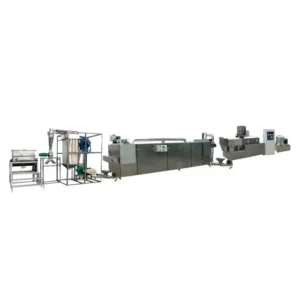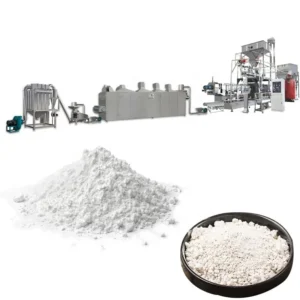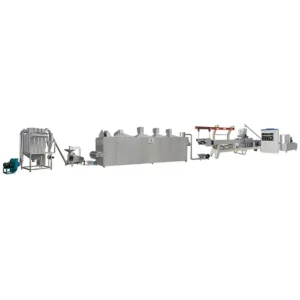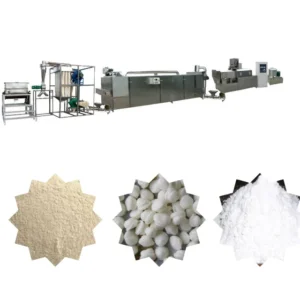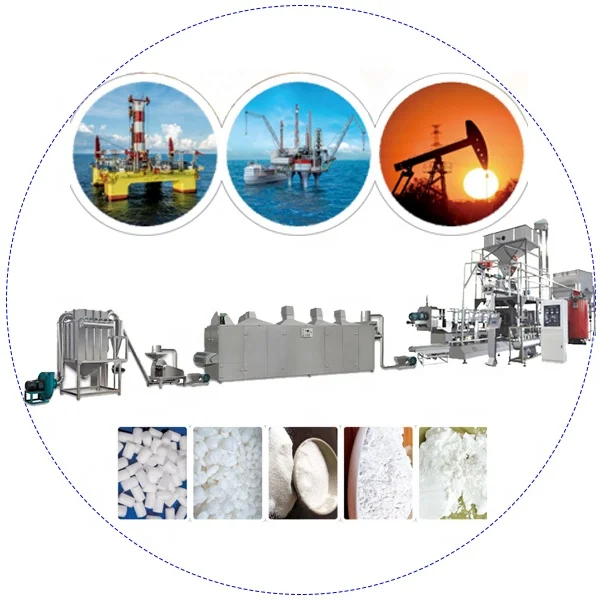
Matched Throughput Across Every Station — every supporting unit from starch hydrolysis to drying is sized to the selected extruder so that no single point constricts the line.
Technical Specifications
| Parameter | Value |
|---|---|
| Model | MT70 / MT85 / MT100 |
| Product Type | Modified Starch Processing Line (Twin-Screw Extrusion) |
| Screw Configuration | Twin-screw, 38CrMoAl material |
| Extruder Screw Diameter (MT70) | 70 mm |
| Extruder Screw Length (MT70) | 1520 mm |
| Main Motor Power (MT70) | 30 kW |
| Feeding System Power (MT70) | 0.75 kW |
| Cutting System Power (MT70) | 0.75 kW |
| Heating Zones (MT70) | 7 × 2 kW rings |
| Overall Line Dimensions (MT70) | 41,000 × 1,500 × 2,200 mm |
| Overall Line Dimensions (MT85) | 43,000 × 1,500 × 3,200 mm |
| Overall Line Dimensions (MT100) | 45,000 × 1,500 × 3,500 mm |
| Installed Power (MT70 / MT85 / MT100) | 160 kW / 190 kW / 210 kW |
| Operating Power Consumption (MT70 / MT85 / MT100) | 120 kW / 140 kW / 150 kW |
| Voltage & Frequency | 380V 50Hz 3-phase (380V/60Hz, 415V/60Hz, 220V/60Hz available on request) |
| Control System | PLC and MCC available |
| Heating / Drying Fuel Options | Gas, diesel, electricity, or steam (buyer to specify) |
| Contact Materials | Food-grade stainless steel (PVC limited to non-contact conveyors) |
| Line Stations | Starch hydrolysis, saccharification, denaturation treatment, drying |
| Warranty | 1 year complete with lifetime maintenance support |
| Certification | CE, ISO |
Application Suitability
| Application | Material or Output |
|---|---|
| Pregelatinized corn starch for instant food bases | Native or modified corn starch, varying moisture |
| Modified wheat starch for textile sizing agents | Wheat flour or starch derivatives |
| Denatured starch for papermaking coatings | Starch feedstock requiring controlled gelatinisation |
| Industrial-grade modified starch for adhesive blending | Blended starch raw materials |
| Fortified starch intermediates for nutritional powder lines | Starch with additive premixes |
Why "Nominal Capacity" Means Nothing Without the Raw Material Context
Output figures on a starch extruder are only valid when tied to a specific feedstock, moisture level, and target modification degree.
I once spent five days in a Colombian plant where an oxidation starch trial had gone perfectly, only for the buyer to switch to acetate starch at start-up. The gelatinisation temperature shifted by more than ten degrees, expansion collapsed, and the entire throughput profile became irrelevant. Capacity claims on a modified starch processing line equipment manufacturer sheet must always state the basis — corn versus wheat, native versus esterified, target viscosity window — otherwise they are marketing filler rather than engineering data [NEED_CITE: effect of starch esterification on gelatinisation temperature window].
How Screw Geometry Dictates Modification Behaviour
In starch extrusion, the degree of denaturation is a function of shear history and residence time inside the barrel. A modified starch processing line equipment manufacturer that supplies a generic screw profile across all starch types will produce inconsistent paste viscosity from batch to batch. The twin-screw configuration on the MT series allows the element sequence — conveying, kneading, reverse-pitch — to be rebuilt around whether the target is pregelatinisation, cross-linking, or esterification. Each model tier carries a different screw diameter and length-to-diameter relationship, so buyers moving from corn to wheat starch can select the barrel geometry that matches their modification chemistry.
Barrel Temperature Zoning and Starch Sensitivity
Starch polymers degrade rapidly once barrel temperature overshoots the gelatinisation peak. The MT70 carries seven individually controlled heating rings, giving operators a granular temperature ramp from feed zone to die face. This zoning matters because acetate starch, oxidised starch, and cationic starch each enter their phase transition at a different point along the barrel. When a line lacks sufficient independent zones, the operator is forced to compromise — running the barrel cooler to protect heat-sensitive variants, which then starves the die of fully gelatinised material and reduces effective throughput [NEED_CITE: temperature ramp requirements across modified starch variants].
Reading the Specification Sheet Like a Process Engineer
The installed power versus operating consumption gap on each model reflects the motor and heater headroom needed for peak load during start-up and feedstock transitions, not a waste margin. A 30 kW main motor on the MT70 paired with a 0.75 kW feeding system indicates a design where the extruder barrel does the mechanical work rather than relying on pre-conditioning. Screw material — 38CrMoAl — is a nitriding-grade alloy steel that resists the abrasive wear caused by starch granules under compression, extending the interval before screw flights need replacement. Voltage configurability across four standards means the motor winding and control panel are specified before production, eliminating the rewiring delays that stall commissioning in markets running 60 Hz or non-380V grids.
The Downstream Bottleneck That Invalidates Extruder Selection
An extruder sized correctly for 300 kg/h of modified corn starch can still deliver only half that output if the dryer was quoted by a separate vendor who never saw the moisture curve of the actual product. Starch exits the die at a moisture level that demands a specific drying residence time and airflow pattern; undersized drying capacity forces the operator to slow the extruder feed to prevent clumping downstream. This mismatch is the most common reason a newly installed modified starch line never reaches the throughput the buyer expected, and it is entirely avoidable when every station is specified under one equipment set [NEED_CITE: moisture removal rate requirements for pregelatinized starch drying].
What You Are Actually Buying When You Source the Full Range
Every station from hydrolysis through saccharification, denaturation, and drying is throughput-calculated against the chosen extruder model before the layout is finalised. Screw configuration and die design are documented against the buyer’s specific starch feedstock, not copied from a generic build. The in-house testing workshop runs the buyer’s actual raw material before shipment, so the trial run report reflects real modification behaviour rather than a proxy feedstock. PLC and MCC control options are wired and labelled in the control language the operator will use on day one. Food-grade stainless steel contact surfaces are maintained across every wetted station, with PVC limited to non-contact conveyor return runs.
Documentation & Verification
- Line layout with station-by-station throughput calculation matched to your selected extruder model
- Screw and die configuration record tied to your specific starch feedstock and modification target
- Electrical schematic confirming voltage, frequency, and control language before production release
- Trial run report performed on your raw material in the testing workshop before dispatch
- CE declaration of conformity and ISO certificate with full machine scope listed
- Wear parts list identifying screw elements, die plates, and seals by part number
Installation, Commissioning & Support
- Foundation plan dimensioned to the selected model’s overall footprint up to 45,000 mm line length
- Dedicated circuit sized for the model’s installed power, up to 210 kW on the MT100
- Extruder barrel and motor shipped separately to protect screw alignment during transit
- Temperature profile across all seven heating zones tuned to your starch variant during commissioning
- Operator training covering screw element sequence changes between starch product runs
- Spare screw flights and die plates shipped with the initial order against the documented wear parts list
Preparing Your Enquiry with the Right Data
Provide the exact starch type — native corn, wheat flour, acetate, oxidised, or cationic — along with the target modification property such as paste viscosity or cold-water solubility. Confirm your facility voltage, frequency, and whether the control panel language needs to be Spanish, Portuguese, or another standard beyond English. If you are integrating this line with an existing milling or packing operation, share the upstream feed rate and downstream packing speed so that every station can be matched before the layout is drawn.
Frequently Asked Questions
Q: How does raw material type affect the actual output of each extruder model?
A: Output capacity shifts depending on whether the feedstock is native corn starch, wheat flour, or a pre-esterified variant, because each requires a different moisture input and barrel residence time. Capacity figures on any model only become meaningful once the raw material and target modification degree are specified. The line configuration is then recalculated so that every downstream station matches the real throughput.
Q: How do I confirm voltage and frequency compatibility before the machine is built?
A: Share your facility’s supply standard — 380V/50Hz, 380V/60Hz, 415V/60Hz, or 220V/60Hz — during the quotation stage. The motor winding, control transformer, and PLC power supply are then specified to that standard. The electrical schematic is sent for approval before production, preventing rewiring work on site.
Q: What is the practical difference between installed power and operating consumption?
A: Installed power covers peak motor draw during start-up and feedstock changeovers, while operating consumption reflects steady-state running load. This gap affects utility planning because your facility’s transformer and circuit breaker must accommodate the installed figure, even though day-to-day energy cost tracks the lower consumption value.
Q: Can the line handle multiple starch modification types without a full rebuild?
A: The twin-screw configuration allows element rearrangement — swapping kneading blocks, adjusting reverse-pitch positions — to shift between pregelatinisation, cross-linking, or esterification targets. Heating zone setpoints are stored per recipe in the PLC. A screw configuration change typically takes a planned maintenance window rather than a capital retrofit.
Q: What supporting equipment is matched to each extruder model to prevent bottlenecks?
A: The dryer capacity, cooling conveyor length, and packing station feed rate are each calculated against the selected extruder’s real output on the buyer’s raw material. This prevents the common failure where an oversized extruder is throttled by an undersized dryer. The line layout document shows the throughput calculation for every station.