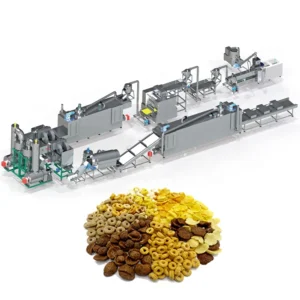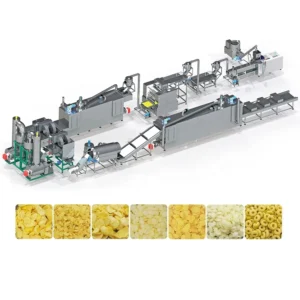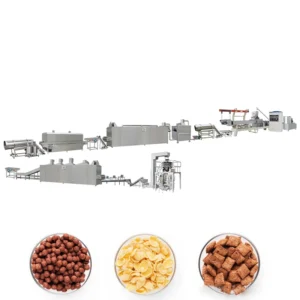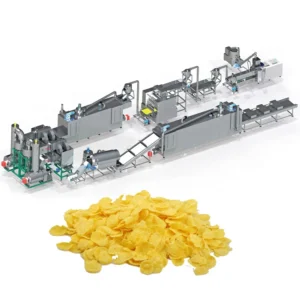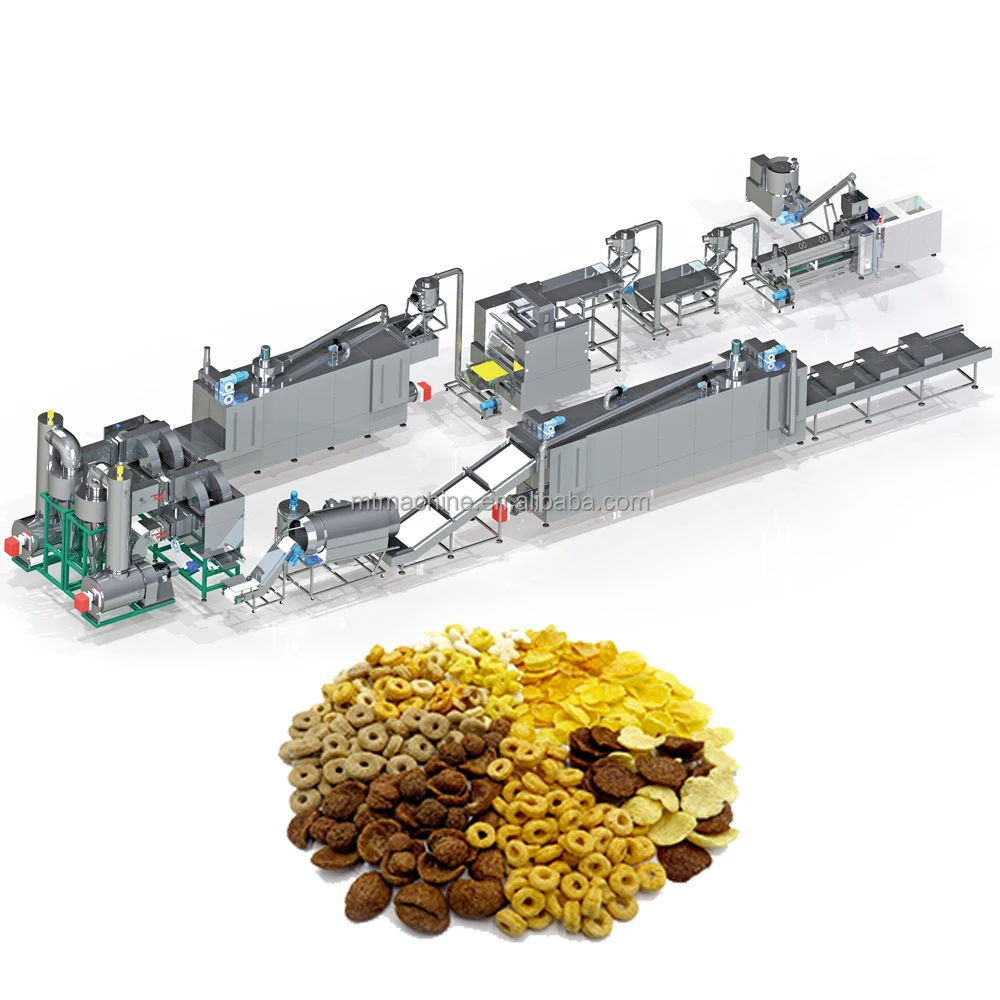
Integrated Line Stations — Every station from mixing to packing is sized to the extruder output, eliminating the bottlenecks that occur when individual modules are sourced from separate vendors.
Technical Specifications
| Parameter | Value |
|---|---|
| Product Type | Corn Flakes Breakfast Cereal Production Line |
| Model | MT-75 |
| Extruder Configuration | Twin-screw |
| Output Capacity | 200–300 kg/h (basis not stated in source — confirm raw material, moisture content, and product format) |
| Voltage Options | 220V / 380V |
| Control System | PLC control (flaking station); line-wide control to be confirmed |
| Flaking Machine Drive | Double motors for separate roller driving; hydraulic system for double rollers |
| Flaking Temperature Control | Infrared sensor for even temperature pipe control |
| Dryer Heating Source | Gas / Electric |
| Roasting Oven Configuration | Hot air roasting with vibrating pan, high-temperature spraying tubes, conciliation burner, two separate circulating fans, cyclone dust removal device |
| Coating System | Double tumble for sugar melting, elevator, coating drum, spraying nozzle |
| Core Components | Gearbox |
| Warranty | 1 Year |
Application Suitability
| Application | Material or Output |
|---|---|
| Standard Corn Flakes Production | Corn grits and corn flour blends |
| Multi-Grain Breakfast Cereals | Rice, wheat, oat, and barley formulations |
| Sugar-Coated Cereal Variants | Base flakes with sugar syrup or honey coating |
| Natural Cereal Formats | Uncoated toasted flakes for health-focused markets |
Why Sizing the Flaking and Roasting Stations Matters for Your Corn Flakes Machine Full Equipment Range
A line only runs as fast as its slowest station, and breakfast cereal lines almost always bottleneck at the dryer or roaster.
When an extruder is quoted without matching the downstream drying and roasting capacity, the entire production rhythm collapses. I have seen lines where the extruder pushes out material faster than the hot air roasting oven can process it, forcing operators to either slow down the screw speed or let product pile up and lose moisture consistency. With the corn flakes machine full equipment range, the mixing, extruding, flaking, drying, roasting, sugar coating, and cooling stations are specified together [NEED_CITE: matching throughput across extrusion line stations]. This means the hydraulic flaking roller, the hot air roasting oven with its two circulating fans, and the sugar coating drum are all balanced against the twin-screw extruder output, preventing the costly idle time that plagues poorly integrated setups.
How the Twin-Screw Extruder Defines Upstream Throughput
The MT-75 twin-screw configuration handles the shear and heat required to gelatinise starch from corn, rice, wheat, oat, or barley blends. The automatic lubricating and cooling system supports continuous operation, which matters when a cereal run stretches across a full shift. Screw configuration and die design must be matched to the specific raw material blend; a die that works for fine corn flour will produce a completely different expansion and texture when the buyer switches to coarser grits.
Balancing the Flaking, Roasting, and Coating Modules Downstream
The hydraulic flaking station uses double-motor separate roller drive and infrared sensor temperature control to maintain uniform flake thickness across the full belt width. After flaking, the hot air roasting oven relies on two separate circulating fans and a cyclone dust removal device to deliver consistent surface blistering. If the sugar coating system is included, the double tumble melter feeds syrup to the spraying nozzle at a rate timed to the upstream roaster discharge [NEED_CITE: cereal coating drum speed and syrup application rate]. Omitting any of these stations or undersizing them relative to the extruder creates a cascade of quality issues, from uneven toast colour to clumped sugar layers.
Interpreting the Specs That Actually Shape Flake Quality
The twin-screw extruder is the starting point, but flake quality is decided at the flaking and roasting stages. The hydraulic pressure on the double rollers directly controls flake thickness, which in turn determines how quickly moisture escapes during roasting and how the final product feels in the mouth. The infrared sensor on the flaking temperature pipe prevents the dough sheet from cooling unevenly before it reaches the rollers, a common cause of thickness variation. The hot air roasting oven uses a conciliation burner and high-temperature spraying tubes to create the characteristic surface blisters; without the two circulating fans, hot spots develop and some flakes scorch while others remain under-toasted. The PLC control at the flaking station allows operators to adjust roller gap and temperature in real time, which is essential when switching between a high-moisture oat blend and a drier corn formulation.
The Hidden Cost of Unmatched Station Capacity
When the dryer or coating drum cannot keep pace with the extruder, operators face a choice: throttle back the extruder and lose output, or let semi-finished product accumulate and degrade. In my experience with breakfast cereal lines in Shandong, the most common complaint is not that the extruder underperforms, but that the roasting oven cannot handle the volume the extruder delivers. This mismatch leads to inconsistent flake colour, variable moisture content in the finished pack, and sugar coating that clumps because the flakes entered the drum at different temperatures [NEED_CITE: thermal balance between extrusion and downstream drying stages]. These are not problems you can fix by adjusting a single parameter; they require re-engineering the station ratios.
Why Source the Complete Range from One Supplier
Every station on this line — from the batching mixer through the extruder, flaking roller, dryer, hot air roasting oven, sugar coating drum, cooler, and packing conveyor — is specified under a single layout calculation. The screw and die configuration is recorded against the buyer’s raw material, not copied from a generic template. The in-house testing workshop allows trial runs on the buyer’s actual corn or multi-grain blend before shipment, verifying that the flaking thickness and roasting profile match the target specification. This approach eliminates the blame-shifting that happens when the extruder vendor points at the dryer vendor and the dryer vendor points back.
Documentation & Verification
- Line layout and capacity calculation showing throughput balance across all stations
- Machine specification sheet with confirmed voltage, frequency, and control language
- Screw and die configuration record matched to the buyer’s raw material blend
- Trial run report on customer raw material verifying flake thickness and roasting profile
- Wear parts list covering screws, dies, and flaking roller sleeves
Installation, Commissioning & Support
- Utility planning for 220V or 380V supply with dedicated circuits for the extruder gearbox and roasting oven burners
- Foundation and footprint confirmation for the full station sequence from mixer to packing conveyor
- On-site assembly of the hydraulic flaking station with double-motor roller alignment and infrared sensor calibration
- First-run parameter setting for PLC control at the flaking station, including roller gap and temperature profiles
- Operator training covering screw speed, hydraulic pressure, and roasting fan balance for different cereal formats
- Spare parts scheduling for gearbox components, extruder screws, and flaking roller sleeves
Preparing Your Inquiry for the Corn Flakes Line
To move from a general enquiry to a confirmed line configuration, we need your target raw material blend (including particle size and moisture content), the desired flake dimensions and toast colour, and your local voltage and frequency specifications. If you are adding flaking and roasting stages to an existing extrusion line, provide the current extruder output rate and the physical space available for downstream modules. For new builds, share your workshop dimensions and ceiling height so the layout can account for the hot air roasting oven ducting and cyclone dust removal routing.
Frequently Asked Questions
Q: How is the output capacity verified, and on which raw material is it based?
A: The capacity range is listed as a general reference. Actual throughput depends on the specific raw material blend, moisture content, and target flake density. We conduct a trial run in the testing workshop using the buyer’s actual corn or multi-grain formulation before shipment, and the verified output is documented in the trial run report.
Q: Can the sugar coating system be omitted for natural cereal production?
A: Yes, the coating system — including the double tumble melter, elevator, coating drum, and spraying nozzle — is a selectable module. The line can be configured to end after the hot air roasting oven and cooling station for uncoated natural flakes, with the packing station connected directly downstream.
Q: What voltage and control language options are available?
A: The line supports 220V and 380V configurations. Voltage, frequency, and PLC language must be confirmed during the specification stage to match the buyer’s local electrical standards and operator requirements. This confirmation is recorded in the machine specification sheet before production begins.
Q: How does the flaking roller system affect flake uniformity?
A: The hydraulic flaking station uses double motors for separate roller driving, allowing independent speed control. The infrared sensor monitors the temperature pipe to maintain consistent dough sheet temperature before pressing. Together, these controls reduce thickness variation across the full roller width, which is critical for even roasting downstream.
Q: What documentation is provided before and after shipment?
A: Buyers receive the line layout, capacity calculation, machine specification sheet, screw and die configuration record, electrical schematic, trial run report, CE declaration, operation and maintenance manual, wear parts list, and packing photographs. Customs documentation support is also included for the destination market.