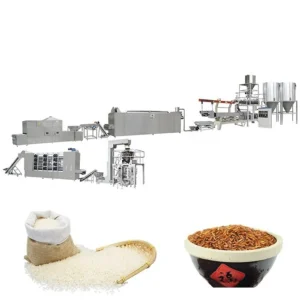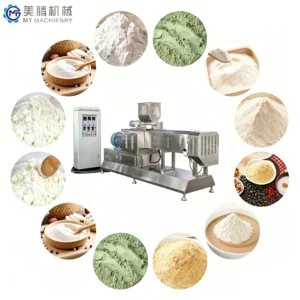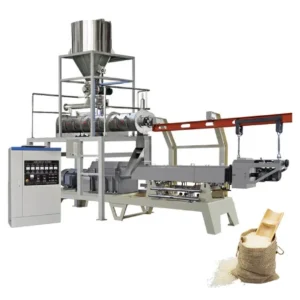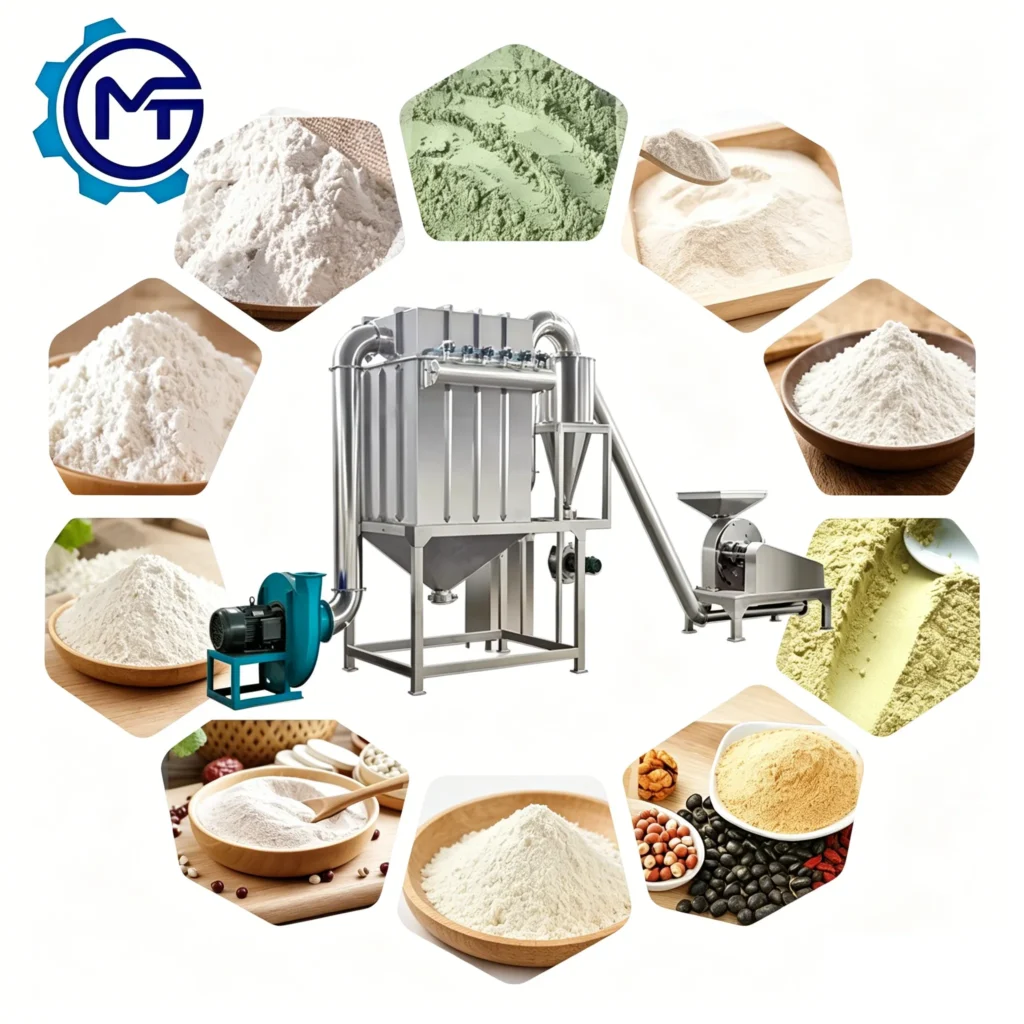
Integrated Extrusion Sequence — Every station from batching through extrusion, drying and packing is engineered under one supplier so throughput stays balanced across the full nutrition powder processing line.
Technical Specifications
| Parameter | Value |
|---|---|
| Product Type | Nutrition Powder Processing Line |
| Output Capacity | 200–500 kg/h (basis not stated in source — confirm raw material type, moisture content and formulation before quoting) |
| Construction Material | Food-Grade 304 Stainless Steel contact surfaces |
| Control System | Touch Control Panel with Digital System |
| Heat Source Options | Electric, Gas, or Steam (selectable based on site utility) |
| Key Line Stations | Baking Oven, Mixer, Extruder, Dryer, Packing Station |
| Automation Level | Full Automatic |
| Warranty | 1 Year |
| After-Sales Service | Overseas Engineer Service Available |
Application Suitability
| Application | Material or Output |
|---|---|
| Baby food nutrition powder manufacturing | Rice, corn, beans and blended grain bases with added vitamins and whey protein |
| Baby cereal and instant porridge production | Pre-cooked grain flours requiring controlled gelatinisation and moisture reduction |
| Fortified infant food formulations | Multi-grain mixes with micro-nutrient and mineral premix integration |
| Grain processing diversification | Raw rice, maize and legume inputs converted into shelf-stable nutritional powder |
Why "500 kg/h" Means Nothing Without the Raw Material Context
Capacity figures only hold when the exact formulation, moisture content and particle size are defined up front.
When buyers request a nutrition powder processing line, the first number they ask about is output. A line rated at a nominal throughput on standard rice flour may behave entirely differently once whey protein isolate, fat powder and trace mineral premix enter the recipe. Gelatinisation temperature shifts, barrel pressure profiles change, and a dryer sized for one moisture curve falls short on another. I have watched lines stall at startup because the extruder was spec’d on a clean starch recipe while the actual production formula carried high fat and fiber fractions that altered shear behaviour inside the barrel. Matching every station to the buyer’s true formulation — not a generic test flour — is the only way a capacity claim survives contact with real production [NEED_CITE: starch gelatinisation behaviour under varying protein and fat ratios in twin-screw extrusion].
How Each Station Connects Across the Nutrition Powder Processing Line
A nutrition powder processing line is not just an extruder with a dryer bolted on. The mixer must deliver a homogeneous blend at a consistent feed rate, because any variation in premix distribution shows up as off-spec nutrient density downstream. The extruder barrel is where starch gelatinisation and protein denaturation happen simultaneously, and the screw configuration must account for both. After extrusion, the baking oven or dryer removes residual moisture to a level that guarantees shelf stability without scorching heat-sensitive vitamins. The full equipment range visible on this page exists so buyers can survey every station and verify that throughput is matched at each hand-off point, not just at the extruder.
The Heat Source Decision That Most Buyers Overlook
Electric, gas and steam heating each impose different constraints on a nutrition powder processing line. Electric barrels offer precise zone control but draw substantial amperage, requiring dedicated circuits and heavy-gauge cabling. Gas firing reduces electrical load but demands ventilation planning and flame safety interlocks integrated into the digital control panel. Steam heating — often available where a factory already runs a boiler for other processes — gives gentle, uniform heat but adds condensate drainage and trap maintenance to daily operation. The Touch Control Panel with Digital System must be configured for whichever heat source is selected, because temperature ramp profiles and PID tuning differ across all three [NEED_CITE: industrial heating method selection criteria for food extrusion barrel zones]. Choosing the wrong heat source for a site’s utility infrastructure delays commissioning and forces costly retrofits.
Reading the Specs That Actually Matter for Nutritional Powder
Food-Grade 304 Stainless Steel contact surfaces are non-negotiable when processing infant food, because trace metal migration from lower-grade alloys can contaminate vitamin-fortified blends and violate food safety limits. The Touch Control Panel with Digital System lets operators store and recall recipe parameters — barrel zone temperatures, screw speed, feed rate — so that batch-to-batch consistency relies on saved profiles rather than manual note-taking. Output capacity spanning 200–500 kg/h covers pilot-scale runs up to mid-volume commercial production, but the actual sustainable rate depends on raw material density and the degree of expansion required. Full Automatic operation means the line sequences mixer discharge, extruder feed, dryer conveyor speed and packing station indexing from a single control point, reducing the operator count on the floor while keeping the entire nutrition powder processing line synchronised.
What Happens When Stations Are Spec’d in Isolation
Sizing an extruder for peak output while the dryer is rated thirty percent lower creates a bottleneck that no amount of operator tweaking can fix. The extruder pushes product into a dryer that cannot remove moisture fast enough, forcing the line to run below its designed throughput. Conversely, an oversized dryer wastes energy cycling empty conveyor space. When the baking oven and mixer are sourced from separate vendors without a single supplier verifying the full sequence, electrical interlocks and signal hand-offs often arrive mismatched — the mixer discharge sensor speaks a different protocol than the extruder infeed gate, and startup turns into weeks of on-site rewiring. These are the hidden costs that never appear in a comparison spreadsheet [NEED_CITE: common causes of throughput mismatch in multi-station food processing lines].
Why Buyers Source the Full Equipment Range Here
Every station on this nutrition powder processing line — mixer, extruder, baking oven, dryer, packing — is configured under one engineering team so that throughput calculations and electrical schematics are cross-checked before fabrication. Screw and die combinations are specified to the buyer’s raw material formulation, not copied from a generic build. An in-house testing workshop allows trial runs on the customer’s actual grain blend and nutrient premix before shipment, catching gelatinisation and density issues that would otherwise surface during on-site commissioning. Pre-sales line layout and capacity documentation ensures the buyer can review station-by-station throughput and utility requirements before committing to production. The result is a line that arrives matched to the real product, not a catalogue placeholder.
Documentation & Verification
- Line layout and capacity calculation matched to your grain blend and target powder density
- Machine specification sheet covering every station from mixer through packing
- Screw and die configuration record tied to your raw material trial run
- Electrical schematic with voltage and frequency confirmed for your facility
- Factory test record on your actual formulation before dispatch
- Operation and maintenance manual with illustrated troubleshooting sequences
Installation, Commissioning & Support
- Foundation load assessment based on full line weight including baking oven and mixer
- Electrical feed sized to total connected kW with dedicated breaker per heat source circuit
- Station-by-station alignment verification ensuring smooth product transfer between conveyor sections
- First-run parameter logging on your raw material through the Touch Control Panel with Digital System
- Operator training covering recipe storage, emergency stop sequences and daily cleaning protocols
- Initial spare wear parts set including screws, dies and seals shipped with the line
What We Need From You to Move Forward
Share the exact grain base, protein additives and micro-nutrient premix you plan to run, along with target moisture content in the finished powder. Confirm your site voltage, frequency and available heat source so the electrical schematic and barrel heating can be spec’d correctly. Let us know your workshop dimensions and ceiling height so the line layout accounts for dryer exhaust ducting and packing station clearance. If you need a trial run on your raw material before shipment, send a sample batch to our testing workshop and we will return a full process report.
Frequently Asked Questions
Q: How is the 200–500 kg/h capacity verified, and what raw material formulation is it based on?
A: The published range reflects general throughput potential; the actual sustainable rate depends on your grain blend, added fat and protein fractions, and target moisture. We confirm the real output by running your formulation through our testing workshop before finalising the quotation, so the capacity figure on your contract reflects your recipe, not a generic starch standard.
Q: Which stations are included in the line, and how is throughput matched between them?
A: The sequence covers mixer, extruder, baking oven or dryer, and packing station. Each station is sized so that its maximum throughput exceeds the upstream station by a calculated margin, preventing bottlenecks. A single line layout document shows every hand-off point so buyers can verify balance before production begins.
Q: What voltage, frequency and control language options are available for the target market?
A: The electrical schematic is built after the buyer confirms local supply voltage, phase configuration and frequency. The Touch Control Panel with Digital System supports multiple language packs, and all labels and alarm messages are set to the operator’s preferred language before the control cabinet leaves the factory.
Q: Can individual stations be sourced separately, or is the line only offered as a complete package?
A: Individual stations such as the mixer or baking oven can be supplied to integrate with existing equipment. However, throughput matching and control signal compatibility are easiest to guarantee when the full nutrition powder processing line is configured together, because every station then shares a common electrical and mechanical design reference.
Q: What spare wear parts are included at shipment, and how are replacements sourced?
A: An initial set of wear parts — screws, dies, seals and gaskets — ships with the line so the first replacement cycle is covered without waiting for international freight. A full wear parts list with part numbers is included in the documentation, and replacement orders can be placed directly through the after-sales service channel.