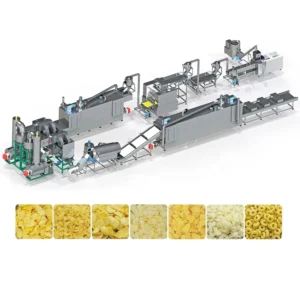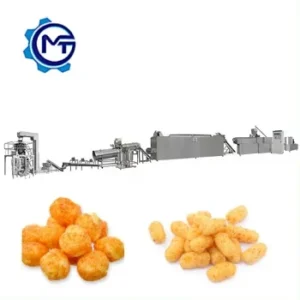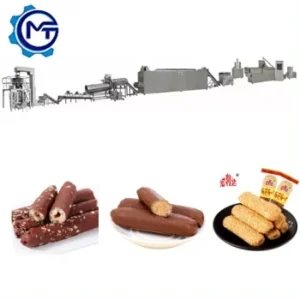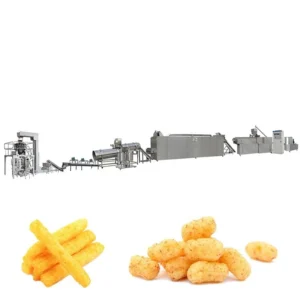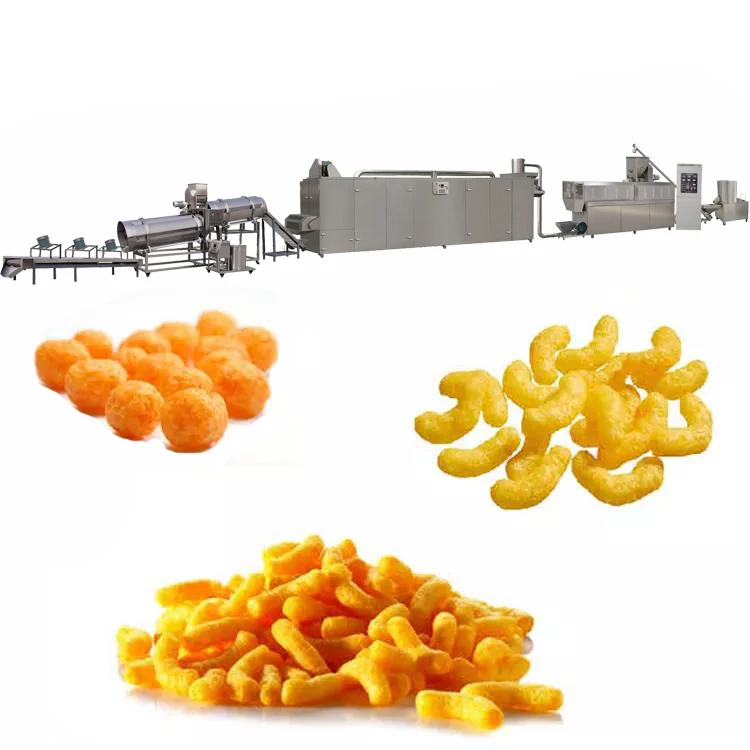
Throughput-Matched Full Line — Every station from mixing to packing specified under one manufacturer, preventing the bottlenecks that plague snack lines assembled from separate vendors.
Technical Specifications
| Parameter | Value |
|---|---|
| Product Type | Twin Screw Puffed Snack Food Extrusion Line |
| Screw Type | Twin screw (double screw) |
| Line Stations | Mixing, extruding, shaping, cutting, drying, flavoring |
| Control System | Electric industrial automatic |
| Dryer Type | Multi-layer dryer (customizable length and layer) |
| Flavoring System | Semi-automatic and automatic options; sugar, oil, powder seasoning |
| Output Capacity | Basis not stated in source — confirm raw material, moisture, product format |
| Voltage & Frequency | Basis not stated in source — confirm target market electrical standard |
| Certification | CE |
| Warranty | 24 months, lifetime service |
| Assembly State | Turnkey complete line |
Application Suitability
| Application | Material or Output |
|---|---|
| Puffed corn snacks | Corn grits, maize flour, corn meal |
| Puffed rice snacks | Rice flour, rice grits, broken rice |
| Core-filled snacks | Grain-based outer shell with cream or chocolate filling |
| Shaped puffed snack foods | Grain blends producing varied shapes and sizes via die change |
Why Mismatched Stations Derail Puffed Snack Output
The extruder sets the pace, but the dryer and flavoring drum decide whether that pace actually reaches the packing table.
I have watched lines where the extruder pushed product faster than the dryer could handle moisture removal. The result was a pile of warm, tacky product stacking up on the transfer belt, forcing operators to throttle back the screw speed and run the whole line below its real capability. When sourcing a puffed snack food extrusion line manufacturer, buyers often compare extruder specs in isolation and discover the mismatch only after the machines are bolted to the floor [NEED_CITE: throughput balancing across extrusion line stations].
Twin-Screw Extruder Configurations for Grain Snack Formats
The twin-screw design sits at the core of this puffed snack food extrusion line manufacturer’s offering, and its value lies in configurability rather than a single fixed build. Different screw element arrangements, barrel sections, and die plates let the same base extruder handle corn grits one week and rice flour the next, shifting between dense pellets and high-expansion puffed shapes. Motor and gearbox options scale to the torque required by heavier grain mixes or high-moisture recipes.
Dryer and Flavoring Station Integration
A multi-layer dryer with adjustable length and layer count dries product to the target moisture content without over-baking or leaving wet cores, a frequent complaint when the dryer is sized by guesswork. Downstream, the flavoring system offers semi-automatic and automatic configurations supporting sugar coating, oil spraying, and powder dusting [NEED_CITE: drying temperature profiles for puffed grain snacks]. Choosing between them depends on the seasoning complexity and the line speed the flavoring drum must sustain.
Reading the Specs That Actually Shape Snack Texture
Screw configuration and die geometry determine expansion ratio and product density far more than motor power alone. A die with smaller orifice openings raises back-pressure inside the barrel, increasing shear and producing a denser, crunchier bite — the kind expected in corn-based puffed snacks sold in convenience channels. Larger orifices lower that pressure, yielding a lighter, more aerated texture suited to rice-based formats. The twin-screw arrangement also means operators can adjust the screw profile section by section, tuning shear and residence time to the specific starch gelatinisation behaviour of corn versus rice versus blended grain inputs. Control system consistency across batches depends on the PLC maintaining barrel temperature zones and screw RPM within tight tolerances, preventing the density drift that turns a crisp product chewy by the end of a shift.
What Happens When the Dryer Is Undersized
An undersized dryer forces the extruder to slow down, meaning the entire line operates below the throughput the buyer originally specified. Product exits the dryer with residual moisture, shortening shelf life and inviting mould complaints from retailers. Flavoring powder clings unevenly to damp surfaces, creating batches where some pieces are over-seasoned and others taste bare [NEED_CITE: moisture content and shelf stability in extruded snack products]. These are not defects in any single machine — they are the direct result of assembling stations from separate vendors who never coordinated capacities.
What You Get by Sourcing the Full Equipment Range Here
Every station — mixer, extruder, shaper, cutter, dryer, flavoring drum — is specified together so throughput matches from the batching hopper to the packing conveyor. Screw and die configurations are selected against the buyer’s actual raw material and target snack format, not copied from a generic build sheet. An in-house testing workshop runs trial extrusions on the customer’s own grain stock before shipment, so expansion ratio and density are confirmed in advance. The line arrives as a coordinated package with a single documentation set covering electrical schematics, layout drawings, and commissioning checklists, reducing the back-and-forth that delays start-up when multiple suppliers are involved.
Documentation & Verification
- Line layout and capacity calculation confirming station-to-station throughput matching
- Machine specification sheet with screw and die configuration matched to your grain type
- Electrical schematic with voltage and frequency confirmed for your local grid standard
- Factory trial run report on your raw material before shipment
- CE declaration of conformity for export markets
- Wear parts list covering screws, dies, and dryer mesh belts
Installation, Commissioning & Support
- Foundation plan aligned to full line footprint and multi-layer dryer weight
- Dedicated power circuits sized to extruder motor, dryer heaters, and flavoring drive loads
- Modular station delivery allowing phased assembly in limited ceiling-height workshops
- First-run parameter setting for barrel temperature zones and screw RPM on your recipe
- Operator training covering die changes, screw element swaps, and dryer belt tensioning
- Spare screws, dies, and dryer belts shipped with initial order to cover early replacements
Preparing Your Inquiry for This Line
Send the grain type and moisture content you plan to extrude, along with the snack shape and expansion level your market expects. Confirm your factory voltage, frequency, and the control language your operators read. If you already run upstream milling or downstream packing equipment, share those interface points so the line layout accounts for them.
Frequently Asked Questions
Q: What supporting stations are included in the complete puffed snack extrusion line, and where does each fit?
A: The line covers mixing, extruding, shaping, cutting, drying, and flavoring in one continuous sequence. Each station is sized to match the extruder output so product flows without queuing or starving the next stage. Mixing prepares the grain blend, extrusion cooks and expands, shaping and cutting set the format, the dryer removes residual moisture, and the flavoring drum applies seasoning before packing.
Q: How is dryer length and layer configuration determined for different snack types?
A: Corn-based puffed snacks typically require longer residence at moderate temperature to drive moisture from the dense core, while rice-based formats dry faster at slightly higher heat. The multi-layer dryer is specified with adjustable length and tier count based on the target moisture content and the throughput rate the extruder delivers.
Q: What is the difference between semi-automatic and automatic flavoring systems?
A: Semi-automatic flavoring relies on manual powder or oil dosing into a rotating drum, suitable for smaller batches or single-seasoning products. Automatic systems meter seasoning through programmable dispensers synchronized with line speed, maintaining consistent coating weight across long production runs with multiple flavor changes.
Q: How do I confirm voltage and control language before shipment?
A: Provide your factory’s voltage, phase, and frequency during the specification stage. The electrical schematic and control panel labeling are then confirmed against those values, and the PLC interface language is set to match your operators before the line leaves the factory.
Q: What spare wear parts should I plan for, and when is the first replacement due?
A: Screws, die plates, and dryer mesh belts are the primary wear items. A wear parts list accompanies every line quotation, and it is advisable to order the first replacement set with the initial shipment so spares are on hand before the first scheduled changeover, avoiding unplanned downtime while waiting for international freight.