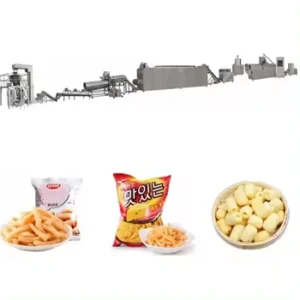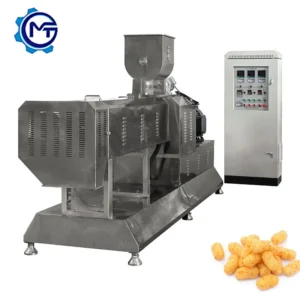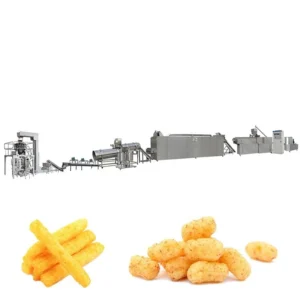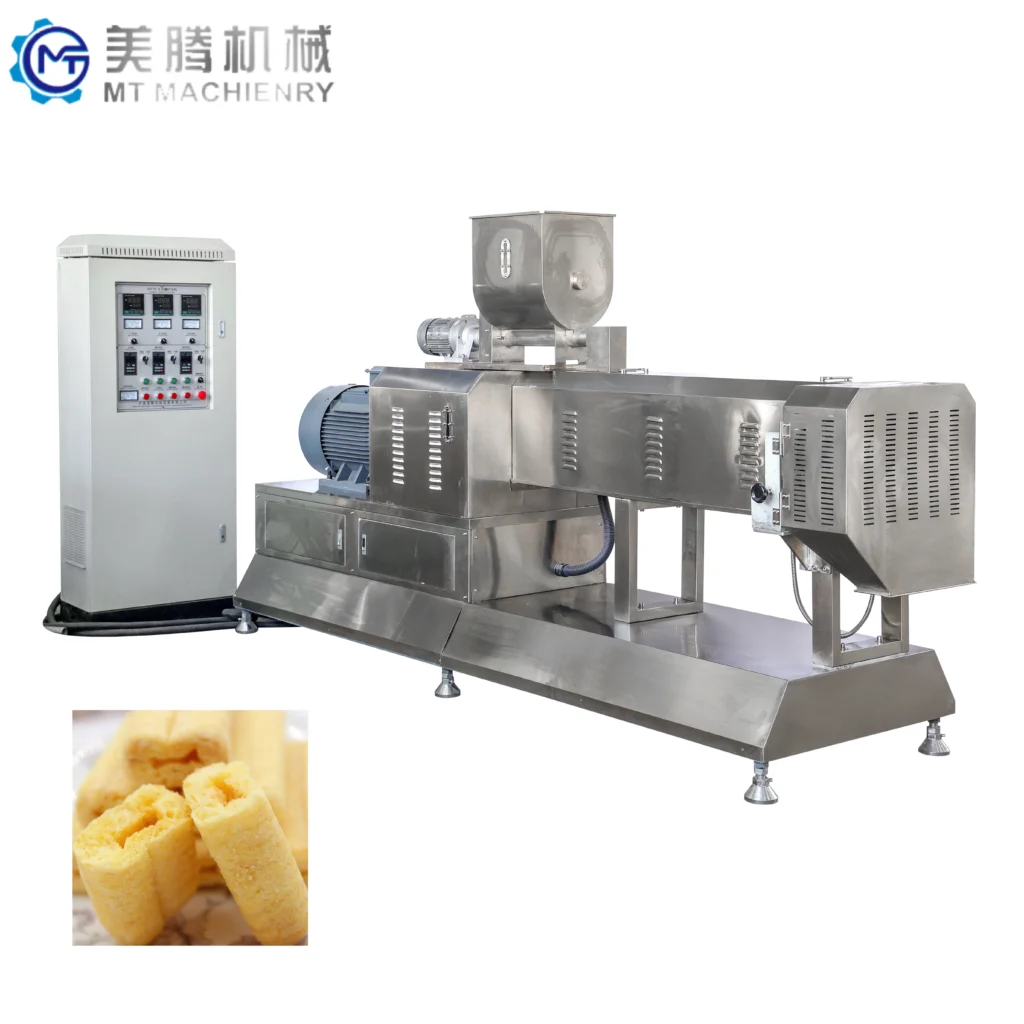
Balanced throughput across every station — Each twin screw extruder model is paired with dryers, flavoring drums and packing systems sized to the actual output of the MT65 through MT100 platform, preventing bottlenecks between extrusion and downstream handling.
Technical Specifications
| Parameter | Value |
|---|---|
| Product Type | Twin Screw Extruded Corn Puff Snack Production Line |
| Model Options | MT65 / MT70 / MT85 / MT100 |
| Screw Type | Twin Screw |
| Installed Power (MT65) | 130 kW |
| Installed Power (MT70) | 180 kW |
| Installed Power (MT85) | 220 kW |
| Installed Power (MT100) | 240 kW |
| Real Power Consumption (MT65) | 95 kW |
| Real Power Consumption (MT70) | 120 kW |
| Real Power Consumption (MT85) | 130 kW |
| Real Power Consumption (MT100) | 160 kW |
| Output Capacity (MT65) | 120–150 kg/h (basis not stated in source — confirm raw material type, moisture content and die configuration) |
| Output Capacity (MT70) | 200–300 kg/h (basis not stated in source — confirm raw material type, moisture content and die configuration) |
| Output Capacity (MT85) | 300–500 kg/h (basis not stated in source — confirm raw material type, moisture content and die configuration) |
| Output Capacity (MT100) | 600–800 kg/h (basis not stated in source — confirm raw material type, moisture content and die configuration) |
| Control System | Frequency speed controlling system with automatic lubrication and cooling |
| Die Configuration | Interchangeable dies for cheese ball, tube, stick, ring, fruit loop, star, wheel, flower, heart shapes |
| Core Filling Option | Available with additional core filling machine and cutting machine |
| Dryer Heating Source Options | Electric / Steam / Gas |
| Flavoring System | Double drum flavoring line with sugar melting and spraying nozzle |
| Line Stations | Mixing → Batching → Extruding → Drying → Coating / Flavoring → Cooling → Packing → Stacking |
| Packing Machine | Automatic weighing, sealing, marking, coding; vibration feeding with electronic pad weighing |
| Standards | CE certified; ISO certified |
| Warranty | 1 year free warranty |
Application Suitability
| Application | Material or Output |
|---|---|
| Direct-expanded puffed snacks | Corn flour, rice flour, wheat flour, oat flour, barley flour |
| Shaped extruded snack formats | Cheese balls, tubes, sticks, rings, fruit loops, stars, wheels, flowers, hearts |
| Core-filled cream or jam snacks | Grain-based outer shell with cream, chocolate or fruit jam center |
| Coated and flavored snack products | Sugar-glazed, salt-seasoned or spice-coated puffed shapes |
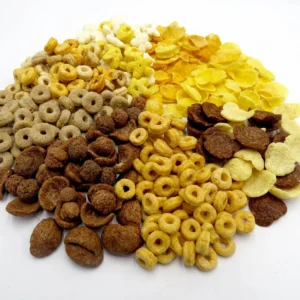
| Breakfast cereal adjuncts | Extruded corn or rice pieces for cereal blending |
Why Nominal Capacity Figures Mislead Snack Equipment Buyers
A quoted output number means little without the raw material and die shape that produced it.
I once worked with a buyer making corn puff snacks who ordered a line based on a catalog capacity figure. When his specific corn flour blend — slightly finer than what we had used during testing — entered the barrel, the expansion rate dropped and throughput fell well short of the nameplate number. We spent days reconfiguring the screw combination before the line ran to his expectation. A snack food extrusion equipment manufacturer that quotes capacity without asking for your raw material sample is guessing, and the buyer absorbs the risk. Different moisture levels, fat contents and particle sizes in grain blends alter how the material behaves inside the barrel, changing expansion, density and ultimately how many kilograms per hour the line can actually hold [NEED_CITE: raw material moisture effect on twin screw extrusion output].
Matching the Extruder to the Downstream Stations
Selecting a twin screw extruder in isolation creates an imbalance the moment the product leaves the die. The MT65 through MT100 models span a wide output range, and each tier requires a correspondingly sized dryer, flavoring system and cooling conveyor. A snack food extrusion equipment manufacturer must specify these stations together so that the drying capacity handles the moisture load exiting the extruder and the double drum flavoring line keeps pace without product backing up on the belt.
Die Selection and Shape Changeover on the Same Platform
The interchangeable die system on this line allows producers to run multiple snack formats — from cheese balls to fruit loops — without purchasing separate extruders. The key is matching the die geometry with the correct screw configuration and barrel temperature profile for the target shape. A tube die requires different shear and residence settings than a star die, and the control system must store or allow quick adjustment of those parameters between runs.
Reading the Power and Capacity Table Correctly
The installed power figures for the MT65 through MT100 models represent peak motor and heating draw, while the real power consumption values reflect sustained running load across a typical shift. For the MT85, the installed power is 220 kW but actual consumption sits around 130 kW — a difference that affects utility planning and transformer sizing at the installation site. Output capacity figures listed for each model carry a caveat: they were established under specific raw material and die conditions, and your actual grain blend must be tested before those numbers can be confirmed for your line [NEED_CITE: electrical load planning for food extrusion facilities].
The Hidden Cost of Unmatched Line Configuration
When the dryer cannot remove moisture fast enough, the product reaches the flavoring drums too wet, causing sugar and seasoning to clump rather than coat evenly. When the cooling conveyor is too short for the extruder output, the snack enters the packing station warm, leading to condensation inside sealed bags and reduced shelf life. These downstream failures trace back to a line assembled from individually quoted stations rather than configured as one balanced system. Buyers who discover this after commissioning face weeks of lost production while individual components are resized or replaced [NEED_CITE: throughput bottleneck causes in snack extrusion lines].
Why Buyers Source the Full Line Here
Every station from batching through stacking is specified under one supplier, meaning throughput calculations start from your raw material rather than from generic assumptions. The screw configuration and die design are documented against your specific grain blend and target shape, not copied from a previous build. Before shipment, the line runs a trial using your actual raw material in the testing workshop, producing a report that shows real expansion, density and output. The MT65 through MT100 platform uses frequency speed control with automatic lubrication and cooling, reducing manual intervention during long production runs. Voltage, frequency and control panel language are confirmed with your facility specifications before production begins, avoiding the delays that occur when a machine arrives wired for the wrong electrical standard.
Documentation & Verification
- Line layout drawing with matched throughput calculations for your selected extruder model and raw material
- Screw and die configuration record specifying the barrel zones, screw element sequence and die geometry for your target snack shape
- Trial run report documenting expansion rate, product density and output on your actual grain blend before shipment
- Electrical schematic confirming voltage, frequency, control language and circuit protection ratings for your site
- Operation and maintenance manual covering screw changeover, die cleaning and lubrication intervals for your specific model
- CE declaration of conformity and ISO certificate for customs clearance and local regulatory compliance
Installation, Commissioning & Support
- Utility plan confirming power supply requirements based on the real consumption figures for your chosen MT65 through MT100 model
- Dryer heating source matched to your local availability — electric, steam or gas — specified before fabrication
- Frequency speed control system calibrated on-site with automatic lubrication intervals set for your shift pattern
- Operator training on die changeover procedure and screw element inspection for your target snack shapes
- Wear parts list identifying screws, dies and barrel liners with recommended replacement intervals for your grain blend
- Packing machine setup with electronic pad weighing calibrated to your bag size and target fill weight
What We Need to Configure Your Line
To move from a general inquiry to a specific proposal, we need your raw material type and particle size, the snack shapes you plan to produce, and your target hourly output. Share your facility voltage and frequency along with the control panel language your operators require. If you already have upstream grinding or downstream cartoning equipment, provide the model and throughput so we can match the interface points. We also recommend sending a raw material sample so the testing workshop can validate expansion and output before we finalize the screw and die configuration.
Frequently Asked Questions
Q: How is the output capacity of each extruder model verified before the line is built?
A: Each model — MT65, MT70, MT85, MT100 — carries a capacity range, but those figures depend on the raw material, moisture level and die shape. We request a sample of your grain blend and run it in our testing workshop on the screw and die combination specified for your product. The resulting trial report documents the actual output and product density, replacing generic catalog numbers with verified figures for your line.
Q: Which supporting stations are included, and how is throughput balanced between them?
A: The line covers mixing, batching, extruding, drying, flavoring, cooling, packing and stacking. Each station is sized to handle the output of the extruder model you select — the dryer length, flavoring drum volume and cooling conveyor speed are all calculated from your extruder throughput so that no single station bottlenecks the others during continuous production.
Q: What heating sources are available for the dryer, and how do we choose the right one?
A: The dryer is available with electric, steam or gas heating. The choice depends on your facility utility infrastructure and local energy costs. We confirm your available heating source during the specification stage so the dryer is fabricated to match, avoiding conversion work or additional equipment after delivery.
Q: What additional equipment does the core filling variant require compared to the standard puffed snack line?
A: The core filling configuration adds a dedicated filling machine that injects cream or jam into the extruded product and a cutting machine that separates individual pieces. These two stations sit between the extruder and the dryer. The remaining line stations — mixing, drying, flavoring, cooling and packing — remain the same as the standard configuration.
Q: How are voltage, frequency and control panel language confirmed before production?
A: During the specification stage we request your facility electrical standard and preferred operator language. These details are documented in the electrical schematic and confirmed before fabrication begins, so the frequency speed control system, motor wiring and panel labels arrive correct for your site and your production team.