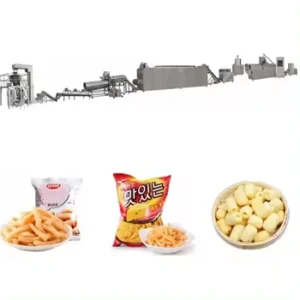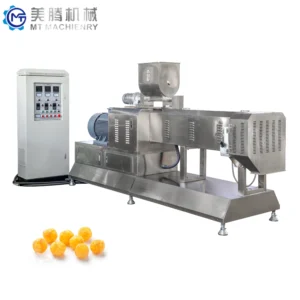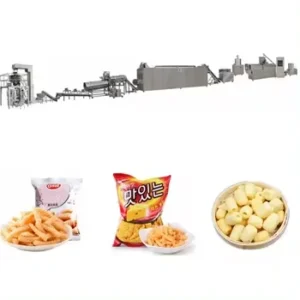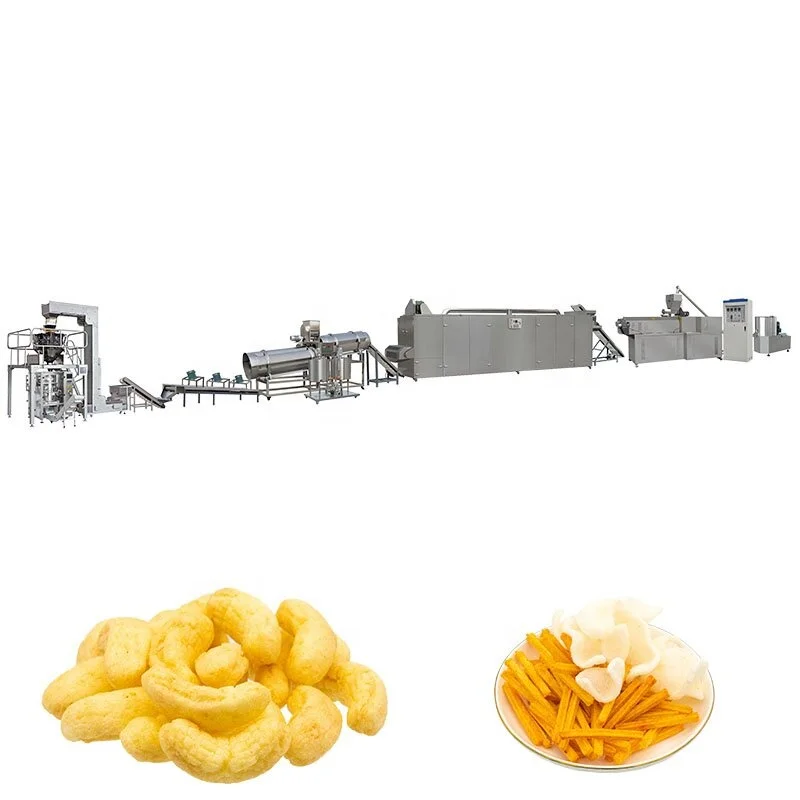
Throughput-Matched Stations — every extruder, dryer, and flavoring drum is sized to the same verified output so no single unit chokes the line when your actual formulation runs.
Technical Specifications
| Parameter | Value |
|---|---|
| Product Type | Twin Screw Puffed Snack Extrusion Line |
| Extruder Configuration | Twin Screw (Double Screw) |
| Line Sequence | Mixing → Extruding → Shaping → Cutting → Drying → Flavoring |
| Control System | PLC or MCC, configurable per project |
| Dryer Type | Multi-layer, variable length based on product moisture target |
| Flavoring System | Semi-automatic or automatic; handles sugar, oil, and powder seasoning |
| Output Capacity | To be confirmed against buyer’s raw material and snack format (basis to be confirmed) |
| Screw & Die Setup | Matched to buyer’s raw material and target product geometry |
| Voltage & Frequency | Configured per destination market |
| Contact Materials | Food-grade stainless steel on all product-contact surfaces |
| Trial Run | In-house testing on customer raw material before shipment |
| Certification | CE (since 2014), ISO |
| Warranty | 24 months, lifetime service support |
Application Suitability
| Application | Material or Output |
|---|---|
| Puffed corn snacks | Maize grits, corn flour, and blended grain formulations |
| Puffed rice snacks | Rice flour, broken rice, and rice-based composite mixes |
| Core-filled snacks | Grain-based shell with cream, chocolate, or fruit filling |
| 2D and 3D pellet snacks | Potato starch, corn starch, and modified starch blends |
| Extruded and fried snacks | Corn, wheat, and multigrain doughs shaped for post-fry finishing |
Why Nominal Capacity Numbers Fail on Your Actual Grain Mix
A rated throughput figure only holds if the screw profile, barrel heating zones, and dryer length were all calculated for the formulation you will actually feed into the hopper.
I spent two weeks on a European commissioning job where the line ran fine on standard corn flour at the factory, but the buyer’s real recipe was a mixed-grain blend with higher fiber content. The extruder pushed product through, yet the downstream dryer could not keep up, and puffed pieces collapsed before reaching the flavoring drum. Nobody had matched the stations to that specific recipe beforehand [NEED_CITE: effects of fiber content on extrusion expansion and drying time]. That is the gap a twin screw puffed snack extrusion line manufacturer must close before the crate leaves the workshop.
Screw Geometry Decides What Your Recipe Becomes
The twin-screw extruder at the heart of this line is not a fixed machine; its screw elements, kneading blocks, and die plate are selected after reviewing the buyer’s raw material data sheet. A high-starch corn grits recipe demands a different compression ratio and residence time than a rice-flour blend intended for delicate 3D pellets. Getting this wrong means the product exits the die at the wrong moisture and density, and no amount of dryer tuning downstream can recover the intended crunch.
Dryer Sizing That Follows the Extruder, Not the Other Way Around
Post-extrusion moisture removal is where many lines quietly lose capacity. The multi-layer dryer on this twin screw puffed snack extrusion line is configured in length and layer count after the extruder’s actual output moisture is measured during the trial run. A line producing core-filled snacks at higher moisture needs more belt travel and more heating zones than one running dry corn puffs. When the dryer is undersized, the extruder must slow down, and the entire line’s effective throughput drops below what was quoted.
Control Architecture Across Every Station
PLC or MCC control links the mixer feed rate, extruder screw speed, barrel temperature zones, dryer belt speed, and flavoring drum rotation into one coordinated sequence. The operator sets the recipe once, and each station tracks the same production target. This matters because manual speed adjustments between stations introduce the kind of variation that causes some batches to arrive at the packing table over-dried and others under-dried [NEED_CITE: PLC synchronization benefits in continuous food processing lines].
What the Specs Mean on the Shop Floor
The twin-screw design allows the processing of low-moisture grain flours and high-fat formulations that a single-screw extruder would struggle to convey consistently. Screw configuration and die selection directly control expansion ratio, meaning the same machine can shift from dense pellet snacks to light puffed corn simply by changing the screw profile and die geometry. Food-grade contact materials throughout the product path prevent metallic contamination and meet export market hygiene requirements. The in-house trial run validates that the chosen configuration actually produces the target snack texture on the buyer’s specific raw material before the line is packed for shipping.
The Hidden Cost of Mismatched Station Capacity
When a dryer or flavoring drum is specified from a catalog rather than calculated against the extruder’s real output, the bottleneck reveals itself only after installation. Production targets slip, operators run the extruder below capacity to avoid product pile-up, and the buyer faces weeks of re-commissioning to rebalance the line. I have seen flavoring drums that could not coat fast enough, leaving half the shift’s output sitting in totes waiting for seasoning. Those losses compound quickly once commercial deliveries begin [NEED_CITE: throughput bottleneck costs in snack food manufacturing].
Why Buyers Source This Line Here
Every station from batching to packing comes from a single supplier, which means throughput calculations are done across the full line rather than per individual machine. Screw and die configurations are documented against the buyer’s raw material, not copied from a generic template. The in-house testing workshop runs the buyer’s actual formulation before shipment, generating a trial report that confirms expansion, density, and moisture. CE certification has been maintained since 2014, satisfying European import requirements without last-minute compliance scrambles. Pre-sales engineering covers line layout, utility planning, and voltage confirmation so that commissioning starts with parameters already close to final.
Documentation & Verification
- Line layout drawing showing throughput balance across every station
- Screw and die configuration record tied to your raw material and snack format
- Trial run report from in-house testing on your actual formulation before dispatch
- Electrical schematic with voltage and frequency confirmed for your market
- Operation and maintenance manual in English with wear parts list
Installation, Commissioning & Support
- Foundation and floor-space plan based on the configured dryer length and line footprint
- Dedicated power circuit sized to the extruder motor and dryer heating load
- Line arrives in modular sections for sequential assembly matching the installation schedule
- First-run parameter setting on your raw material with screw speed and temperature profile logged
- Operator training covering recipe changeover, die swaps, and daily cleaning procedures
- Wear parts list including screws, dies, and dryer belts with reorder codes
What We Need to Configure Your Line
Send us the grain or starch formulation you plan to run, including moisture content and particle size if available. Tell us the target snack format — corn puff, core-filled, pellet — and the daily output you need to meet. Confirm your facility’s voltage and frequency, the control language your operators prefer, and whether you want to ship raw material to our testing workshop for a trial run before the line is finalized.
Frequently Asked Questions
Q: How do you verify the line’s output on my specific raw material before shipment?
A: We run your actual formulation through the configured extruder in our in-house testing workshop. The trial records expansion ratio, product density, moisture at the die exit, and final texture. You receive a written trial run report so you can evaluate the result before the line ships.
Q: How do you ensure the dryer and flavoring stations keep pace with the extruder?
A: Dryer length, layer count, and belt speed are calculated from the moisture and throughput measured during the trial run. The flavoring drum rotation and seasoning feed rate are matched to the same output figure. Every station is sized to the same verified capacity.
Q: What voltage, frequency, and control language will the line ship with?
A: We confirm your facility’s electrical standard and the operator language during the specification stage. The electrical schematic and PLC interface are built to those values, and the confirmation is documented before production begins.
Q: Can I send my own raw material for a trial before the line ships?
A: Yes. Buyers are encouraged to ship a sample batch of their production formulation to our testing workshop. The trial run uses your material on the configured screw and die setup, and the results are shared in a report before the line is packed.
Q: What spare wear parts ship with the line, and how do I reorder?
A: The initial shipment includes a documented wear parts list covering screws, die plates, and dryer belt sections. Each item carries a reorder code so replacements can be specified and dispatched without guesswork when your first changeover is due.