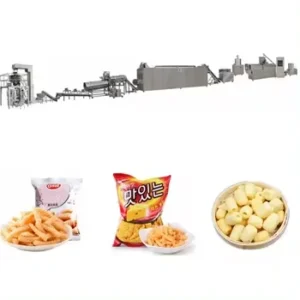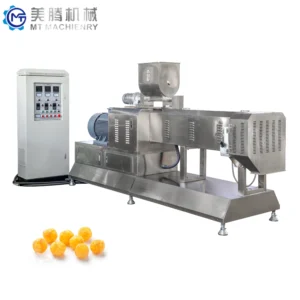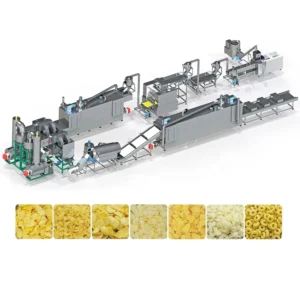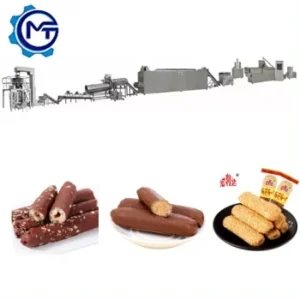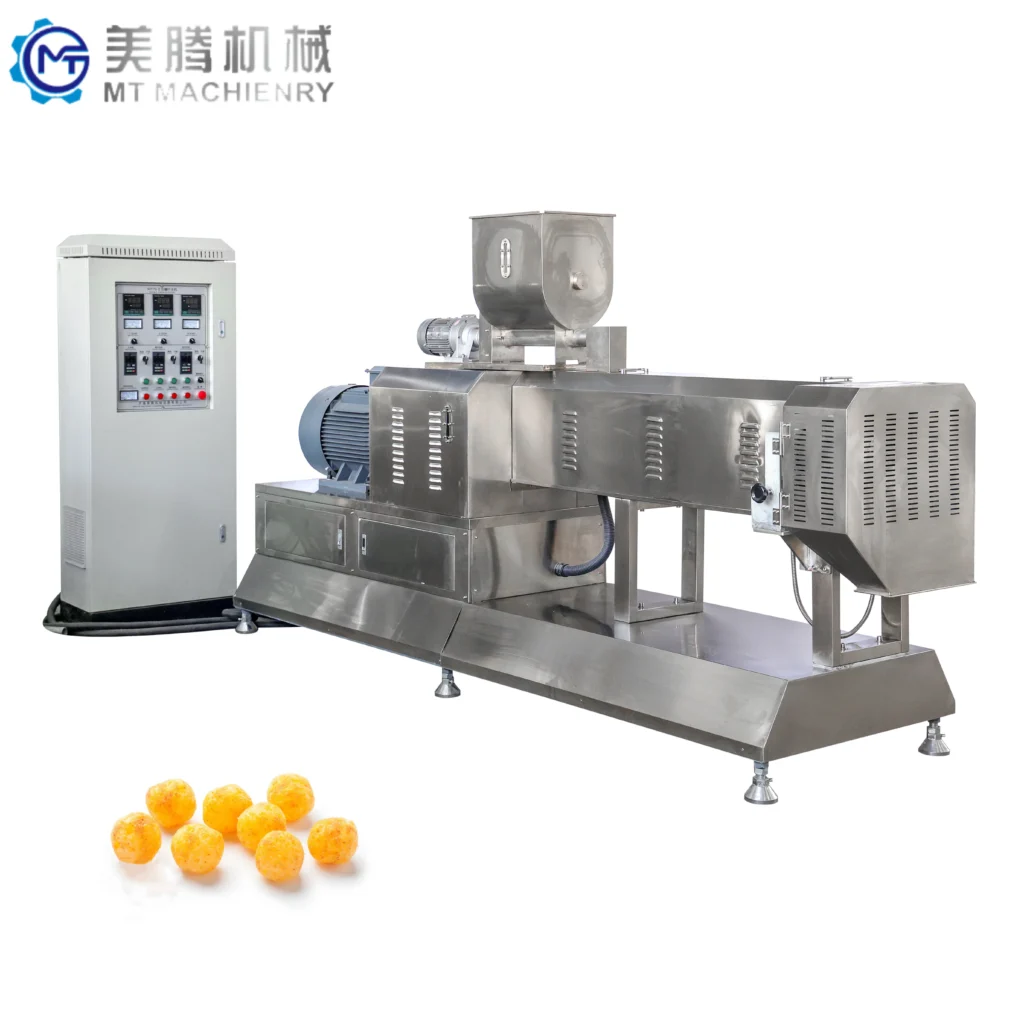
Balanced Throughput Across Stations — Every supporting station in the twin screw puffed snack extrusion line is matched to the extruder’s real consumption and output, preventing dryer or flavoring bottlenecks before the line ships.
Technical Specifications
| Parameter | Value |
|---|---|
| Product Type | Twin Screw Puffed Snack Food Extrusion Line |
| Models Available | MT65, MT70, MT85, MT100 |
| Screw Type | Twin Screw |
| Installed Power (MT65) | 130 kW |
| Real Consumption (MT65) | 95 kW |
| Installed Power (MT70) | 180 kW |
| Real Consumption (MT70) | 120 kW |
| Installed Power (MT85) | 220 kW |
| Real Consumption (MT85) | 130 kW |
| Installed Power (MT100) | 240 kW |
| Real Consumption (MT100) | 160 kW |
| Output Capacity (MT65) | 120–150 kg/h (basis not stated in source — confirm raw material type and moisture content) |
| Output Capacity (MT70) | 200–300 kg/h (basis not stated in source — confirm raw material type and moisture content) |
| Output Capacity (MT85) | 300–500 kg/h (basis not stated in source — confirm raw material type and moisture content) |
| Output Capacity (MT100) | 600–800 kg/h (basis not stated in source — confirm raw material type and moisture content) |
| Control System | Frequency speed controlling system |
| Dryer Heating Source Options | Electric / Steam / Gas |
| Flavoring System | Double drum flavoring line with sugar melting and spraying nozzle |
| Optional Add-on | Core filling machine and cutting machine |
| Die Configuration | Interchangeable dies (ball, tube, stick, ring, star, wheel, flower, heart, fruit loop) |
| Assembly State | Turnkey complete line |
| Warranty | 1 year |
| Certification | CE |
Application Suitability
| Application | Material or Output |
|---|---|
| Puffed corn snacks | Corn flour, corn grits — cheese balls, rings, tubes, sticks, stars, wheels |
| Puffed rice snacks | Rice flour, rice grits — rice balls, fruit loops, flowers, hearts |
| Multi-grain extruded snacks | Wheat, oat, barley flour blends — varied shapes via die changeover |
| Core-filled snacks | Cereal-based shell with cream or jam center (requires optional core filling station) |
Why the Dryer and Flavoring Drum Matter More Than the Extruder Nameplate
A Twin Screw Puffed Snack Extrusion Line Full Equipment Range only performs as well as its slowest station.
Many buyers focus on the extruder motor and screw diameter, then discover after installation that the dryer cannot keep pace or the flavoring drum creates a backlog. The result is an extruder running at partial capacity while downstream equipment catches up, wasting energy and shrinking actual output. Specifying every station side by side — with real power consumption and throughput figures — prevents this mismatch before the purchase order is signed. [NEED_CITE: throughput balancing across extrusion line stations]
Surveying the Complete Station Catalogue
The twin screw puffed snack extrusion line full equipment range covers material batching, extruding, drying, coating and flavoring, cooling, packing, and stacking. Each station is listed with its own power draw and functional role, so buyers can compare capacity across the entire workflow rather than evaluating the extruder in isolation. This catalogue approach helps technical teams verify that no single station constrains the others.
Matching Utility Requirements to Factory Infrastructure
Real consumption figures for each extruder model — from 95 kW on the MT65 to 160 kW on the MT100 — allow electrical engineers to plan transformer capacity and dedicated circuits accurately. Dryer heating source options include electric, steam, and gas, letting buyers align the line with existing boiler or gas infrastructure. Confirming these utility parameters before production avoids costly rewiring or fuel system modifications after delivery. [NEED_CITE: industrial voltage and frequency standards by export market]
Reading the Power and Capacity Table Correctly
Installed power and real consumption diverge significantly across all four models, reflecting the difference between peak motor rating and sustained operating draw. The frequency speed controlling system adjusts screw RPM to match raw material behavior, meaning actual consumption shifts with formulation changes. Die configuration — spanning ball, tube, stick, ring, star, wheel, flower, heart, and fruit loop shapes — determines expansion ratio and product density, which in turn affects dryer residence time and flavoring drum throughput. Buyers should cross-reference their target shape with the capacity calculation document to confirm that downstream stations remain balanced under that specific die and formulation.
The Cost of an Unbalanced Line Configuration
When an extruder is paired with an undersized dryer, partially dried product enters the flavoring drum, causing seasoning to clump rather than coat evenly. Undersized cooling conveyors then pass warm product into packing bags, trapping moisture and shortening shelf life. These problems surface only during production, when re-engineering the line means replacing stations and absorbing weeks of downtime. [NEED_CITE: common causes of post-installation extrusion line reconfiguration]
Why Procurement Starts with the Full Catalogue
Every station from batching to stacking is available from a single supplier, so throughput calculations are coordinated rather than assembled from separate vendor quotations. Screw configuration and die design are specified to the buyer’s raw material and target product shape, not copied from a generic template. An in-house testing workshop runs trial production on customer-supplied raw material before shipment, generating a trial run report that validates texture and expansion. Pre-sales consultation covers line layout, utility planning, and phased installation scheduling. CE-certified equipment and complete documentation packages support customs clearance and local regulatory compliance.
Documentation & Verification
- Line layout and capacity calculation matched to your target snack shape and raw material formulation
- Machine specification sheet for every station with rated and real power consumption values
- Screw and die configuration record documenting the exact tooling shipped with your extruder
- Electrical schematic with voltage and frequency confirmed for your destination market
- Trial run report on your raw material validating expansion ratio and product density before dispatch
- CE declaration of conformity and factory test record included in shipping documentation
Installation, Commissioning & Support
- Foundation and floor space plan provided for the full line from batching through stacking stations
- Dedicated circuit sizing based on real consumption figures ranging from 95 kW to 160 kW per extruder model
- Stations shipped in modular sections for sequential assembly aligned with your facility access constraints
- First-run parameter setting covering screw speed, barrel temperature profile, and dryer residence time
- Operator training on die changeover procedures across all interchangeable shape formats
- Wear parts list specifying screws, dies, and spray nozzles with recommended first-order quantities
What to Include in Your Inquiry
Provide your target raw material formulation — including flour type, moisture content, and any fat or sugar additions — along with the specific snack shapes you plan to produce. Specify your local voltage, frequency, and preferred control language so that electrical and interface configurations are locked before production begins. Indicate your available floor space and ceiling height to guide the line layout proposal.
Frequently Asked Questions
Q: How do I select the right extruder model for my target output and raw material?
A: Each model from MT65 through MT100 covers a different capacity band, but actual throughput depends on your raw material formulation and moisture content. Request a capacity calculation based on your specific flour blend and target shape, then verify the result through a trial run on your material before confirming the order.
Q: How is throughput balanced across dryer, flavoring, and cooling stations?
A: Every supporting station is sized to match the extruder’s real consumption and output for your product format. The line layout document shows throughput at each station, and the trial run validates that no single station creates a bottleneck under your actual operating conditions.
Q: Can this line produce core-filled snacks, and what changes are required?
A: Yes. Adding the optional core filling machine and cutting station converts the standard puffed snack line into a core-filled format. The extruder, dryer, and flavoring stations remain the same; only the forming and cutting section is modified to inject and seal the center filling.
Q: What electrical and control options should I confirm before production?
A: Confirm your factory voltage, frequency, and preferred control panel language. The dryer heating source — electric, steam, or gas — must also match your available utilities. These parameters are documented in the electrical schematic and locked before manufacturing begins.
Q: What spare wear parts should I order with the initial shipment?
A: Screws, dies, and spray nozzles are the primary wear items. The wear parts list included in your documentation specifies recommended first-order quantities based on your production volume and raw material abrasiveness, ensuring replacements are on hand when the first changeover is due.