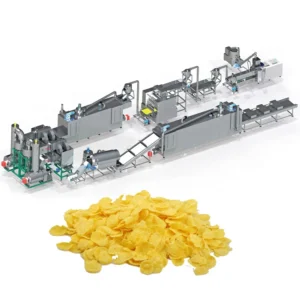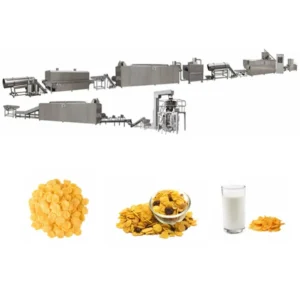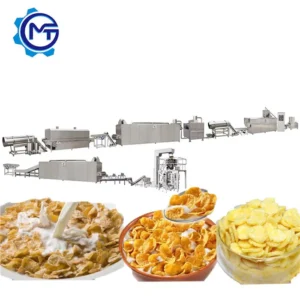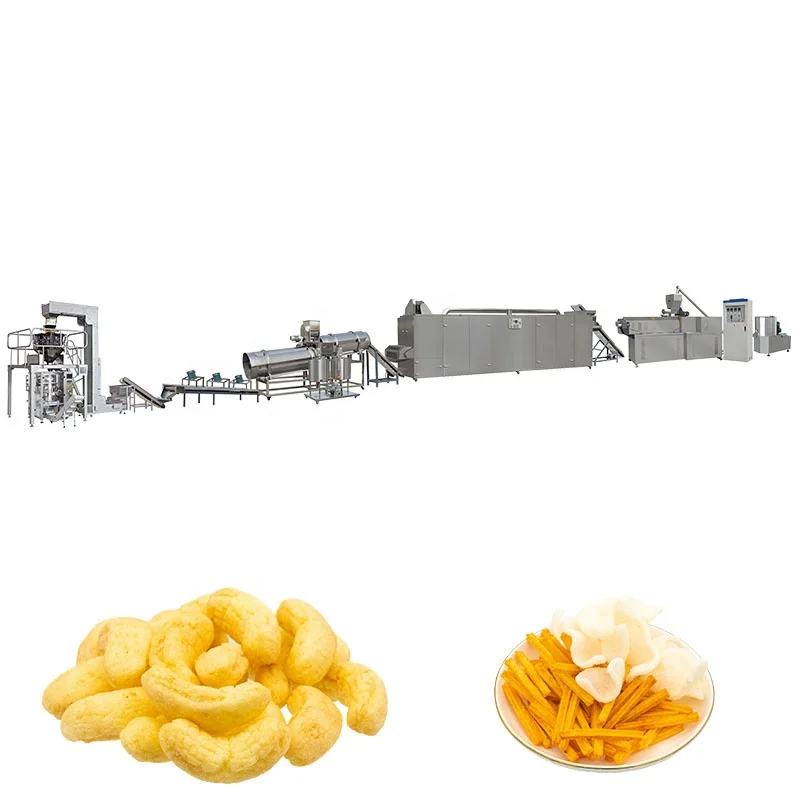
Complete Line Synchronization — throughput at every station from mixing to packing is calculated against the MT75 extruder’s actual output so no single machine bottlenecks the corn flakes line.
Technical Specifications
| Parameter | Value |
|---|---|
| Model | MT75 |
| Product Type | Twin Screw Extruder Corn Flakes Production Line |
| Screw Type | Twin Screw |
| Installed Power | 210 kW |
| Power Consumption | 150 kW |
| Output Capacity | 300–500 kg/hr (basis not stated in source — confirm raw material, moisture, and product format) |
| Overall Dimensions | 45 × 1.5 × 3.5 m |
| Control System | PLC and MCC control |
| Flaking Machinery Drive | Dual independent motors with hydraulic roller system |
| Flaking Temperature Control | Infrared sensor |
| Dryer Heating Source | Gas or Electric |
| Roasting Oven | Hot air with conciliation burner, dual circulating fans, cyclone dust removal, vibrating pan |
| Coating System | Double tumble sugar melter, elevator, coating drum, precision spraying nozzles |
| Assembly State | Complete line from mixing to packing |
| Certifications | CE, ISO |
Application Suitability
| Application | Material or Output |
|---|---|
| Natural corn flakes | Corn grits, de-germed corn meal |
| Sugar-coated corn flakes | Corn, rice, wheat base with sugar syrup coating |
| Shaped breakfast cereals | Corn, rice, oat, barley powders formed into balls, tubes, rings, stars, wheels |
| Fortified cereal production | Cereal blends with added vitamin and mineral premix |
Why the Supporting Equipment Matters More Than the Extruder Itself
A corn flakes machine full equipment range only performs as well as its slowest station.
When buyers focus entirely on extruder capacity and treat dryers, flakers, and roasters as afterthoughts, the line stalls. I saw this firsthand on a corn flakes installation in West Africa where the extruder was pushing product faster than the dryer could handle moisture removal — the flakes arrived at the roaster damp, stuck to the vibrating pan, and scorched within minutes. The breakfast cereal production line equipment had been quoted as matched, but the dryer’s residence time had never been verified against the actual throughput [NEED_CITE: industrial dryer residence time calculations for extruded cereal products]. Matching every station to the extruder’s real output on your specific raw material prevents these costly mismatches.
How Each Station Shapes the Final Flake
The MT75 twin screw extruder handles the initial gelatinisation and expansion, but the flaking mill downstream determines whether you get a uniformly thin flake or a cracked, uneven sheet. The hydraulic double-roller system with independent motors allows each roller to maintain consistent pressure even when feed density fluctuates, and the infrared sensor monitors roller temperature in real time to prevent sticking on high-sugar formulations.
From Roasting to Coating — Where Texture Is Won or Lost
The hot air roasting oven uses a conciliation burner with two separate circulating fans and a cyclone dust removal device, which keeps fine cereal particles from recirculating and burning onto the flake surface. The vibrating pan with high-temperature spraying tubes ensures flakes tumble rather than stack, so each piece receives even heat exposure. Downstream, the double tumble sugar melter feeds the coating drum through a dedicated elevator and precision spraying nozzles, giving sugar-coated variants a consistent glaze without clumping — a common defect when coating systems are undersized relative to the extruder [NEED_CITE: sugar coating uniformity challenges in breakfast cereal production].
Reading the Specs That Actually Affect Your Output
The twin screw configuration on the MT75 provides the shear and mixing intensity needed for thorough starch gelatinisation across a range of cereal bases, from corn grits to oat blends. Screw configuration and die design must be matched to the specific raw material — a generic setup will produce the wrong density, causing flakes that either shatter during roasting or remain too dense and chewy. The 210 kW installed power with 150 kW operating consumption reflects the energy profile across continuous extrusion, flaking, and drying cycles, so buyers planning utility infrastructure should size transformers and dedicated circuits accordingly. PLC and MCC control across the line means every station communicates throughput status, which matters when a feed interruption at the mixer needs to cascade into a pause at the flaker and roaster rather than dumping product onto a stopped conveyor.
The Cost of Undersized Supporting Equipment
When a dryer cannot keep pace with the extruder, partially dried flakes enter the roaster and require extended dwell time, which reduces overall line throughput and increases gas or electric consumption without delivering a crispier product. When the coating drum is too small for the sugar-coated corn flakes volume, flakes pile up, syrup distribution becomes uneven, and the rejected batch rate climbs noticeably [NEED_CITE: coating system capacity and product rejection rates in cereal manufacturing]. These are not problems that appear during a factory demonstration — they surface during the first full production run on your actual raw material.
What Sets This Equipment Range Apart
Every station in this corn flakes machine full equipment range is sourced and configured by a single supplier, so throughput calculations span the entire line rather than stopping at the extruder discharge. Screw and die configurations are specified against the buyer’s raw material and target flake thickness, not copied from a generic build. The flaking machinery, roasting oven, and coating system are sized to match the extruder’s verified output, eliminating the station-level bottlenecks that plague assembled-from-separate-vendors lines. An in-house testing workshop allows trial runs on customer-supplied raw material before shipment, so screw adjustments and moisture targets are confirmed before the line leaves the factory.
Documentation & Verification
- Line layout and capacity calculation for every station from mixing through packing
- Machine specification sheet with screw and die configuration matched to your cereal base
- Electrical schematic and voltage confirmation for your facility’s utility supply
- Trial run report documenting output on your raw material before dispatch
- Factory test record covering all stations under continuous operation
Installation, Commissioning & Support
- Foundation and floor space planning based on the 45 × 1.5 × 3.5 m line footprint
- Dedicated power circuits sized for 210 kW installed load with local voltage and frequency confirmation
- Station-by-station commissioning starting with extruder screw alignment and barrel temperature profiling
- PLC and MCC control language configured to match your operator team’s requirements
- Flaking roller pressure and infrared sensor calibration during initial production runs
- Wear parts list covering screws, dies, and roller surfaces with recommended replacement intervals
Before You Request a Quote
To configure a corn flakes line that holds capacity on your material, share your raw material type and moisture content, target flake dimensions, and whether the end product is natural or sugar-coated. Also confirm your facility’s voltage, frequency, and available floor length so the layout can be drafted without revision cycles.
Frequently Asked Questions
Q: How is throughput matched across every station to avoid bottlenecks?
A: Each station — extruder, flaker, dryer, roaster, coater — is sized using capacity calculations based on the extruder’s verified output on your raw material. The layout proposal documents residence time and throughput at every point so no single machine restricts the line.
Q: Can the line be configured for different voltage and frequency standards?
A: Yes. Voltage, frequency, and control language are confirmed during the specification stage to match your facility’s utility supply and operator requirements. The electrical schematic reflects your local standards before production begins.
Q: How are screw and die configurations determined for specific cereal shapes?
A: Screw elements and die geometry are selected based on your raw material composition and target product — whether flat flakes, rings, balls, or tubes. The in-house testing workshop runs your actual material before shipment to verify expansion, density, and shape.
Q: Is a trial run performed before the line ships?
A: Yes. Customer-supplied raw material is processed through the extruder and supporting stations in the testing workshop. The trial run report documents throughput, moisture levels, and product quality so adjustments are made before installation.
Q: What supporting equipment sizing is needed to match the extruder?
A: Dryer length, roaster capacity, and coating drum volume are all calculated against the extruder’s confirmed output. Undersized supporting equipment causes bottlenecks that reduce effective line capacity, so each station is specified to maintain continuous flow.