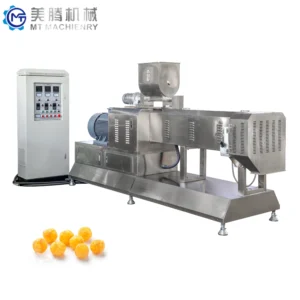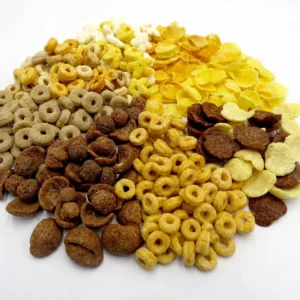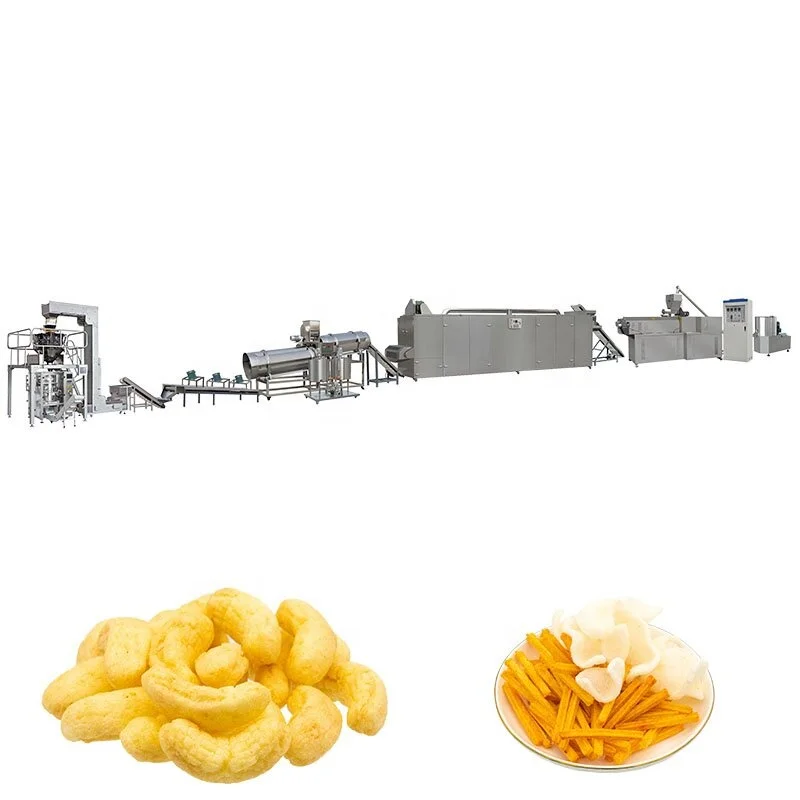
Complete Line Integration — Every station from batching to packing is sourced and configured under one supplier, eliminating the throughput mismatches that plague multi-vendor snack lines.
Technical Specifications
| Parameter | Value |
|---|---|
| Product Type | Puffed Snack Food Extrusion Line |
| Extruder Type | Twin-screw |
| Line Configuration | Full automatic from mixing, extruding, shaping, cutting, drying to flavoring |
| Control System | Electric industrial automatic with PLC/MCC options |
| Dryer Design | Multi-layer, configurable length and layer count |
| Flavoring System | Semi-automatic and automatic options for powder, oil, and sugar seasonings |
| Screw & Die Setup | Interchangeable configurations for varied puff and fried snack formats |
| Assembly State | Complete turnkey line |
| Certification | CE, ISO |
| Warranty | 24 months, lifetime service |
Application Suitability
| Application | Material or Output |
|---|---|
| Puffed Corn Snacks | Maize, corn grits, and grain-based formulations |
| Puffed Rice Snacks | Rice flour and composite grain blends |
| Core-Filled Snacks | Cereal-based shells with cream, chocolate, or fruit paste centers |
| Fried Extruded Snacks | Corn and wheat-based pellets for secondary frying |
| Artificial Rice | Rice flour, starch, and fortified nutrient blends |
Why "Nominal Capacity" Quotations Derail Snack Line Throughput
A rated output means nothing unless it is validated against the moisture, fat, and starch content of the specific corn or rice formulation you will actually run.
I have seen buyers lock in a twin-screw extruder based on a brochure figure, only to discover during commissioning that their local corn grits carry a higher moisture baseline than the factory test material. The extruder then requires a slower feed rate to achieve proper gelatinisation, and the entire line — dryer, coating drum, packing station — sits half-empty. The puffed snack food machine full equipment range is configured around your raw material profile, not a generic benchmark. [NEED_CITE: starch gelatinisation temperature and moisture dependence in twin-screw extrusion]
Matching Every Station to Your Snack Format
The extruder is only the beginning of the thermal and mechanical journey your raw material takes. A puffed corn snack requires a specific die geometry and cutting speed to achieve the expected crunch, while a core-filled product demands precise co-extrusion timing so the filling ratio stays consistent across thousands of pieces per shift. The puffed snack food machine full equipment range specifies the dryer layer count, belt speed, and air temperature zones around the exact moisture reduction curve your product requires.
How Raw Material Data Shapes Line Configuration
Before any equipment is finalized, the buyer’s raw material certificate — including moisture percentage, particle size distribution, and fat content — determines the screw profile, barrel heating zones, and die selection. A rice-based formulation behaves differently under shear than a maize-heavy recipe, and the screw configuration must reflect that. This data also dictates the flavoring drum residence time, as oil-based seasonings adhere differently than sugar slurries to the surface of extruded puffed snacks. [NEED_CITE: raw material particle size influence on extrusion stability]
Reading the Specification Sheet for Real Production Impact
The twin-screw design provides self-wiping action and higher shear than single-screw alternatives, which is essential when processing formulations with fat or fiber that tend to slip in a single-screw barrel. The interchangeable screw and die sets allow a single extruder platform to produce multiple snack formats — from direct-expanded curls to pellet shapes destined for frying — simply by changing the screw profile and die plate. The multi-layer dryer’s configurable length and layer count means the drying footprint scales with the product’s required moisture reduction, rather than forcing all products through a one-size-fits-all tunnel. The PLC-controlled automation coordinates the mixer discharge timing, extruder feed rate, cutter speed, and dryer belt speed so that a change in target product shape is managed through the control recipe rather than manual adjustment at each station.
The Hidden Cost of Mismatched Station Capacities
When an extruder is paired with an undersized dryer, the bottleneck does not announce itself until the first full production day. Wet, insufficiently dried snacks reach the flavoring drum, causing seasoning clumping and inconsistent coating. Similarly, a flavoring system sized for a lower throughput forces the extruder to idle, wasting energy and allowing the barrel temperature to drift. These are not hypothetical failures — they are the direct result of sourcing stations from separate vendors who each size their equipment to their own catalog defaults rather than to the line’s unified throughput requirement. [NEED_CITE: throughput balancing across extrusion, drying, and seasoning stations]
Why Buyers Source the Full Range Here
Every station in the puffed snack food machine full equipment range — mixer, extruder, shaping cutter, multi-layer dryer, flavoring drum, and packing interface — is specified against the same throughput calculation, so no single machine constrains the others. Screw and die configurations are matched to the buyer’s actual raw material certificate and target snack density, not copied from a generic build. Before shipment, the in-house testing workshop runs the buyer’s own formulation through the extruder, producing a trial run report that confirms product texture, expansion ratio, and density. Electrical schematics are prepared with the destination market’s voltage, frequency, and control language confirmed before production begins, avoiding commissioning delays on site.
Documentation & Verification
- Line layout drawing with throughput calculation across all stations for your snack format
- Screw and die configuration record matched to your raw material certificate
- Trial run report on your corn or rice formulation from the in-house testing workshop
- Electrical schematic with confirmed voltage, frequency, and HMI language for your market
- CE declaration of conformity and ISO certificate in electronic edition for customs clearance
Installation, Commissioning & Support
- Foundation and floor space plan coordinated with the full line footprint including dryer length
- Dedicated power circuit sizing based on total connected load of extruder motor and dryer heating zones
- Station-by-station mechanical assembly sequence with matched belt and conveyor interfaces
- First-run parameter setting for screw speed, barrel temperatures, and cutter timing on your product
- Operator training covering recipe recall on the PLC for switching between snack shapes and formulations
- Wear parts list identifying screw elements, die plates, and dryer belt sections for initial spare stock
What to Prepare Before Requesting a Quotation
To configure a line that matches your actual production environment, share your primary raw material specification including moisture content and particle size, your target daily output in kilograms, and the specific snack formats you intend to produce. Confirm the electrical standard at your facility — voltage, phase, and frequency — along with your preferred HMI language. If you have existing upstream batching or downstream packing equipment, provide the interface dimensions and throughput so the line endpoints are matched.
Frequently Asked Questions
Q: How is each station sized so that no single machine bottlenecks the line?
A: Throughput is calculated from the buyer’s target output and raw material profile, then applied uniformly to every station. The extruder screw speed, dryer belt capacity, and flavoring drum volume are all specified against this single figure, so no machine is oversized or undersized relative to the others.
Q: What screw and die configuration fits my raw material and target snack density?
A: The configuration depends on your formulation’s starch, fat, and moisture content. High-maize recipes typically need a specific screw shear profile and die geometry to achieve the expected expansion. The setup is confirmed during the pre-shipment trial run using your actual material.
Q: Is a trial run on my raw material performed before shipment?
A: Yes. The in-house testing workshop processes your supplied raw material through the configured extruder and produces a trial run report covering product texture, expansion ratio, density, and moisture after drying. This report accompanies the shipment.
Q: What voltage, frequency, and control language options are available?
A: Electrical specifications are confirmed during the quotation stage to match the destination market. The PLC and HMI can be configured for the local voltage and frequency standard, with the interface language set to the operator’s preference before dispatch.
Q: Which supporting stations are included and which are optional?
A: The core line includes mixing, extruding, shaping, cutting, drying, and flavoring stations. Upstream batching systems and downstream cooling conveyors or packing machines can be integrated based on the buyer’s existing equipment and facility layout.