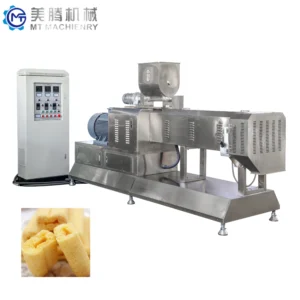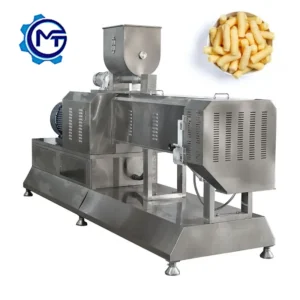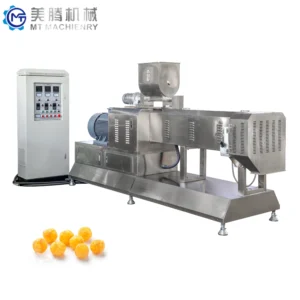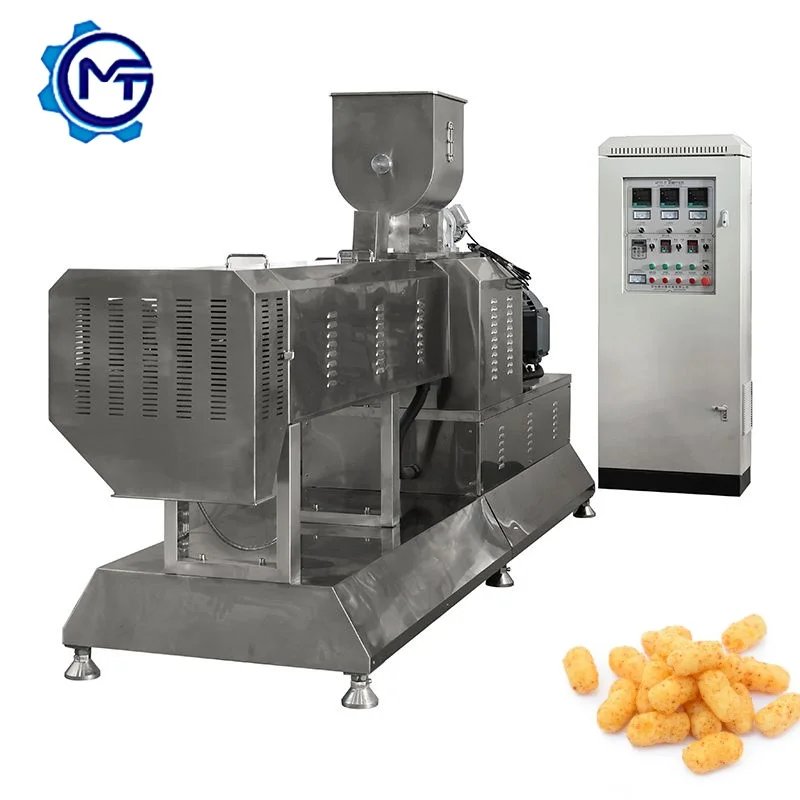
Screw Configuration Matched to Your Material — every MT series extruder is tested on the buyer’s actual flour blend in our workshop before dispatch, preventing the dead-dough failures that happen when generic builds meet unfamiliar recipes.
Technical Specifications
| Parameter | Value |
|---|---|
| Model | MT65 / MT70 / MT85 / MT100 |
| Product Type | Twin Screw Extruder for Puffed Snack Production Line |
| Screw Type | Twin-screw |
| Installed Power | MT65 — 130 kW; MT70 — 180 kW; MT85 — 220 kW; MT100 — 240 kW |
| Real Consumption | MT65 — 95 kW; MT70 — 120 kW; MT85 — 130 kW; MT100 — 160 kW |
| Output Capacity | MT65 — 120–150 kg/h; MT70 — 200–300 kg/h; MT85 — 300–500 kg/h; MT100 — 600–800 kg/h (basis not stated in source — confirm raw material, moisture content and die configuration) |
| Control System | Frequency speed controlling system |
| Lubrication | Automatic lubricating and cooling system |
| Dryer Heating Source | Electric / Steam / Gas (selectable per site utility) |
| Core Filling Option | Available with added core filling machine and cutting machine |
| Die Shapes | Interchangeable — cheese ball, tube, stick, ring, fruit loop, star, wheel, flower, heart, and others |
| Raw Materials | Corn, rice, wheat, oat, barley flour, and compound formulations |
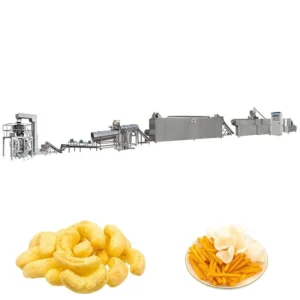
| Line Stations | Batching → Extruding → Drying → Coating / Flavoring → Cooling → Packing → Stacking |
| Warranty | 1 year |
| Lead Time | Approximately 20 working days for extruder line; approximately 35 working days with packing and stacking machines |
| Certification | CE / ISO |
Application Suitability
| Application | Material or Output |
|---|---|
| Cheese puffs and corn curls | Corn flour and corn grits with seasoning oil |
| Rice puffs and rice rings | Rice flour blends at controlled moisture |
| Core-filled snacks | Wheat or corn dough with cream or jam center filling |
| Multi-grain extruded shapes | Oat, barley, and compound grain formulations |
| Fortified breakfast rings | Grain flour blended with vitamin and mineral premix |
What "Rated Capacity" Leaves Out When Stations Are Mismatched
A Twin Screw Snack Extruder Machine only performs as well as the weakest station downstream.
I have watched lines sit idle for weeks because the extruder pushed material faster than the dryer could handle, leaving product soggy and unsalable. The Twin Screw Snack Extruder Machine catalogue on this page lists every station — batching, extruding, drying, flavoring, cooling, packing — so you can see throughput relationships before a single weld is made. When dryers, drums, and conveyors are sourced from separate vendors, capacity gaps hide until commissioning day. [NEED_CITE: line throughput bottleneck caused by mismatched downstream equipment] Matching throughput across stations matters more than the extruder’s nameplate number.
Matching Every Station to the Extruder Output
The full equipment range here covers the entire puffed snack line from material preparation to stacking. Each Twin Screw Snack Extruder Machine model — from MT65 to MT100 — has a corresponding dryer length, flavoring drum diameter, and cooler belt width calculated against its real consumption output, not the installed motor rating. This station-by-station approach eliminates the bottleneck problem that plagues lines assembled from unrelated vendors.
Dryer and Coating Flexibility Across Utility Conditions
Drying is where many snack lines fail silently. The dryer in this range offers electric, steam, or gas heating, configurable to whatever utility your facility already has on site. A gas-fired dryer may lower operating cost where natural gas is cheap, while an electric dryer simplifies installation in regions without steam boiler infrastructure. The double-drum flavoring station that follows allows two distinct seasonings to be applied in sequence, which matters when producing coated snacks with layered flavor profiles. [NEED_CITE: industrial dryer heating source selection for food processing]
Reading the Specs That Actually Matter
Twin-screw extrusion relies on shear, heat, and pressure built up inside the barrel to gelatinise starch and expand the product at the die face. The installed power versus real consumption figures across the MT65 through MT100 range tell you how much energy the process genuinely draws under load — real consumption runs noticeably lower than installed power across all four models, which affects your transformer sizing and monthly utility bill. The automatic lubricating and cooling system keeps bearing temperatures stable during continuous runs, reducing the thermal drift that causes product density to wander from one shift to the next. Die interchangeability means a single extruder platform can produce rings, sticks, stars, and tubes simply by swapping the die plate and adjusting the cutter — no second machine required. Frequency speed control lets operators dial screw RPM to match different flour formulations, since rice flour and corn grits demand different shear profiles to expand correctly at the die.
The Hidden Cost of Wrong Screw and Die Configurations
Generic screw builds copied from a standard template will produce dense, under-expanded product when your raw material deviates from the builder’s default assumption. I have seen a customer run rice flour through a screw set designed for corn grits — the output came out as hard pellets that cracked teeth during the tasting session. The screw configuration and die design must be specified against your exact formulation and target density before the extruder leaves the factory. [NEED_CITE: twin screw configuration impact on extrudate density and texture]
Why Source the Full Range Here
The MT series covers four capacity tiers within one screw platform family, so buyers comparing options can evaluate energy draw, footprint, and downstream requirements from a single catalogue. Screw configuration and die design are matched to the buyer’s raw material and target product rather than copied from a generic build. The in-house testing workshop runs trial batches on customer-supplied flour blends before shipment, catching formulation issues early. Pre-sales consultation covers line layout, utility planning, and station throughput matching. CE and ISO documentation supports import clearance and compliance audits in regulated markets.
Documentation & Verification
- Line layout and capacity calculation matching extruder output to dryer and flavoring throughput
- Screw and die configuration record tied to your specific flour formulation
- Machine specification sheet with confirmed voltage, frequency, and control language
- Trial run report on your raw material from the in-house testing workshop
- CE declaration of conformity and ISO certificate for customs and compliance
- Operation and maintenance manual with wear parts list
Installation, Commissioning & Support
- Electrical supply must match the confirmed voltage and frequency before the MT65 through MT100 range is energised
- Frequency speed controlling system requires trained operators to set screw RPM for each recipe
- Automatic lubricating and cooling system needs oil level and flow checks at defined intervals
- Dryer heating source — electric, steam, or gas — must be connected per site utility availability
- Die changes and cutter adjustments require operator training on shape-specific parameters
- Wear parts list covers screws, dies, and barrel liners with reorder codes
Preparing Your Inquiry
To move forward, share your target snack shape and coating type, the primary flour or grain blend you plan to run, your daily output target in kilograms, and the voltage and frequency standard at your facility. If you have existing upstream mixers or downstream packing equipment, note their throughput so we can match station capacity across the full line.
Frequently Asked Questions
Q: How do I choose between MT65, MT70, MT85, and MT100 for my output target?
A: Start with your target hourly output and the specific raw material formulation. Real consumption figures differ across the four models, and actual throughput depends on moisture content, die configuration, and product density. We calculate the capacity match during line layout and confirm it through a trial run on your material before shipment.
Q: What supporting stations come with the extruder and how is throughput matched?
A: The line includes batching, extruding, drying, double-drum flavoring, cooling, packing, and stacking stations. Each station’s capacity is calculated against the extruder’s real consumption output so no single point constrains the line. We provide a throughput matching sheet with every layout proposal.
Q: Which dryer heating source should I select for my facility?
A: Electric, steam, and gas options are available. The choice depends on your site’s existing utility infrastructure and local energy costs. We confirm the heating source during specification so the dryer arrives ready to connect without additional field modifications or boiler procurement.
Q: Can custom die shapes be produced for proprietary snack formats?
A: Interchangeable dies cover standard shapes including balls, tubes, rings, stars, and wheels. Custom die geometry can be manufactured to your product drawing. The die configuration record documents the exact profile and expansion ratio validated during your trial run.
Q: What documentation ships with the Twin Screw Snack Extruder Machine?
A: Each unit ships with a machine specification sheet, electrical schematic, screw and die configuration record, trial run report on your raw material, CE declaration, ISO certificate, operation manual, and wear parts list. These documents support customs clearance, compliance audits, and maintenance planning.