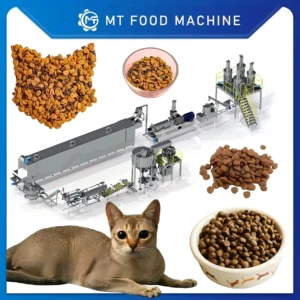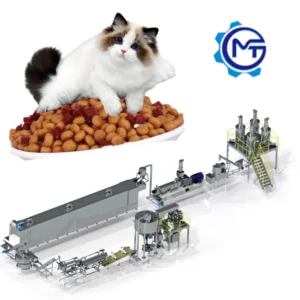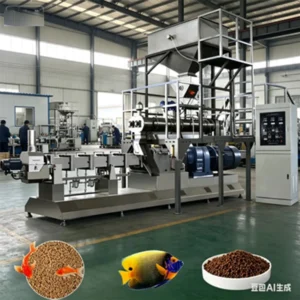
Integrated System Engineering — Every station in this fish feed pet feed extruder production line full equipment range is throughput-matched from mixer to screening, eliminating the bottlenecking that happens when machines are sourced from separate vendors.
Technical Specifications
| Parameter | Value |
|---|---|
| Product Type | Twin Screw Fish Feed and Pet Feed Extruder Production Line |
| Extruder Type | Twin screw |
| Control System | Intelligent PLC automatic control system |
| Material Contact Parts | Food grade 304 stainless steel |
| Line Stations | Raw material mixer, extruder, dryer, seasoning coating machine, vibrating sieve, conveyor equipment |
| Production Mode | Full continuous automatic production |
| Pellet Adjustability | Size, hardness, buoyancy adjustable |
| Feed Type Output | Floating and sinking pellets |
| Output Capacity | (basis to be confirmed — depends on raw material formulation and pellet size) |
| Screw Diameter | (basis to be confirmed) |
| L:D Ratio | (basis to be confirmed) |
| Barrel Zones | (basis to be confirmed) |
| Die Configuration | (basis to be confirmed) |
| Moisture Range | (basis to be confirmed) |
| Rated Power (kW) | (basis to be confirmed) |
| Voltage & Frequency | (basis to be confirmed) |
| Overall Dimensions (L×W×H) | (basis to be confirmed) |
| Net Weight | (basis to be confirmed) |
| Assembly State | Complete matched production configuration, turnkey line |
| Language Options | (basis to be confirmed) |
| Certifications | CE, ISO |
Application Suitability
| Application | Material or Output |
|---|---|
| Aquatic feed for koi and goldfish | Fish meal, soybean meal, corn powder with compound additives producing floating pellets |
| Tropical fish and freshwater fish feed | Compound formulations with adjustable buoyancy for sinking or slow-sinking pellets |
| Dry pet kibble production | Meat meal, grain blends, and nutritional additives shaped through interchangeable dies |
| Medium to large scale commercial feed factories | Continuous uninterrupted mass production across aquatic and pet feed formats |
What "Full Automatic Production" Actually Requires From Your Line
A fish feed pet feed extruder production line full equipment range only delivers continuous output when every station is sized to the same throughput on your specific raw material.
I watched a kibble line stall twice an hour because the dryer could not keep pace with the extruder running a high-moisture fresh meat recipe. The extruder was rated correctly, but the dryer was spec’d for a standard corn-starch mix. When the formulation changed, moisture load at the dryer jumped and product backed up. That mismatch never shows up on a quotation that lists machines individually. [NEED_CITE: throughput matching across extrusion line stations]
How Each Station Connects to the Next
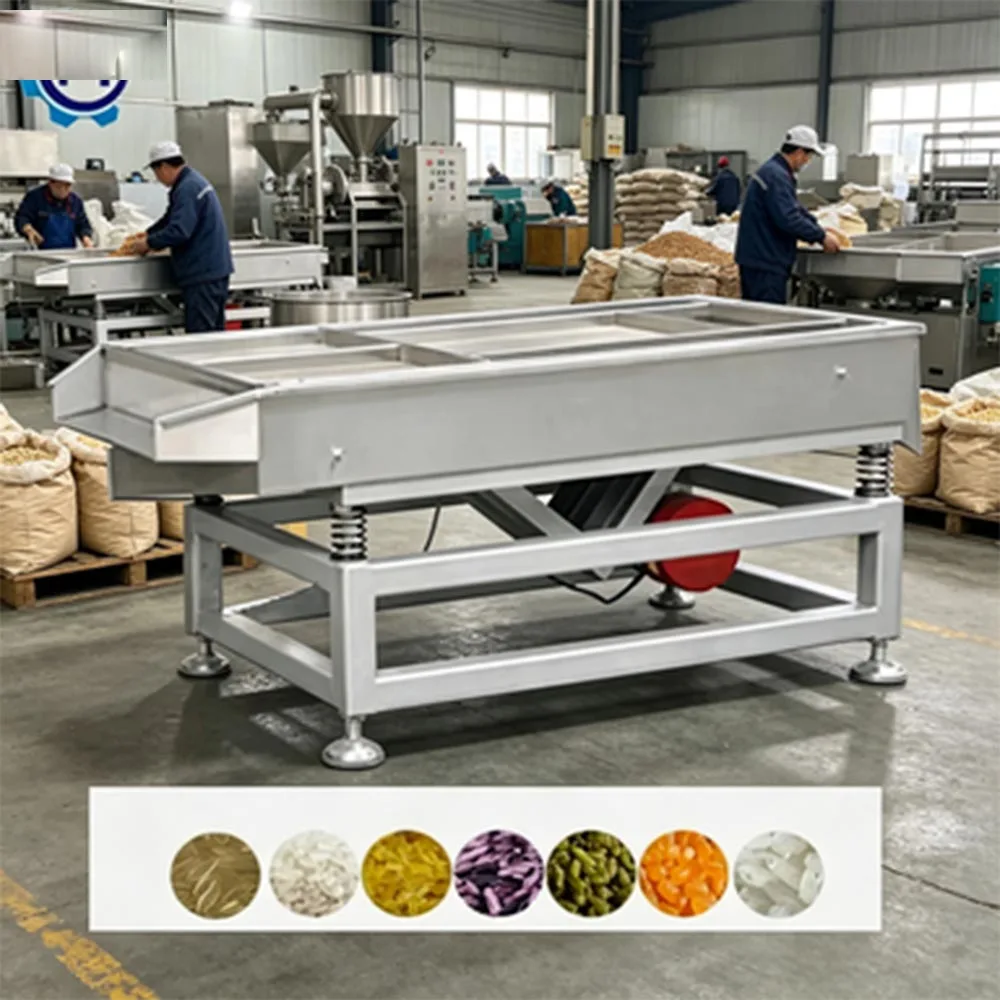
The raw material mixer feeds the twin screw extruder at a rate that must align with the screw profile and barrel zone configuration chosen for your formulation. From there, extruded pellets move through the dryer where moisture removal rate determines whether pellets reach the seasoning coating machine at the correct surface condition. The vibrating sieve then separates on-spec product from undersized or oversized pieces before conveyor equipment carries finished pellets to packing. Each transition point is where a mismatched station creates a constraint.
Why the PLC Matters Beyond the Control Panel
The intelligent PLC automatic control system coordinates motor speeds, barrel temperatures, and feed rates across all stations simultaneously. When the extruder barrel zones respond to a moisture change in the raw material, the dryer temperature profile adjusts accordingly rather than waiting for manual intervention. This coordination is what keeps a fish feed pet feed extruder production line full equipment range running continuously without operators chasing setpoints station by station. [NEED_CITE: PLC coordination in multi-station food extrusion lines]
Reading the Specifications That Actually Matter
The twin screw configuration determines shear intensity and residence time inside the barrel, which directly affects starch gelatinisation and the final pellet density. Food grade 304 stainless steel on all material contact parts prevents corrosion from fish meal and compound additives that would degrade carbon steel surfaces within months. The die configuration controls pellet shape and size, and must be matched to the specific buoyancy target — floating pellets for koi require different die geometry than sinking pellets for bottom-feeding species. Pellet adjustability across size, hardness, and buoyancy depends on having the correct screw profile installed before production begins, not on discovering the right configuration during commissioning.
What Happens When Stations Are Sourced Separately
An extruder supplied without matching dryer or coating capacity creates a bottleneck that no amount of operator adjustment can solve. I have seen lines where the seasoning coating machine could not apply flavouring evenly because pellets arrived too wet from an undersized dryer, and the vibrating sieve then rejected a noticeable portion of the output as clumped product. The individual machines all met their own specifications, but the line as a system failed to hold the throughput the buyer had planned around. [NEED_CITE: downstream bottlenecking in separately sourced extrusion lines]
Why Procurement Consolidation Reduces Commissioning Risk
Every station in this line is specified under one supplier, meaning the raw material mixer capacity, extruder throughput, dryer residence time, and coating drum speed are all calculated against the same formulation and target pellet specification. The screw and die configuration is selected based on your actual ingredient list — fish meal ratios, soybean meal percentages, corn powder content, and compound additive proportions — rather than copied from a generic build. An in-house testing workshop runs your raw material before shipment, so pellet density, buoyancy, and surface texture are verified on your formulation instead of discovered during on-site installation. Food grade 304 stainless steel contact parts across every station mean corrosion resistance and hygiene compliance are consistent from the mixer bowl through to the vibrating sieve screens.
Documentation & Verification
- Line layout and capacity calculation matched to your raw material formulation and target pellet buoyancy
- Screw and die configuration record specifying the profile selected for your ingredient ratios
- Trial run report from the in-house testing workshop performed on your actual raw material
- Electrical schematic with voltage, frequency, and PLC control language confirmed to your facility
- Factory test record documenting continuous run performance across all line stations before dispatch
- Operation and maintenance manual covering every station from mixer through vibrating sieve
Installation, Commissioning & Support
- Foundation requirements and floor space layout calculated from the overall line dimensions and station spacing
- Dedicated electrical circuits sized to the rated power of the twin screw extruder and dryer combined
- Arrival in complete matched configuration with station-by-station assembly sequence documented
- First-run parameter setting on your raw material with barrel zone temperatures and screw speed calibrated
- Operator training covering PLC interface navigation, die changeover, and buoyancy adjustment procedures
- Wear parts list specifying screw segments, die plates, and dryer belt replacement intervals
What to Include With Your Inquiry
Provide your raw material formulation including fish meal, soybean meal, corn powder ratios and any compound additives, along with your target pellet size, hardness, and whether you need floating or sinking output. Confirm your facility voltage, frequency, and preferred PLC control language so electrical specifications are locked before production. Share your available floor space and ceiling height so the line layout positions each station — from raw material mixer through conveyor equipment — within your building constraints.
Frequently Asked Questions
Q: How is the output capacity of each station verified against my raw material formulation?
A: Each station is sized using capacity calculations based on your specific ingredient ratios and target pellet specification. The trial run in the testing workshop confirms actual throughput on your raw material, and the trial run report documents whether the mixer, extruder, dryer, and coating stations all hold the same rate without bottlenecking.
Q: How do I confirm the screw and die configuration matches my pellet buoyancy requirement?
A: The screw profile and die geometry are selected based on your formulation and whether you need floating, sinking, or slow-sinking pellets. The configuration record documents the exact screw segments and die plate chosen, and the pre-shipment trial run verifies buoyancy on your actual raw material blend.
Q: What stations are included and how is throughput balanced between them?
A: The line includes raw material mixer, twin screw extruder, dryer, seasoning coating machine, vibrating sieve, and conveyor equipment. Throughput balance is calculated during line layout design so each station handles the same mass flow rate on your formulation, preventing downstream constraints.
Q: Can a trial run be performed on my raw material before shipment?
A: Yes. The in-house testing workshop runs your actual raw material through the extruder with the selected screw and die configuration. The trial run report covers pellet density, buoyancy, surface texture, and whether the output meets your target specification before the line ships.
Q: How are voltage, frequency, and PLC language confirmed before production?
A: You provide your facility electrical specifications and preferred control language during the inquiry stage. The electrical schematic and voltage confirmation document are reviewed and approved before production begins, ensuring the PLC interface and motor configurations match your site requirements.