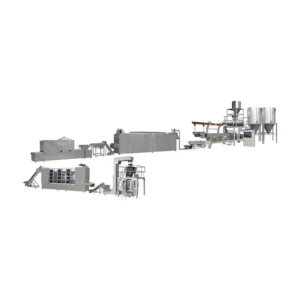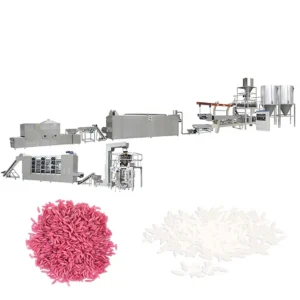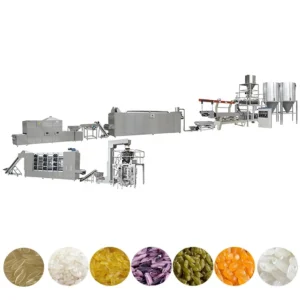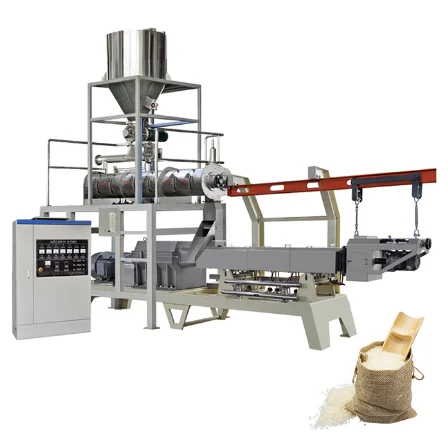
Throughput-Matched Station Design — Every mixer, extruder, dryer, and cooler in this line is sized against the others so quoted output holds across the entire sequence rather than bottlenecking at a single machine.
Technical Specifications
| Parameter | Value |
|---|---|
| Product Type | Artificial Rice & Nutritional Fortified Rice Extrusion Line |
| Model Options | MT65 / MT70 / MT85 / MT75 / MT95 |
| Screw Type | Twin-screw |
| Installed Power | MT65: 85 kW; MT70: 120 kW; MT85: 235 kW; MT75: 180 kW; MT95: 260 kW |
| Power Consumption | MT65: 60 kW; MT70: 85 kW; MT85: 165 kW; MT75: 135 kW; MT95: 195 kW |
| Capacity Range | MT65: 80–100 kg/h; MT70: 100–120 kg/h; MT85: 200–300 kg/h; MT75: 300–500 kg/h; MT95: 800–1000 kg/h (basis not stated in source — confirm raw material formulation, moisture content, and pellet size) |
| Overall Dimensions (L×W×H) | MT65: 28 × 1.2 × 2.2 m; MT70: 30 × 1.5 × 2.2 m; MT85: 34 × 3.5 × 4.3 m; MT75: 32 × 3.5 × 4.3 m; MT95: 36 × 3.5 × 4.3 m |
| Control System | Frequency speed control with automated operation |
| Screw Material | Wear-resistant alloy with special surface treatment |
| Feeding System | Single or double screw feeder selected per material characteristics |
| Drying Oven Heating Source | Electric or gas |
| Drying Oven Feature | Circulation drying, variable mesh-belt speed via frequency motor |
| Lubrication | Automatic lubricating and cooling system |
| Line Stations | Mixing → Extruding → Vibrating → Low-temperature drying → Cooling → Packing |
| Standards | CE; ISO |
Application Suitability
| Application | Material or Output |
|---|---|
| Artificial rice kernel production | Broken rice, rice bran, corn, millet, wheat, oats, buckwheat as base starch |
| Nutritional fortified rice programs | Vitamin and mineral micro-nutrient blends incorporated during extrusion |
| Staple food diversification projects | Bean flour, starch blends reprocessed into rice-shaped kernels |
| Rice bran reprocessing | Rice bran and broken rice fractions converted into high-nutrition kernels |
| Fortified breakfast grain bases | Oat, buckwheat, and millet formulations shaped as uniform rice kernels |
Why Quoted Line Capacity Often Fails at the Dryer
An artificial rice extrusion machine manufacturer may promise a specific hourly output, but if the drying oven cannot remove moisture fast enough at that throughput, the entire line slows to match the slowest station. Capacity is only real when every station from mixer to packer is matched to the same throughput target.
I have walked onto factory floors where the extruder was running at its rated output while the dryer sat three meters away with a belt piled high in wet, half-dried kernels waiting to move through. The operator had no choice but to throttle the extruder back, which meant the quoted line capacity was never achievable in practice. [NEED_CITE: common bottlenecks in extrusion line throughput matching]. This happens more often than buyers expect, because quotations frequently list the extruder model and its standalone capacity without confirming the downstream equipment can keep pace.
Matching Extruder Output to Dryer Residence Time
The extrusion stage gelatinises the starch matrix and forms each kernel through the die, but those kernels exit the die plate at high moisture and must be dried to a shelf-stable level before cooling and packing. If the dryer belt speed and thermal zones are not calculated against the actual extruder output and the specific moisture differential of the formulation, kernels will either retain too much internal moisture or crack from overly aggressive heat. An artificial rice extrusion machine manufacturer that sizes the dryer based on the extruder’s nominal output rather than the buyer’s actual formulation will deliver a line that looks correct on paper but underperforms during commissioning.
How Screw Configuration Shapes Kernel Density
Twin-screw extrusion allows the screw element sequence to be rearranged for different shear profiles, which directly controls how much the starch expands as it exits the die. For fortified rice kernels, the target is a dense, rice-shaped pellet with minimal puffing — very different from a snack pellet that needs maximum expansion. The screw configuration must balance conveying elements and kneading blocks so that vitamin and mineral additives disperse evenly through the starch matrix without introducing excess air pockets that would make the kernel float during cooking. [NEED_CITE: screw element configuration effects on extrudate density in twin-screw food extrusion].
Reading the Specification Sheet Against Your Raw Material
The power and capacity figures listed for MT65 through MT95 reflect specific operating conditions, and the actual output on a buyer’s formulation depends on factors the specification sheet alone cannot capture. Installed power ranges from 85 kW on the MT65 to 260 kW on the MT95, but the relationship between motor load and throughput changes when the base flour shifts from rice to a high-fibre bean blend. The feeding system — single or double screw feeder — must also be selected to match the flow characteristics of the specific grain mix, because a feeder that bridges or surges will cause density variation in the finished kernels. This is why a factory test on the buyer’s actual raw material before shipment is more reliable than a catalogue number. [NEED_CITE: importance of material-specific trial runs in food extrusion equipment procurement].
The Hidden Cost of Skipping Pre-Shipment Trials
When an extrusion line arrives at a buyer’s facility and the first production run fails to hold kernel shape or meet moisture targets, the problem is often traced back to a raw material difference that was never tested beforehand. The screw configuration that worked for the manufacturer’s test flour may not generate enough shear for the buyer’s higher-protein blend, and reconfiguring screws on-site means days of downtime while replacement elements are shipped. A buyer who did not insist on a pre-shipment trial run on their own material ends up paying for commissioning delays and potentially ordering a second set of screw elements that should have been specified from the start. [NEED_CITE: commissioning delays caused by unverified raw material compatibility].
Why Equipment Range Matters When Sourcing a Line
Selecting individual machines from different suppliers introduces interface risks — the extruder discharge height may not align with the dryer infeed conveyor, or the cooler airflow may be insufficient for the kernel load the extruder delivers. When the full equipment range is sourced from one manufacturer, each station’s throughput, physical dimensions, and control signals are coordinated before fabrication. For the MT series lines, the station sequence from mixing through extruding, vibrating, low-temperature drying, cooling, and packing is engineered so that transfer points and material flow rates match, reducing the interface troubleshooting that typically consumes the first weeks of commissioning.
Documentation & Verification
- Line layout drawing showing station throughput calculations matched to your target output
- Screw and die configuration record specific to your grain and micronutrient formulation
- Electrical schematic with voltage and frequency confirmed for your facility
- Factory trial run report produced on your raw material before shipment
- CE declaration of conformity and ISO certificate for the complete line
Installation, Commissioning & Support
- Foundation plan accounts for the MT95 line length of up to 36 m with dryer and cooler spans
- Power supply sizing based on installed power up to 260 kW with dedicated circuit requirements
- Station alignment verified during assembly to ensure extruder-to-dryer transfer continuity
- Screw configuration and die plate selection validated against your material during first production run
- Operator training covers frequency speed adjustment on extruder, feeder, and dryer belt drives
- Wear parts list identifies screws, dies, and barrel segments with replacement intervals
Before You Request a Quote
To configure the right line, we need your raw material formulation including base grain types and any vitamin or mineral additives, your target hourly output, and the moisture specification for the finished kernel. Share your facility voltage and frequency along with available floor space and ceiling height so the layout fits your building. If you can send a sample of your raw material, we will run a trial in the testing workshop before finalising the screw configuration and quotation.
Frequently Asked Questions
Q: How is the quoted capacity verified for my specific raw material formulation?
A: Capacity figures for MT65 through MT95 are based on specific operating conditions that may differ from your blend. We run your raw material in the testing workshop to measure actual throughput, kernel density, and moisture at the dryer exit. The trial run report documents the achievable output on your formulation, and that figure — not the catalogue number — is what the quotation guarantees.
Q: What voltage and frequency options are available for the control system?
A: The electrical system is configured to match your facility supply before production begins. We confirm voltage, frequency, and phase during the specification stage, and the electrical schematic reflects your local standard. Control panel labelling and HMI language are set to your preference so operators can read all parameters in their working language from day one.
Q: How do I choose between MT65, MT70, MT85, MT75, and MT95 for my production target?
A: Model selection depends on your target output, raw material characteristics, and available floor space. The MT65 and MT70 suit smaller-scale fortified rice programs with lower power consumption, while the MT75 and MT95 serve higher-volume nutritional rice projects. We match the model to your confirmed trial run data rather than selecting on catalogue capacity alone.
Q: How is the screw and die configuration determined for different grain and micronutrient blends?
A: Each grain base — rice, corn, millet, buckwheat, or bean flour — responds differently to shear and temperature inside the barrel. We select screw element sequencing and die geometry based on your formulation’s starch content, fibre level, and additive ratio, then validate the configuration during the pre-shipment trial to ensure kernel shape, density, and nutrient dispersion meet your specification.