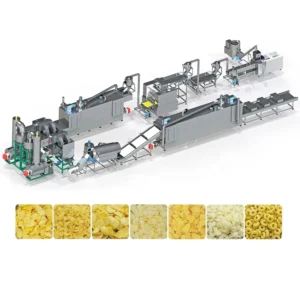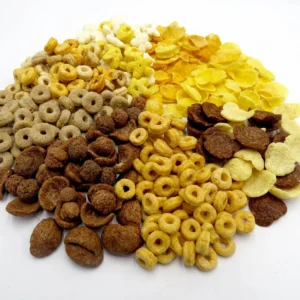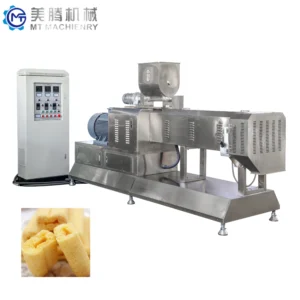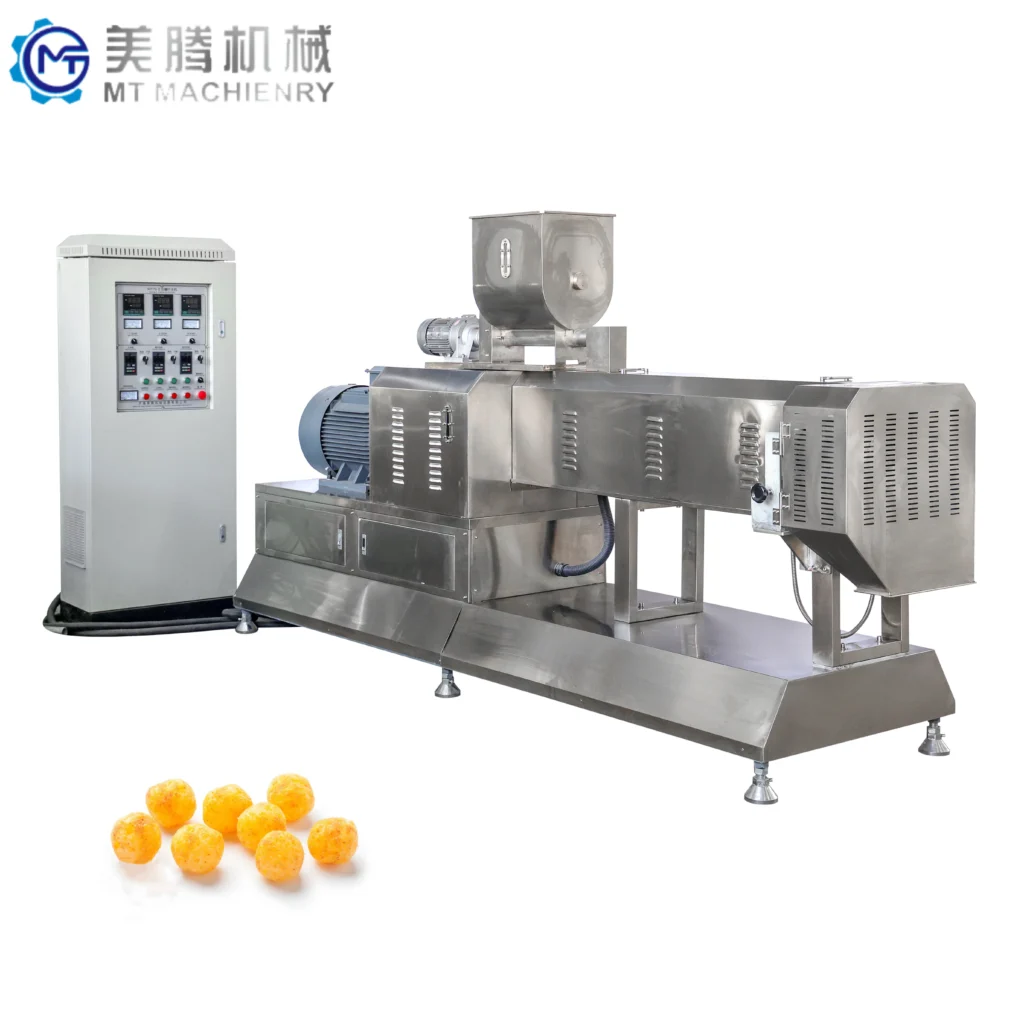
Screw and die configurations — matched to your actual raw material recipe and target snack texture, with every line station sized so throughput stays balanced from mixer to packer.
Technical Specifications
| Parameter | Value |
|---|---|
| Product Type | Twin Screw Corn Puff Snack Extrusion Line |
| Model Options | MT65 / MT70 / MT85 / MT100 |
| Screw Type | Twin-screw |
| Installed Power | 130 kW (MT65) / 180 kW (MT70) / 220 kW (MT85) / 240 kW (MT100) |
| Real Consumption | 95 kW (MT65) / 120 kW (MT70) / 130 kW (MT85) / 160 kW (MT100) |
| Output Capacity | 120–150 kg/h (MT65) / 200–300 kg/h (MT70) / 300–500 kg/h (MT85) / 600–800 kg/h (MT100) (basis not stated in source — confirm raw material, moisture, die configuration) |
| Control System | Frequency speed controlling system |
| Die Shapes | Ball, tube, stick, ring, fruit loop, star, wheel, flower, heart |
| Heating Source (Dryer) | Electric / Steam / Gas (configurable) |
| Flavoring System | Double drum with sugar melting and spraying nozzle |
| Lubrication | Automatic lubricating and cooling system |
| Core Filling | Optional core filling and cutting module |
| Line Stations | Batching → Extruding → Drying → Coating / Flavoring → Cooling → Packing → Stacking |
| Standards | CE |
| Warranty | 1 year |
| Lead Time | Approximately 20 working days (extrusion line); approx. 35 working days (with packing and stacking) |
Application Suitability
| Application | Material or Output |
|---|---|
| Puffed corn snacks and cheese balls | Corn flour and corn grits at controlled moisture |
| Rice ball and cereal ball snacks | Rice flour, oat flour, and blended cereal formulations |
| Fruit loops and ring-shaped snacks | Wheat flour and barley flour blends |
| Core-filled puffing snacks | Cereal-based outer shell with cream or jam filling |
| Multi-shape extruded snack runs | Interchangeable dies for quick format changeovers |
Why Matching Dryer Capacity to Extruder Output Matters for Your Food Extrusion Processing Line Full Equipment Range
An undersized dryer will hold the entire line below its nameplate throughput no matter how fast the extruder runs.
When buyers survey equipment for a puffed snack project, the extruder often gets the most attention. The drying stage, however, determines whether the line can sustain continuous output. If the dryer cannot remove moisture fast enough, product backs up on the conveyor and texture drifts out of spec. We have walked into plants where the extruder was capable of much more, but a mismatched dryer forced operators to throttle feed rates just to keep the product dry enough for coating [NEED_CITE: moisture migration effects in cereal extrusion post-processing].
Every Station in the Corn Puff Snack Line, Sized as One System
A food extrusion processing line full equipment range is only as strong as its weakest link. On this system, the batching mixer feeds the twin-screw extruder at a rate that matches the downstream dryer belt speed and drum flavoring residence time. Each station is selected and configured so that material flow stays continuous without intermediate buffers or manual transfer.
From Die Plate to Final Pack — What the Complete Range Covers
Beyond the extruder itself, the line includes a drying oven, a double-drum flavoring station with integrated sugar melting, a cooling conveyor, and packing plus stacking equipment. This means you are not sourcing a dryer from one vendor and a flavoring drum from another, then hoping the throughput figures align. The entire food extrusion processing line full equipment range arrives from a single supplier with matched throughput at every transition point [NEED_CITE: throughput matching across food processing line stations].
Reading the Specs: What Twin-Screw Geometry Means for Your Snack
The twin-screw design gives operators control over shear, residence time, and mixing intensity inside the barrel — variables that single-screw machines handle less flexibly. Interchangeable dies allow shape changes without swapping the entire screw set; a die change on this platform involves loosening the die plate bolts and sliding in the new profile. The frequency speed controlling system lets you dial screw RPM independently of the feeder, so you can adjust expansion and density without stopping the line. Automatic lubrication and cooling keeps barrel and screw temperatures within range during long production runs, preventing scorching in high-sugar recipes. The optional core filling module slots between extrusion and cutting, adding cream-filled formats without a separate line.
What Happens When Line Stations Are Sourced Separately
When an extruder is paired with a dryer or flavoring system from a different vendor, the communication gap usually surfaces during commissioning. Conveyor heights do not align, product drops from too high and fractures, or the flavoring drum cannot keep pace and product piles up. These issues rarely appear in the quotation stage; they show up when the line is bolted to your floor and the first batch runs through. Fixing them after installation costs more time and rework than matching the stations before the order is placed [NEED_CITE: integration challenges in multi-vendor food processing lines].
Why Buyers Spec the Full Equipment Range Here
One supplier covers every station from batching to stacking, so capacity calculations reflect the entire chain rather than individual machine nameplates. Screw configurations and die profiles are specified against your raw material formulation and target product texture, not copied from a generic build. An in-house testing workshop runs your actual recipe before shipment, producing a trial report that documents screw speed, barrel temperature, and die selection for your product. Voltage, frequency, and control language are confirmed during the engineering stage so the line starts up without electrical rework. Pre-sales consultation, on-site installation, commissioning, and operator training are included in the project scope.
Documentation & Verification
- Line layout drawing with station-by-station capacity matched to your target output
- Screw and die configuration record tied to your specific snack shape and raw material
- Trial run report on your actual recipe before shipment, with processing parameters logged
- Electrical schematic with confirmed voltage, frequency, and control language
- Factory test record showing each station running under load before crating
- Wear parts list covering screws, dies, and dryer belt sections for first-year maintenance
Installation, Commissioning & Support
- Foundation plan provided based on the MT65–MT100 footprint and dryer length for your chosen model
- Dedicated power circuit sizing confirmed against the installed power rating of your specific extruder model
- Equipment arrives in modular sections for staged assembly inside existing workshops
- First-run parameter setting covers screw speed, barrel zones, and dryer temperature for your recipe
- Operator training includes die changeover procedure and double-drum flavoring system adjustment
- Spare screw elements and die plates shipped with the line to cover initial wear cycles
What to Include in Your Inquiry
To get an accurate line layout, share your raw material formulation, target snack shape, and desired hourly output based on your specific recipe. Let us know your factory voltage, frequency, and preferred control language so electrical design starts correctly. If you have existing upstream grinders or downstream packing machines, tell us their throughput so the new stations can be matched to them.
Frequently Asked Questions
Q: How is each station’s capacity matched so no single machine bottlenecks the line?
A: We calculate throughput at every transition — from mixer discharge rate through extruder output, dryer belt speed, flavoring drum residence time, and packing speed. Each station is then sized so the slowest point still meets your target capacity on your actual recipe, not on a generic material benchmark.
Q: What die shapes are available, and how long does a die change take?
A: Standard dies cover ball, tube, stick, ring, fruit loop, star, wheel, flower, and heart profiles. A trained operator can complete a die changeover by loosening the die plate bolts and swapping the insert, typically within a short production pause rather than a full shift stoppage.
Q: Can the dryer heating source be configured for my factory’s utilities?
A: Yes. The dryer is available with electric, steam, or gas heating. We confirm your available utility type and supply pressure during the engineering stage so the heating system is built to match before the dryer ships.
Q: What supporting equipment sits between the extruder and the packing station?
A: Between extrusion and packing, the line includes a drying oven to reduce moisture, a double-drum flavoring station with sugar melting and spray nozzles for surface coating, and a cooling conveyor to stabilize product temperature before it enters the packing and stacking section.
Q: How do I choose between the MT65, MT70, MT85, and MT100 for my target output?
A: Selection depends on your target capacity, raw material formulation, and available factory footprint. Each model covers a different output band and power envelope. We recommend sharing your specific recipe and daily production target so the correct extruder and matching downstream stations can be proposed together.