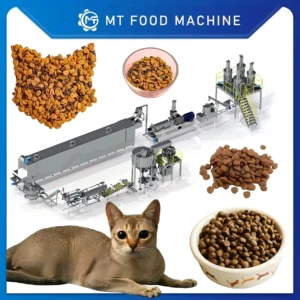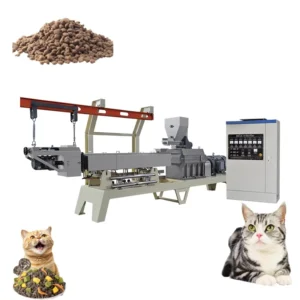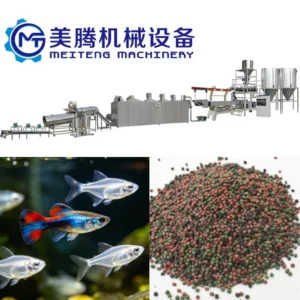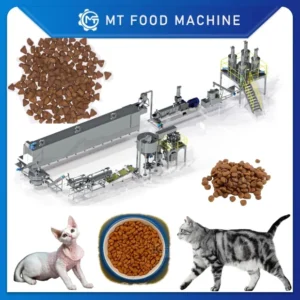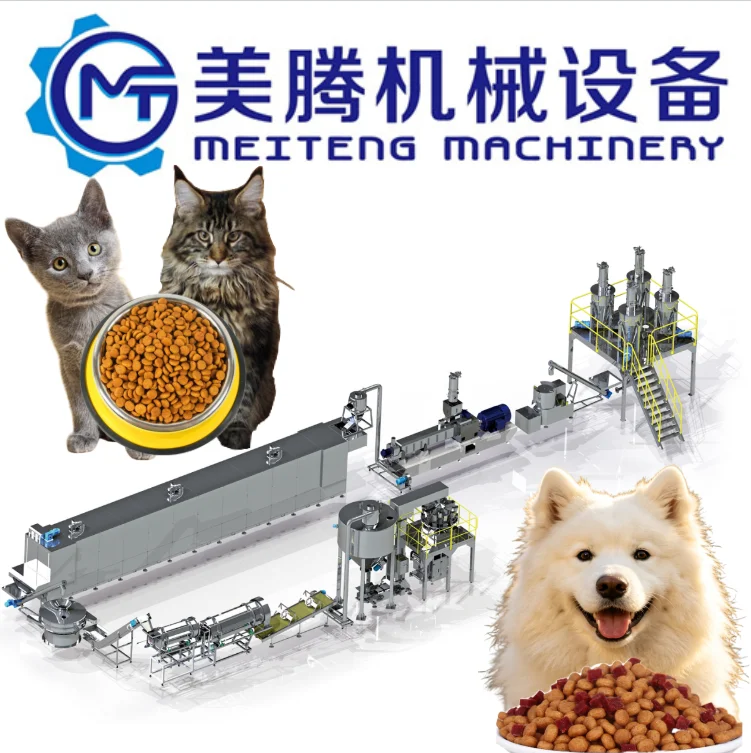
Throughput-Matched Stations — Every mixer, extruder, dryer and flavouring drum on this line is sized against the same capacity target so no single station bottlenecks the rest.
Technical Specifications
| Parameter | Value |
|---|---|
| Product Type | Pet Food Extrusion Production Line |
| Output Capacity | 150 kg/h – 3 T/h (basis not stated in source — confirm raw material formulation, moisture content, and kibble size) |
| Screw Configuration | Twin-screw, geometry matched to recipe |
| Control System | PLC and MCC available |
| Automation Level | Full automation from mixing through extrusion, drying, to packaging |
| Construction | Food-grade contact materials throughout product zones |
| Product Formats | Dry kibble, semi-moist pet food, pet treats |
| Compliance | CE, FDA |
Application Suitability
| Application | Material or Output |
|---|---|
| Dry kibble for dogs and cats | Corn, wheat, rice, meat meal, poultry by-product, fat |
| Semi-moist pet food | High-moisture meat slurries, glycerin, starch binders |
| Floating and sinking aquatic feed | Fish meal, soy protein, starch, vitamin premix |
| Bird and small animal pellets | Seed meals, grain flour, calcium carbonate |
| Pet treats and chews | Gelatin, rawhide powder, starch, flavouring agents |
What Capacity Figures Leave Out on a Pet Food Making Machine Full Equipment Range
A rated output number means nothing until it is verified against the exact recipe you intend to run.
I have watched lines sold on a headline capacity collapse the first week in a customer’s plant because the supplier tested on plain corn starch while the buyer’s formula carried a heavy fresh-meat slurry load. The starch gelatinisation window shifts, expansion drops, and kibble density climbs past the floating threshold the market expects [NEED_CITE: density specifications for premium dry pet food kibble]. When you evaluate a pet food making machine full equipment range, the conversation must start with your raw material sheet, not a brochure number.
How Every Station Is Sized to the Same Throughput Target
A complete pet food making machine full equipment range covers batching, mixing, extrusion, drying, flavouring, cooling and packing. Each station must hold the same hourly throughput; otherwise the extruder pushes product faster than the dryer can remove moisture, or the coating drum cannot keep pace with upstream output. We calculate station capacity from your target kibble size, moisture reduction requirement and dwell time, then lock the configuration before production begins.
Screw Geometry and Die Selection Against Your Recipe
The twin-screw configuration handles a wider recipe range than a single-screw build because intermeshing flights self-clean and manage high-fat or high-moisture slurries without surging [NEED_CITE: twin-screw versus single-screw extrusion for high-meat pet food formulations]. Die plate hole diameter and land length set the final kibble shape and expansion ratio. We record the screw element sequence and die specification against your formula so the same texture is reproducible on every production run.
Reading the Specs That Actually Matter
L/D ratio determines how long material stays inside the barrel, directly influencing starch gelatinisation degree and final kibble digestibility. Motor power must be evaluated together with screw speed range; a high-torque gearbox at lower RPM gives the shear control needed for dense aquatic feed, while higher RPM suits light expanded kibble. PLC control with recipe memory lets operators recall saved parameters for each product, reducing batch-to-batch variation. Food-grade stainless steel in all contact zones prevents cross-contamination between recipes, which matters when a plant switches from poultry-based to fish-based formulas on the same line.
The Hidden Cost of Mismatched Line Stations
An undersized dryer forces the extruder to slow down, cutting real output well below the nameplate rating. A flavouring drum that cannot keep up leaves coated kibble sitting in a surge bin where moisture migrates back into the product, compromising shelf life. These mismatches rarely show up during a factory test on a standard starch recipe [NEED_CITE: post-drying moisture migration in coated kibble]. They surface weeks after commissioning, when the buyer is already committed to production schedules.
Why Source the Full Line From One Equipment Range
Complete station coverage under one supplier means throughput calculations are cross-checked at every junction rather than left to separate vendors who size independently. Screw configuration and die design are specified to the buyer’s raw material before metal is cut. Our in-house testing workshop runs trial batches on customer-supplied formulas, locking parameters before the line ships. Pre-sales consultation covers layout engineering, utility planning and phased installation, then continues through commissioning and operator training on site.
Documentation & Verification
- Line layout drawing with throughput calculation for each station matched to your recipe
- Screw element sequence and die specification record tied to your target kibble format
- Trial run report on your raw material conducted in our testing workshop before dispatch
- Electrical schematic with voltage, frequency and control language confirmed for your market
- Factory test record documenting actual output, moisture content and kibble density
- Operation and maintenance manual with wear parts list and recommended replacement intervals
Installation, Commissioning & Support
- Foundation plan accounting for extruder weight and vibration isolation at rated motor power
- Dedicated electrical circuit sized to PLC and MCC combined load with voltage confirmation
- Modular station design allowing staged assembly to fit restricted factory access routes
- First-run parameter tuning on your recipe with screw speed, barrel temperature and feed rate logged
- Operator training covering recipe changeover, screen cleaning and emergency stop procedures
- Wear parts inventory including spare screw elements and die plates for initial replacement cycle
- Scheduled maintenance checklist aligned to bearing, seal and gearbox service intervals
What We Need to Configure Your Line
Send us your raw material formula with moisture percentages, the kibble size range you target, and your intended daily output split across product variants. Include your factory floor dimensions, available ceiling height and local voltage and frequency so we can match motor and control specifications from the start. If you have existing upstream or downstream equipment you plan to retain, share those models so we can verify interface compatibility.
Frequently Asked Questions
Q: How is output capacity verified against my specific raw material and recipe?
A: We run trial batches in our in-house testing workshop using the exact raw material and formula you supply. Actual throughput, kibble density and moisture content are recorded, and screw and die settings are locked before the line ships so the rated capacity reflects your product, not a generic starch test.
Q: What supporting stations are needed to avoid bottlenecking the extruder?
A: Dryer length, flavouring drum volume and conveyor speed are all calculated from your extruder output and target moisture reduction. We size every station to the same throughput figure, ensuring no single unit forces the rest of the line to idle or surge during steady production.
Q: How do I compare single-screw versus twin-screw extruders for my target product format?
A: Single-screw extruders suit simple starch-based kibble where recipe variation is minimal. Twin-screw configurations handle high-fat, high-moisture and multi-protein formulas with better self-cleaning and consistent expansion, making them the standard choice for premium dry kibble, semi-moist food and aquatic feed.
Q: What voltage, frequency and control language options are available for my market?
A: We confirm your local supply standard during the quotation stage and match motor windings, transformer taps and PLC interface language accordingly. Electrical schematics are issued for approval before production so commissioning is not delayed by mismatched control components.
Q: Can I run a trial on my raw material before the line ships?
A: Yes. Our testing workshop is equipped for full trial runs using customer-supplied raw material. You receive a written report covering output rate, expansion ratio, kibble density and final moisture, and all verified parameters are programmed into the PLC before dispatch.