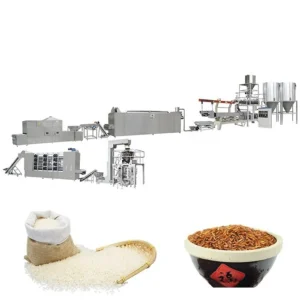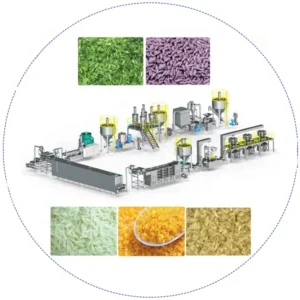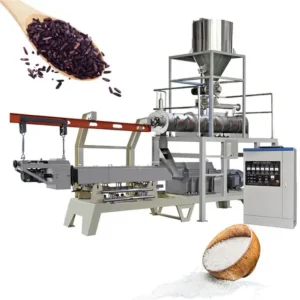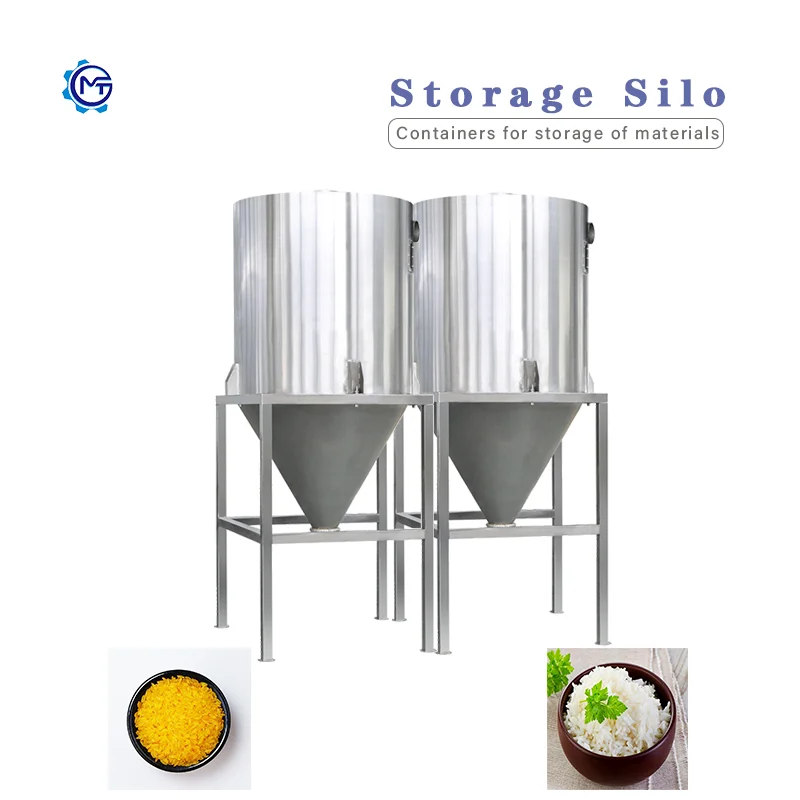
Matching Stations Across the Entire Line — Every mixer, dryer, and roaster in this artificial rice production line is sized to the extruder output, eliminating throughput bottlenecks from mismatched vendor equipment.
Technical Specifications
| Parameter | Value |
|---|---|
| Model | MT65 / MT70 / MT85 / MT75 / MT95 |
| Product Type | Fortified Artificial Rice Production Line |
| Screw Type | Twin-screw |
| Installed Power | MT65 — 85 kW; MT70 — 120 kW; MT85 — 235 kW; MT75 — 180 kW; MT95 — 260 kW |
| Power Consumption | MT65 — 60 kW; MT70 — 85 kW; MT85 — 165 kW; MT75 — 135 kW; MT95 — 195 kW |
| Output Capacity | MT65 — 80–100 kg/h; MT70 — 100–120 kg/h; MT85 — 200–300 kg/h; MT75 — 300–500 kg/h; MT95 — 800–1000 kg/h (basis not stated in source — confirm raw material type, moisture content and grain formulation) |
| Overall Dimensions (L×W×H) | MT65 — 28 × 1.2 × 2.2 m; MT70 — 30 × 1.5 × 2.2 m; MT85 — 34 × 3.5 × 4.3 m; MT75 — 32 × 3.5 × 4.3 m; MT95 — 36 × 3.5 × 4.3 m |
| Control System | Frequency speed control with PLC automation |
| Feeding System | Single or double screw feeding, matched to material type |
| Screw Material | Wear-resistant alloy |
| Lubrication & Cooling | Automatic lubricating and cooling system |
| Dryer Heating Source | Electric or gas |
| Dryer Features | Circulation drying with frequency motor-controlled mesh belt speed |
| Contact Material | 304 stainless steel |
| Standards | CE, ISO certified |
Application Suitability
| Application | Material or Output |
|---|---|
| Fortified artificial rice for retail markets | Broken rice, corn, millet, wheat, oats with vitamin and mineral premix |
| Micronutrient rice kernels for food aid programs | Rice flour base blended with iron, folic acid, zinc, and vitamin A |
| Value-added reprocessing of milling by-products | Rice bran and broken rice reconstituted into whole-grain-shaped kernels |
| Alternative grain rice from non-rice cereals | Buckwheat, oats, and bean flour blends shaped into rice-like kernels |
| Nutritional infant rice cereal base | Pre-gelatinised rice and oat blends for downstream milling into powder |
What a Capacity Number Hides When Stations Are Not Matched
A rated extruder output means nothing if the dryer downstream cannot hold the same throughput on your actual grain formula.
I have watched lines where the extruder was pushing product at full rate while the dryer mesh belt was still running wet kernels through the discharge end. The operator had to slow the extruder to keep up, and the real output dropped to a fraction of the quoted figure [NEED_CITE: throughput matching between extrusion and drying stations]. This artificial rice production line pairs each of the five extruder models with a dryer, roaster, and cooler whose belt width, heating capacity, and residence time are calculated from the same throughput baseline. That way the number on the quotation is the number you actually run at.
How the Feeding System Changes With Your Grain Blend
Different raw materials behave differently in the hopper. Rice flour flows freely, but a multigrain blend with oat and bean content tends to bridge and rat-hole. This line offers single or double screw feeding configurations selected based on the flow characteristics of your specific formulation. The double screw option provides positive displacement for cohesive blends, keeping feed rate stable and preventing the surging that causes density variation in the final kernel. Choosing the right feeding system at the specification stage avoids the need for retrofitting vibrators or live-bottom hoppers after installation.
Why the Dryer and Roaster Are Separate Stations
Some processors assume a single thermal station can handle both moisture removal and high-temperature roasting. In practice, these two steps require different temperature profiles and residence times. The circulation drying oven uses frequency-controlled mesh belt speed to hold kernels at moderate heat long enough to reduce moisture without case-hardening the surface. The downstream roasting station then applies high-temperature treatment for the colour and texture the market expects [NEED_CITE: staged drying and roasting for extruded grain products]. Splitting these into separate stations gives the operator independent control over each parameter, which matters when you switch between a standard white rice formula and a darker buckwheat blend.
Reading the Power and Capacity Data Across the Range
The five models in this artificial rice production line span from MT65 to MT95, covering different production scales. Installed power rises from 85 kW on the MT65 to 260 kW on the MT95, while power consumption — the figure that matters for your electricity cost — runs lower at 60 kW to 195 kW respectively. The gap between installed and consumed power reflects the motor overhead needed for startup torque and viscous dough conditions. When evaluating capacity, note that the output figures depend on your grain formulation, moisture content, and target kernel density. A high-protein multigrain blend will process differently from straight broken rice flour, so confirm the basis with your supplier before locking in a model. Screw configuration and die selection are matched to the raw material you intend to run, which directly affects expansion ratio and final kernel shape. The 304 stainless steel contact surfaces throughout the line ensure food-grade compliance for nutritional rice destined for human consumption programs.
The Cost of Shipping Without a Trial Run on Your Formula
One of the most common failures I have seen on site is an extruder that was factory-tested on a standard rice flour recipe and then asked to run a buyer’s high-protein multigrain blend without any adjustment. The screw profile that works for one material can produce completely the wrong texture for another — too dense, too porous, or misshapen at the die face [NEED_CITE: screw configuration adjustment for different grain formulations]. Three days of re-dialing on the factory floor after installation is three days of lost production, wasted raw material, and frustrated operators. Every station in this line should be trial-run on the buyer’s actual formula before it ships, not after.
Why This Equipment Range Stands Up to Procurement Scrutiny
The line is supplied as a complete artificial rice production line from one manufacturer, meaning throughput calculations are consistent from the mixer through to the packing station rather than assembled from separate vendors with mismatched capacity claims. Screw configuration and die design are specified to your raw material and target kernel shape, not copied from a generic build. The in-house testing workshop allows trial runs on your actual grain formulation before dispatch, so the screw profile and dryer settings are validated before you receive the equipment. Twin-screw expertise across grain processing applications means the supplier understands how oat flour, buckwheat, and bean blends behave under shear and heat differently from plain rice starch. Pre-sales engineering covers line layout, utility planning, and phased installation scheduling so the equipment fits your building and your commissioning timeline.
Documentation & Verification
- Line layout drawing with capacity calculation showing throughput at every station from mixer to packer
- Machine specification sheet recording screw and die configuration matched to your grain blend
- Electrical schematic and voltage confirmation document signed off before production begins
- Factory trial run report on your specific raw material formulation with kernel density and moisture data
- CE declaration of conformity and ISO certificate for import and compliance filing
- Operation and maintenance manual with wear parts list covering screws, dies, and dryer belt sections
Installation, Commissioning & Support
- Line footprint up to 36 × 3.5 × 4.3 m requires level concrete floor with utility trenches for the MT95 configuration
- Power supply must match confirmed voltage and frequency; PLC cabinet wired for agreed supply before dispatch
- Dryer heating source selectable between electric and gas, requiring gas line or dedicated electrical circuit on site
- PLC control system language and interface configured to operator preference before commissioning begins
- First-run parameter setting covers screw speed, barrel temperature zones, and dryer belt frequency for your formula
- Wear parts inventory including screws and dies supplied with the line; replenishment lead time confirmed at handover
What We Need to Move Forward With a Quotation
To size the right extruder model and match every downstream station, we need your raw material list with approximate blend ratios and the target kernel specification — size, colour, and nutritional fortification level. Share your intended daily output, workshop dimensions including ceiling height, and the local voltage and frequency standard so we can configure the electrical system before production. If you have existing upstream milling or downstream packing equipment, let us know the interface points so the line layout accounts for them.
Frequently Asked Questions
Q: How is each station’s capacity matched so no single machine bottlenecks the line?
A: Every station — from the mixer through extrusion, drying, roasting, cooling, and packing — is sized based on the same throughput calculation for your chosen extruder model. The dryer belt width, roaster heating capacity, and cooler length are all calculated from the extruder output on your specific grain formulation, not from a generic catalogue figure. This prevents the common problem where one undersized station limits the entire line.
Q: What raw materials can the line process, and how does feeding system selection change?
A: The line handles broken rice, corn, millet, wheat, oats, buckwheat, and bean flour, with vitamin and mineral additives. Free-flowing materials like rice flour typically use single screw feeding, while cohesive multigrain blends with oat or bean content require the double screw option to prevent bridging in the hopper and maintain stable feed rate into the extruder barrel.
Q: What supporting equipment is included, and where does each fit in the production flow?
A: The production procedure runs mixing, extruding, vibrating, low-temperature drying, cooling, high-temperature roasting, a second cooling stage, and packing. Each station is included in the line scope. The dryer uses circulation heating with a frequency-controlled mesh belt, and the roaster is a separate station to allow independent temperature control for kernel colour development.
Q: How is voltage, frequency, and control language confirmed before the line ships?
A: The electrical schematic and voltage confirmation document is signed off during the specification stage, before production starts. The PLC control system is then configured to match your local power supply and preferred operator language. This prevents the commissioning delays that happen when voltage or control interface details are left until the equipment arrives on site.
Q: Can the line be customised to fit an existing factory layout and phased installation schedule?
A: Yes. Machine placement and factory layout are designed around your building dimensions, ceiling height, and utility entry points. The line can be installed in phases — for example, extrusion and drying first, with roasting and packing added later — provided the throughput matching and utility planning account for the full configuration from the start.