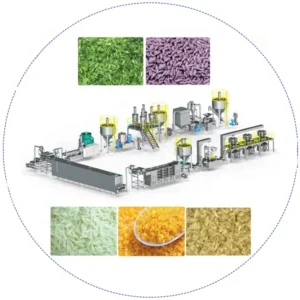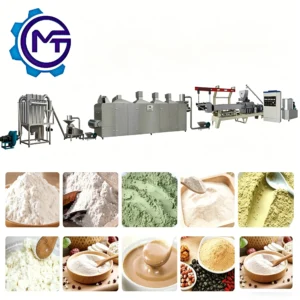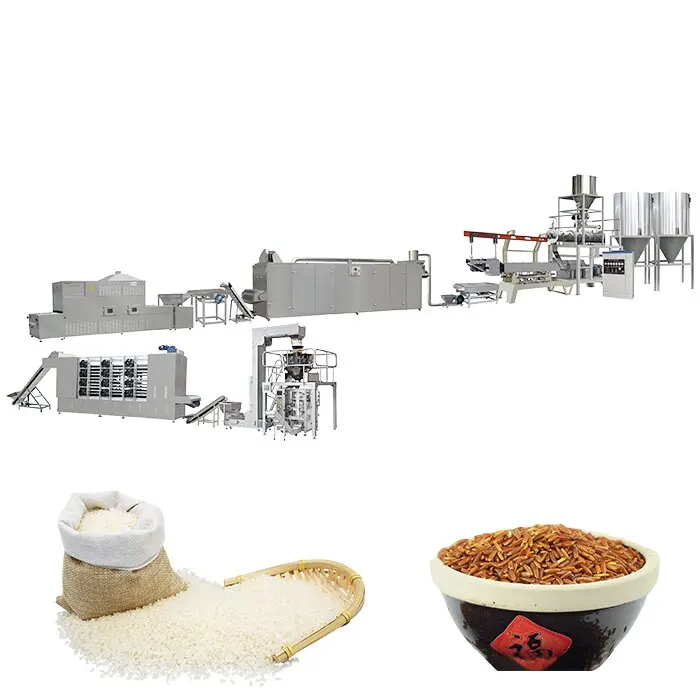
Station-by-station throughput matching — every mixer, extruder, dryer and packing unit in this fortified artificial rice production line is sized to the same output tier so no single machine creates a bottleneck between batching and final bagging.
Technical Specifications
| Parameter | Value |
|---|---|
| Product Type | Fortified Artificial Rice Production Line |
| Models Available | MT65, MT70, MT85, MT75, MT95 |
| Installed Power (MT65 / MT70 / MT75 / MT85 / MT95) | 85 kW / 120 kW / 180 kW / 235 kW / 260 kW |
| Power Consumption (MT65 / MT70 / MT75 / MT85 / MT95) | 60 kW / 85 kW / 135 kW / 165 kW / 195 kW |
| Output Capacity (MT65) | 80–100 kg/h (basis not stated in source — confirm raw material formulation and moisture content) |
| Output Capacity (MT70) | 100–120 kg/h (basis not stated in source — confirm raw material formulation and moisture content) |
| Output Capacity (MT75) | 300–500 kg/h (basis not stated in source — confirm raw material formulation and moisture content) |
| Output Capacity (MT85) | 200–300 kg/h (basis not stated in source — confirm raw material formulation and moisture content) |
| Output Capacity (MT95) | 800–1000 kg/h (basis not stated in source — confirm raw material formulation and moisture content) |
| Overall Dimensions (MT65 / MT70 / MT75 / MT85 / MT95) | 28×1.2×2.2 m / 30×1.5×2.2 m / 32×3.5×4.3 m / 34×3.5×4.3 m / 36×3.5×4.3 m |
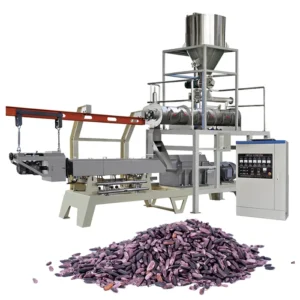
| Screw Type | Twin-screw extrusion |
| Feeding System | Single or double screw feeding selectable based on material |
| Control System | Frequency speed controlling with high automation |
| Lubrication | Automatic lubricating and cooling system |
| Heating Source (Dryer) | Electric or gas |
| Line Stations | Mixing → Extruding → Vibrating → Low Temperature Drying → Cooling → High Temperature Roasting → Cooling → Packing |
| Screw Construction | Special wear-resistant technology |
| Standards | CE, ISO |
Application Suitability
| Application | Material or Output |
|---|---|
| Fortified rice for institutional nutrition programmes | Broken rice and rice flour blended with vitamin and mineral premix |
| Artificial rice from milling by-products | Rice bran, broken rice and starch reconstituted into whole-grain-shaped kernels |
| Multi-grain nutritional rice | Corn, millet, wheat, oats, buckwheat and bean flours with micro-nutrient addition |
| Commercial staple food diversification | Starch-based formulations for retail and food-service rice alternatives |
Why Capacity Numbers Alone Cannot Define a Fortified Artificial Rice Production Line
A rated output means nothing when the dryer downstream cannot remove moisture fast enough to keep the extruder running.
I once watched a buyer sign off on an extruder based on its barrel-throughput figure, only to discover during commissioning that the dryer belt speed and heating zone length were sized for a lighter snack product. The line spent weeks idling while the dryer caught up. [NEED_CITE: throughput balance between extruder and dryer in starch-based production lines] The same trap applies in reverse — an oversized dryer wastes energy and floor space when the extruder cannot feed it continuously. Every station from the batching mixer to the packing scale must be calculated against the same formulation and moisture curve.
Station Sequence and Where Each Machine Fits
The line begins with a batching and mixing station where broken rice flour, starch carriers and micro-nutrient premix are blended to a uniform moisture level before entering the feeder. From there, the twin-screw extruder gelatinises the starch matrix under controlled barrel temperature zones and shear, forcing the dough through a die plate that shapes individual rice-shaped kernels. A vibrating conveyor separates any fused pieces before the kernels enter the low-temperature dryer, where circulation air and frequency-controlled mesh belt speed gradually reduce moisture without cracking the surface. After the first cooling pass, a high-temperature roasting stage develops colour and final texture, followed by a second cooling stage that brings the kernels to ambient temperature before the packing station weighs and bags the finished product.
How the Feeding System Influences Kernel Uniformity
Choosing between single and double screw feeding depends on how free-flowing the premix is. A blend heavy in rice flour with low fat content typically feeds well through a single screw, whereas formulations with added oils or sticky vitamin carriers benefit from the positive displacement of a double screw feeder. [NEED_CITE: single versus twin screw feeding for cohesive powder blends] Inconsistent feed rate translates directly into density variation across the die face — some kernels emerge under-expanded while others burst and deform. Matching the feeder to the raw material blend is therefore as important as the extruder model itself.
Reading the Power and Dimension Figures
Installed power across the range spans from 85 kW on the MT65 to 260 kW on the MT95, but actual consumption sits lower — between 60 kW and 195 kW — because heaters and drives cycle during steady-state running. The dimension gap between the smaller units (roughly 28–30 m in line length) and the larger models (34–36 m) is driven mainly by dryer and roasting oven length, which must be longer at higher throughput to maintain the same residence time. [NEED_CITE: dryer length and residence time calculation for starch kernels] Buyers planning floor layout should also account for the wider footprint of the MT75, MT85 and MT95 lines — 3.5 m versus 1.2–1.5 m — caused by the wider mesh belt needed for higher volume. The automatic lubricating and cooling system on the extruder gearbox reduces scheduled downtime for oil checks, which matters when the line is scheduled for continuous shifts.
The Cost of Undersizing One Station
When a supplier quotes each machine separately without a unified capacity calculation, the extruder may deliver wet kernels faster than the dryer can process them. The result is product sitting on transfer conveyors, absorbing ambient humidity and developing surface tackiness that causes clumping downstream. [NEED_CITE: moisture re-absorption risks in starch-based kernel handling] Similarly, if the cooling stage after roasting is too short, kernels enter the packing bag above ambient temperature and condensation forms inside the sealed package, shortening shelf life. These failures rarely show up during a short factory acceptance test — they surface only after the line has run for several days in the buyer’s own humidity and altitude conditions.
Why Sourcing the Full Range from One Supplier Matters Here
Every station in this fortified artificial rice production line is documented in a single line layout and capacity calculation, so throughput is matched rather than assembled from separate vendors who each optimise for their own machine. Screw configuration and die design are specified against the buyer’s actual raw material blend — broken rice ratio, starch type, vitamin premix viscosity — instead of copied from a generic build. An in-house testing workshop allows trial runs on the customer’s own formulation before shipment, generating a report that covers kernel density, expansion ratio and nutritional retention. Electrical schematics and voltage confirmation are locked in during the order stage, preventing the commissioning delays that arise when a 400 V motor arrives in a 380 V market. CE and ISO certification covers the complete line, not just individual machines.
Documentation & Verification
- Line layout showing throughput balance for your chosen capacity tier and raw material formulation
- Screw and die configuration record matched to your broken rice and micro-nutrient blend
- Trial run report from in-house testing workshop on customer-supplied raw material
- Electrical schematic with confirmed voltage, frequency and control language for target market
- CE declaration of conformity and ISO certificate covering the full line scope
- Operation and maintenance manual with wear parts list for screws, dies and dryer belts
Installation, Commissioning & Support
- Floor plan and utility drawing provided for line lengths from 28 m to 36 m, including foundation load points for the extruder and dryer
- Power distribution plan specifies dedicated circuits for the 60–195 kW operating range and gas supply routing if gas-heated dryer is selected
- Machines shipped in sectioned modules to fit standard containers; reassembly supervised on site by commissioning engineers
- First-run parameter setting covers barrel temperature zones, feeder speed, dryer belt frequency and roasting oven profile for your formulation
- Operator training addresses screw change procedure, automatic lubrication system checks and die cleaning between formulation switches
- Wear parts list identifies screws, dies and mesh belt segments with recommended stock quantities for the first year of operation
What to Include in Your Inquiry
To size the line accurately, share your raw material formulation — including the ratio of broken rice to starch carriers and the type of vitamin premix — along with the target hourly output and the moisture level you expect at the packing stage. Provide your workshop length, ceiling height and local voltage and frequency so that motor ratings and dryer heating source can be specified before production begins. If you have an existing packing system or upstream milling line, describe its throughput so the new stations can interface without creating a new bottleneck.
Frequently Asked Questions
Q: How is output capacity verified across the full line, and what raw material formulation is it based on?
A: Each capacity tier is calculated against a specific formulation and moisture content. Before the order is confirmed, we request your raw material blend and run a trial in the testing workshop. The resulting report documents kernel density, expansion ratio and throughput, so the quoted figure reflects your actual material rather than a generic benchmark.
Q: What voltage, frequency and control language options are available for different markets?
A: Motor ratings and control panels are configured during the specification stage. Buyers confirm local voltage, frequency and preferred HMI language before production starts. This prevents the common delay of rewiring or replacing contactors after the line arrives on site.
Q: How is screw and die configuration matched to a specific raw material blend?
A: Screw elements are arranged and die orifice diameter is selected based on the starch composition, fat content and particle size of your blend. The configuration record is documented and shared before shipment, allowing future replication or adjustment when formulations change.
Q: Is a trial run on the buyer’s raw material possible before shipment?
A: Yes. Customers can send raw material to the in-house testing workshop. The trial covers extrusion, drying and roasting stages, and the report records moisture reduction curve, kernel integrity and output rate on your exact formulation before the line is dispatched.