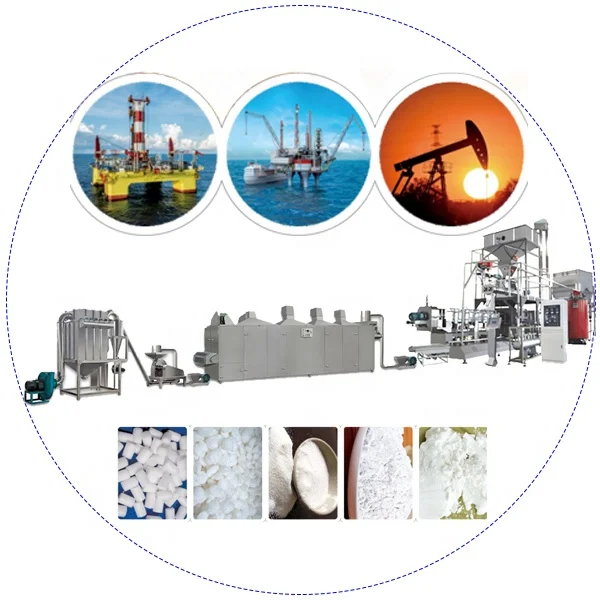
Starch-Specific Line Engineering — every modified starch processing line is matched to the buyer’s actual raw material through in-house testing, not assembled from a generic catalog.
Technical Specifications
| Parameter | Value |
|---|---|
| Product Type | Modified Starch Processing Line (Twin-Screw Extrusion Based) |
| Capacity Range | 80–500 kg/h (basis not stated in source — confirm raw material type and moisture content) |
| Raw Materials | Corn starch, potato starch, wheat flour |
| Extruder Type | Twin-screw |
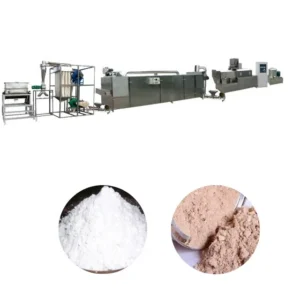
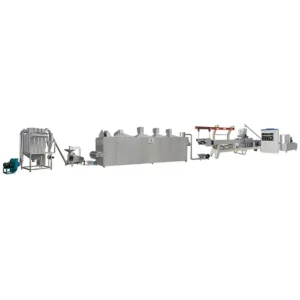
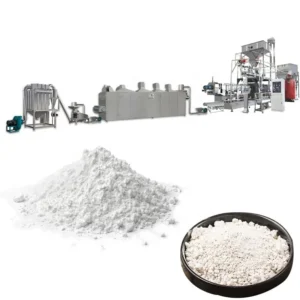
| Process Flow | Mixer → Screw Conveyor → Twin Screw Extruder → Shift → Air Conveyor → Dryer → Air Conveyor → Conditioning → Conveyor → Grinder |
| Key Contact Material | Food-grade stainless steel 304 |
| Frame Material | Stainless steel 201 |
| Total Power (Electric Heating) | Approx. 100 kW |
| Total Power (Gas / Diesel Heating) | Approx. 50–60 kW |
| Energy Source Options | Electricity, gas, diesel, steam |
| Voltage | 380V / 50Hz (three-phase); 220V / 50Hz (single-phase); customizable to local voltage |
| Mixer Motor | 4.0 kW |
| Mixer Dimensions | 1.2 × 0.9 × 1.4 m |
| Mixer Batch Output | 3.0–4.0 kg per batch |
| Screw Conveyor Motor | 1.1 kW |
| Screw Conveyor Dimensions | 2.5 × 0.6 × 2.3 m |
| Screw Conveyor Throughput | 0–150 kg/h |
| Motor Brand | Siemens (made in China) or Chinese top brand |
| Inverter | Delixi or Delta |
| Standards | CE, ISO |
| Warranty | One year |
Application Suitability
| Application | Material or Output |
|---|---|
| Pre-gelatinized starch for food additives | Corn starch, potato starch |
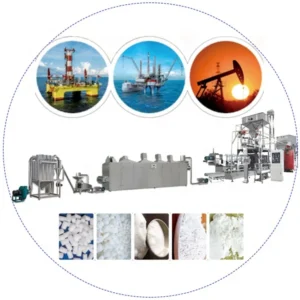
| Industrial adhesive starch modification | Wheat flour, corn starch |
| Modified starch for paper coating and sizing | Potato starch, wheat flour |
| Nutritional ingredient with controlled viscosity and gelling | Corn starch, potato starch |
| Physical modification replacing chemical treatment | Various native starches |
Why the Nominal Capacity Number Can Mislead Your Modified Starch Processing Line Equipment Purchase
A rated output means nothing unless it is verified on your exact starch source and moisture level.
I once watched a line designed around corn starch struggle badly when the buyer switched to cassava starch on day one. The gelatinization window shifted, the expansion ratio dropped, and the dryer could not keep up because the product carried more residual moisture than expected. The extruder ran, but the whole modified starch processing line equipment produced at barely half the quoted figure. This happens more often than equipment suppliers like to admit [NEED_CITE: twin-screw extrusion behavior across different starch sources].
How Starch Type Changes the Entire Line Setup
Different starches gelatinize at different temperatures and require different shear profiles inside the barrel. Corn starch, potato starch, and wheat flour each respond to screw configuration and barrel heating in distinct ways, which means the modified starch processing line equipment must be configured with a specific screw arrangement and die geometry to match.
Matching Dryer and Conditioner Capacity to Extruder Output
The extruder does not operate in isolation. When starch exits the die and enters the dryer, its moisture content and temperature determine how long it must stay in the drying chamber. If the dryer is undersized relative to the extruder output, partially dried material accumulates downstream, creating a bottleneck that reduces actual throughput of the modified starch processing line equipment [NEED_CITE: throughput balancing in continuous food processing lines].
Reading the Specifications That Actually Matter
The twin-screw design provides the mechanical shear and controlled residence time necessary for consistent starch gelatinization and molecular weight modification. Contact parts built from food-grade stainless steel 304 prevent contamination when processing starch destined for food or paper industries. Multi-energy support — electricity, gas, diesel, or steam — lets buyers align operating costs with local utility pricing, which varies significantly between regions running 380V three-phase power and those relying on gas-fired heating. The mixer batch output of 3.0–4.0 kg per cycle must synchronize with the screw conveyor feed rate of up to 150 kg/h to maintain steady extruder loading.
The Cost of Skipping Raw Material Verification
When a line ships without a trial run on the buyer’s actual starch, the first weeks of production become an expensive experiment. Screw configurations need adjustment, barrel temperature profiles need recalibration, and drying times need reworking — all while raw material is being wasted and delivery commitments slip. I have seen buyers spend weeks tuning a line that should have been dialed in before it left the factory [NEED_CITE: pre-shipment testing practices in extrusion equipment supply].
What You Gain from a Single-Source Line Build
Every station on this modified starch processing line equipment is specified as a matched set rather than sourced from separate vendors. The extruder screw and die configuration are documented against your target starch properties, not copied from a generic build. An in-house testing workshop runs your raw material before shipment, producing a trial report you can review. Voltage, frequency, and control language are confirmed before production begins, avoiding delays during on-site commissioning. The complete process flow — from batching through drying, conditioning, and grinding — is laid out with throughput calculated at each station.
Documentation & Verification
- Line layout and capacity calculation showing throughput matching at every station
- Screw and die configuration record matched to your starch type and target viscosity
- Electrical schematic with confirmed voltage and frequency for your destination market
- Trial run report on your actual corn starch, potato starch, or wheat flour
- CE declaration of conformity and ISO certificate
- Factory test record and operation manual with wear parts list
Installation, Commissioning & Support
- Foundation planning based on total line footprint and the 1.2 × 0.9 × 1.4 m mixer station weight
- Power supply sized to the approximately 100 kW electric heating load or 50–60 kW gas/diesel option
- Modular delivery allowing station-by-station assembly in facilities with limited overhead clearance
- On-site extruder parameter tuning including barrel temperature profile and screw speed
- Operator training covering batch loading sequence and moisture adjustment at the mixer
- Wear parts list covering screws, dies, and barrel liners with replacement intervals
- Routine maintenance schedule aligned with the stainless steel 304 contact surface inspection points
What to Prepare Before Requesting a Quote
To configure a modified starch processing line equipment that actually performs as specified, share your starch source — corn, potato, wheat, or cassava — along with the target modification properties such as viscosity range or gelling temperature. Include your local voltage and frequency, the preferred energy source for the dryer, and whether you need the grinder calibrated to a specific mesh size. If you have an existing facility, provide workshop dimensions so the line layout can account for conveyor routing and access space.
Frequently Asked Questions
Q: How is the 80–500 kg/h capacity verified, and on which raw material is it based?
A: The capacity range requires confirmation based on your specific starch type and incoming moisture content. Corn starch, potato starch, and wheat flour each behave differently inside the twin-screw extruder, affecting achievable throughput. A trial run on your actual material in the testing workshop produces a verified output figure before the line ships.
Q: How does the screw configuration adapt to different starch types?
A: Each starch source has a different gelatinization temperature and shear sensitivity. The screw elements and die geometry are selected to match — potato starch may need a gentler shear profile than corn starch to avoid molecular degradation. The configuration is documented and can be adjusted if you change raw materials later.
Q: What prevents bottlenecks between the extruder, dryer, and grinder?
A: Throughput is calculated at every station during line layout design. The dryer capacity accounts for the moisture content of your specific starch after extrusion, and the grinder is sized to handle the dried output rate. This prevents material accumulation between stations that would otherwise reduce actual production.
Q: How is voltage and control language confirmed before production?
A: The electrical schematic is reviewed and signed off during the specification confirmation stage. Your local voltage and frequency — whether 380V/50Hz or another standard — are built into the motor and inverter selection. Control panel language is set to match your operators before the line leaves the factory.