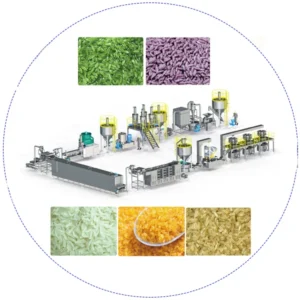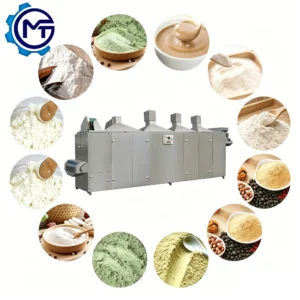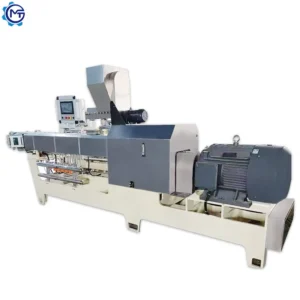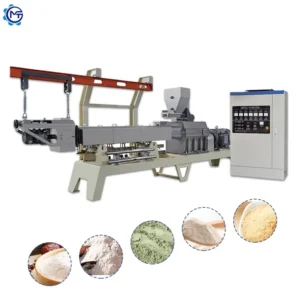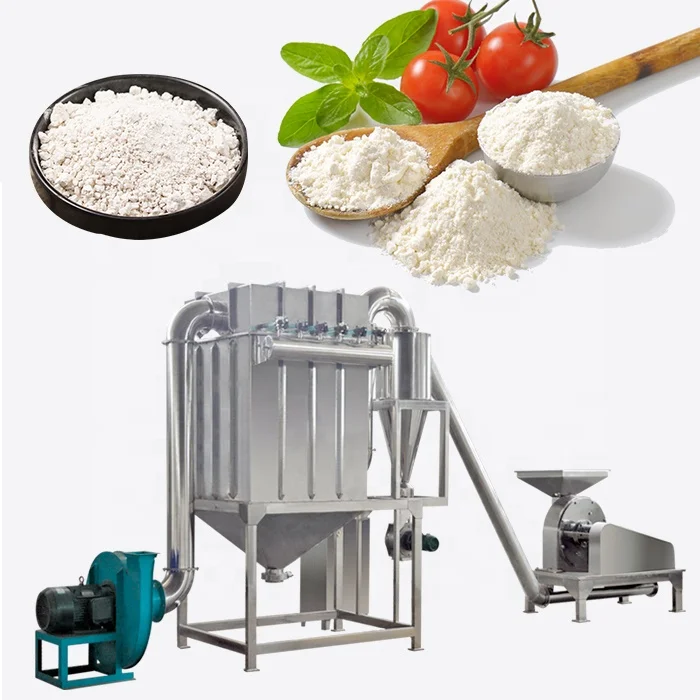
Station-matched throughput — Every mixing, extrusion, drying and blending unit in the MT65 nutritional powder processing line is sized against the others so no single stage chokes the flow.
Technical Specifications
| Parameter | Value |
|---|---|
| Model | MT65 / MT70 / MT85 |
| Product Type | Nutritional Powder Processing Line |
| Screw Type | Twin-screw |
| Installed Power | MT65 — 85 kW; MT70 — 120 kW; MT85 — 195 kW |
| Real Power Consumption | MT65 — 65 kW; MT70 — 90 kW; MT85 — 165 kW |
| Output Capacity | MT65 — 150–200 kg/h (basis not stated in source); MT70 — 200–300 kg/h (basis not stated in source); MT85 — 600–800 kg/h (basis not stated in source) |
| Overall Dimensions (L×W×H) | MT65 — 18,000 × 1,300 × 2,300 mm; MT70 — 20,000 × 1,500 × 2,400 mm; MT85 — 24,000 × 3,500 × 4,300 mm |
| Construction | Stainless steel (food-grade contact surfaces) |
| Control System | PLC and MCC |
| Line Stations | Mixing → Extrusion → High-temperature Roaster → Crushing → Final Blending |
| High-temperature Roaster Effective Belt Length | 3.5 m |
| Roaster Far Infrared Heater | 3.9 kW × 24 elements |
| Roaster Gas Consumption | 6.8 m³/h |
| Powder Mixer Tank Volume | 150 kg |
| Powder Mixer Rotary Speed | 385 rpm |
| Powder Mixer Batch Time | 10 min per batch |
| Warranty | 1 year complete; lifetime maintenance service |
| Standards | CE; ISO |
Application Suitability
| Application | Material or Output |
|---|---|
| Infant formula and baby food powder | Rice flour, whey protein isolate, mineral premix |
| Nutritional porridge powder | Soybean, sesame, fortified grain blends |
| Instant breakfast powder | Oat, corn, multivitamin premix |
| Modified starch (industrial) | Cassava, corn starch for textile and papermaking |
Why Extruder Output Alone Tells You Almost Nothing
A nutritional powder processing line full equipment range only performs when every station is rated on the same raw material baseline. Throughput claims without a stated moisture content and feed composition are estimates, not guarantees.
I have watched lines stall because the extruder was spec’d at a nominal figure on plain rice flour, then the buyer introduced high-ratio whey protein and trace mineral premix. The twin-screw torque climbed, barrel temperatures drifted, and the entire batch fused into unusable lumps. Sizing each station against the actual formulation prevents that kind of two-week commissioning delay [NEED_CITE: twin-screw torque behaviour on high-protein formulations].
Matching Every Station to the Formulation
The MT65 twin-screw extruder processes the cooked slurry that the upstream powder mixer prepares at 385 rpm in 150 kg batches. Because the screw configuration and barrel zones are selected against the buyer’s exact raw material, gelatinisation happens at the correct shear and residence time rather than at a generic default. Downstream, the high-temperature roaster with its 3.5 m belt and 24 far infrared elements dries the extrudate to a moisture level suitable for crushing without case-hardening the outer layer.
What Happens When Dryer Capacity Lags Behind
If the roaster cannot keep pace with extruder output, semi-dried material piles up on the belt, creating uneven moisture gradients that ruin powder flowability after crushing. The far infrared array on this line delivers distributed heat across the full belt width, and the gas consumption figure of 6.8 m³/h indicates the thermal headroom available for higher-moisture formulations [NEED_CITE: far infrared drying uniformity on extruded nutritional substrates]. Every station in the nutritional powder processing line full equipment range is cross-referenced during layout design so the dryer never becomes the constraint.
Reading the Spec Sheet Like a Process Engineer
The installed versus real power gap on the MT65 — 85 kW versus 65 kW — reflects the difference between motor nameplate rating and actual draw during steady-state extrusion of typical nutritional slurries. A wider gap means the main drive has thermal headroom when formulation viscosity spikes. The 385 rpm mixer speed and 10-minute batch cycle determine how quickly the upstream station can feed the extruder; if the mixer cycle is too slow, the extruder idles between batches and barrel temperature fluctuates. Stainless steel construction across every contact surface is non-negotiable for infant formula compliance, and the PLC and MCC control architecture allows recipe storage so operators can switch between a high-protein baby food run and a modified starch run without manual recalibration.
The Cost of Skipping the Trial Run
Buyers who approve a line based on a generic spec sheet and skip the in-house trial run frequently discover during commissioning that the screw combination cannot handle their actual protein-to-starch ratio. Torque alarms trip, barrel zones overshoot target temperatures, and the roaster receives material at the wrong moisture. Debugging these mismatches on-site, in a foreign workshop with limited tooling, stretches commissioning from days into weeks [NEED_CITE: on-site versus factory commissioning duration comparison].
What Distinguishes This Equipment Catalogue
Every station — from the 4 kW powder mixer to the air conveyor — is designed and supplied under one responsibility, so throughput mismatches between vendors disappear before the line ships. Screw and die configurations are documented against the buyer’s raw material, not copied from a generic build. The in-house testing workshop runs the buyer’s actual formulation before dispatch, producing a trial run report that becomes the commissioning baseline. Electrical schematics and voltage are confirmed to the target market standard before production begins, eliminating the rewiring delays that plague uncoordinated exports. CE and ISO documentation is compiled per machine, not just per company.
Documentation & Verification
- Machine specification sheet covering motor power and dimensions for every station in the line
- Screw and die configuration record matched to buyer’s raw material and target powder fineness
- Electrical schematic with voltage and frequency confirmed to destination market before production
- Trial run report on customer’s actual formulation conducted in the testing workshop before shipment
- CE declaration of conformity and ISO certificate compiled per line
- Factory test record documenting steady-state throughput on the agreed recipe
Installation, Commissioning & Support
- Foundation layout accounts for the MT65’s 18 m line length and 2.3 m height clearance requirement
- Dedicated electrical circuit sized for 85 kW installed power with MCC protection at each station
- Modular station design allows phased uncrating and positioning within the workshop footprint
- Commissioning engineer sets barrel temperature profile and screw speed on the buyer’s live formulation
- Operator training covers PLC recipe recall for switching between nutritional powder and modified starch runs
- Wear parts list itemises screws, dies and roaster belt sections with reorder part numbers
Preparing Your Enquiry
Share your raw material formulation, including protein and fat percentages and any mineral premix additions, along with the target daily output and the voltage and frequency standard at your facility. If you already operate upstream batching or downstream packing equipment, provide their throughput ratings so the line can be matched at both ends.
Frequently Asked Questions
Q: How are output capacities verified for each station in the line?
A: Capacities listed for the MT65, MT70 and MT85 are based on reference formulations; actual throughput depends on raw material composition, moisture content and target powder fineness. We verify figures by running your formulation in our testing workshop and document the result in a trial run report before shipment.
Q: What voltage and frequency options are available?
A: The PLC and MCC control system can be configured to match destination market standards. Voltage, frequency and HMI language are confirmed during the specification stage before production begins, so the line arrives ready for connection without on-site rewiring.
Q: How do I prevent the extruder from outpacing the roaster?
A: During layout design we cross-reference the extruder output with the roaster belt speed and far infrared heating capacity. The 3.5 m effective belt length and 24-element heater array are sized to handle the extruder’s steady-state discharge without material backlog.
Q: Can the twin-screw extruder handle modified starch as well as nutritional powder?
A: Yes. Barrel zone configuration and screw element arrangement are adjusted to suit the target product. The same MT65 platform can run infant formula powder on one shift and modified starch for industrial applications on another, with recipes stored in the PLC.
Q: What control system and language options come with each station?
A: The line ships with PLC and MCC control as standard. HMI language is confirmed to the operator’s preference before production. Recipe storage allows quick changeover between different powder formulations without manual parameter entry.