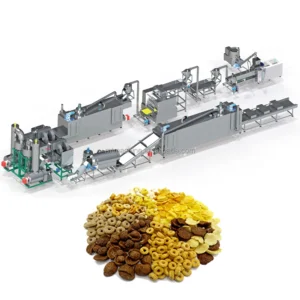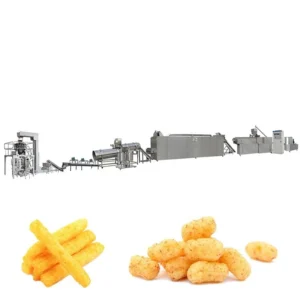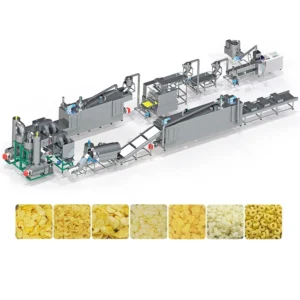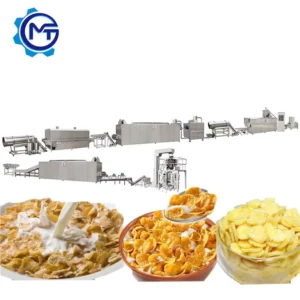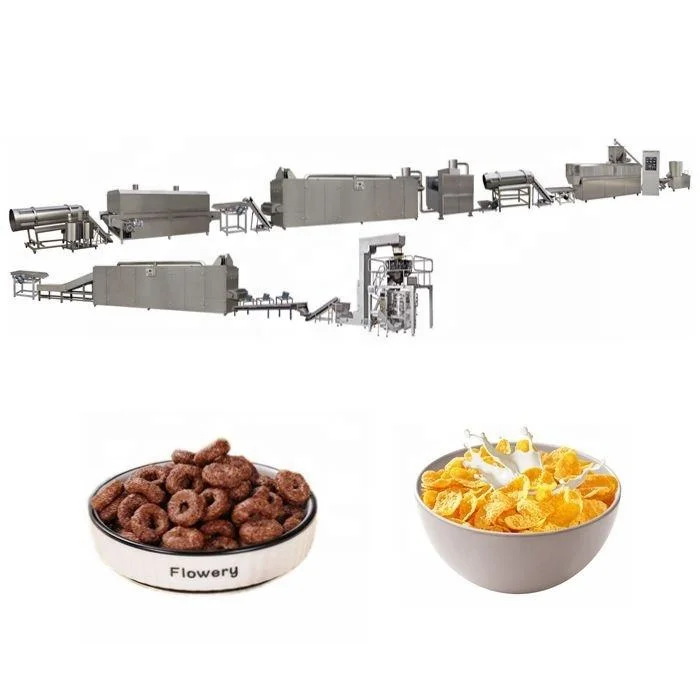
Integrated Flaking and Roasting — every station from mixing through sugar coating is throughput-matched to the MT75 twin-screw extruder, preventing bottlenecks that stall commissioning on breakfast cereal lines.
Technical Specifications
| Parameter | Value |
|---|---|
| Product Type | Corn Flakes Production Line with Twin Screw Extruder |
| Screw Type | Twin-screw with automatic lubricating and cooling |
| Installed Power | 210 kW (MT75) |
| Power Consumption | 150 kW (MT75) |
| Output Capacity | 300–500 kg/hr (basis to be confirmed — depends on raw material type, moisture content and product format) |
| Overall Dimensions (L×W×H) | 45 × 1.5 × 3.5 m (MT75 line layout) |
| Control System | PLC control system |
| Dryer Heating Source | Gas / Electric |
| Flaking Machinery | Hydraulic double-roller system, double motor drive, infrared temperature sensor |
| Hot Air Roasting Oven | Vibrating pan, conciliation burner, dual circulating fans, cyclone dust removal |
| Coating System | Double tumble sugar melter, elevator, coating drum, spraying nozzle |
| Assembly State | Complete line, assembled on site |
| Standards | CE, ISO certified |
Application Suitability
| Application | Material or Output |
|---|---|
| Natural corn flakes | Corn grits, maize powder |
| Sugar-coated corn flakes | Corn base with sugar or honey coating |
| Multi-grain breakfast cereals | Wheat, oat, barley, rice blends |
| Extruded cereal shapes | Loops, rings, stars, balls via die changes |
| Fortified breakfast cereals | Cereal blends with added vitamin and mineral premix |
What "300–500 kg/hr" Leaves Out on a Corn Flakes Machine Manufacturer’s Datasheet
The rated capacity only holds if your raw material matches the test conditions — and corn flour particle size varies significantly between suppliers.
I once configured a corn flake line for a Middle Eastern buyer based on the supplier’s sample and nominal output figures. When they ran their local corn grits, which were noticeably coarser than the test sample, the extruder could not reach the expected gelatinisation level and throughput dropped to roughly six tenths of the nameplate value [NEED_CITE: effect of corn grit particle size on twin-screw extrusion throughput]. The screw combination and die had to be reconfigured before the line performed as intended. That is why I now insist on a trial run with the buyer’s actual raw material before any breakfast cereal production line equipment ships. A capacity number without the material spec next to it is not a capacity — it is a guess.
How the Flaking Station Controls Your Final Flake Density
The flaking machinery on the MT75 line uses a hydraulic double-roller system with independent motors for each roller, giving you control over nip gap and roller speed separately. An infrared sensor monitors roller surface temperature continuously, keeping the dough sheet at the right plasticity for consistent flake thickness. Inconsistent flake thickness is the main reason some flakes shatter in the bowl while others stay hard — the PLC-controlled hydraulic system addresses this directly.
Why the Roasting Oven Determines the Crispness Your Market Expects
The hot air roasting oven uses a vibrating pan with a conciliation burner and two separate circulating fans to produce the surface blistering that buyers in mature cereal markets look for. The cyclone dust removal device captures fines before they recirculate. Getting this step wrong means flakes that look flat and taste stale within weeks [NEED_CITE: relationship between roasting profile and bowl-life crispness in corn flakes]. The oven is sized to match the extruder and flaker output so product does not queue and over-dry before entering the roasting chamber.
Reading the Specs That Actually Matter
The MT75 twin-screw extruder draws 210 kW installed power with a running consumption of around 150 kW — that gap reflects the start-up surge and the headroom needed when the barrel is fully loaded with cereal dough. The 45-meter line length accommodates every station from mixing to packing without tight bends in the conveyor path, which matters because cereal flakes are fragile after roasting and break easily on sharp transfer points. The twin-screw design gives you longer residence time and better mixing uniformity than a single-screw setup, which is critical when processing blends of corn with oat or barley that gelatinise at different rates. The automatic lubricating and cooling function on the screws extends service intervals compared to manual greasing, reducing unplanned stops during long cereal production runs.
The Cost of Undersized Downstream Equipment
The most common line failure I see is not at the extruder — it is at the dryer or coating drum. If the coating system cannot keep pace with extruder output, semi-finished flakes accumulate, lose moisture, and crack before sugar coating. The MT75 line addresses this by matching the double tumble sugar melter and coating drum capacity to the extruder throughput, but buyers who swap in a smaller dryer to save budget often discover the bottleneck only during commissioning [NEED_CITE: throughput mismatch between extruder and dryer in breakfast cereal lines]. A corn flakes machine manufacturer should confirm station-by-station capacity in the layout document, not just quote a single line speed.
Why Source the Full Line from One Supplier
Every station on the MT75 corn flake line — mixing, extruding, flaking, drying, roasting, coating, cooling, packing — is specified together so that throughput, utility load and control logic are coordinated from the start. The screw configuration and die design are chosen based on the buyer’s actual raw material and target flake density, not copied from a generic build. An in-house testing workshop runs trial production on the buyer’s corn or multi-grain blend before the line ships, so product development happens before installation, not after. Voltage, frequency and PLC language are confirmed in writing before production begins, avoiding the commissioning delays that occur when a 50 Hz machine arrives at a 60 Hz site. Spare wear parts including replacement screws and dies are supplied with the first shipment so the first changeover does not halt production.
Documentation & Verification
- Line layout and capacity calculation showing throughput at every station from mixer to packer
- Trial run report on your corn or cereal blend executed in the testing workshop
- Screw and die configuration record matched to your target flake density and crispness
- Electrical schematic with voltage, frequency and PLC language confirmed before production
- CE declaration of conformity and ISO certificate for customs clearance
- Wear parts list with part numbers for screws, dies and roller sleeves
Installation, Commissioning & Support
- 45-meter line length requires clear floor span with level concrete base and drainage for the cooling station
- 210 kW installed power needs a dedicated three-phase circuit sized for start-up surge current
- Arrives in modular sections for on-site assembly; flaking and roasting stations aligned during installation
- First-run parameter setting covers barrel temperature profile, roller nip gap and burner temperature
- Operator training on PLC interface, screw changeover and infrared sensor calibration
- Replacement screws, dies and roller sleeves supplied with initial shipment for first maintenance cycle
What We Need to Configure Your Line
To size the MT75 line correctly, share your corn or cereal raw material specification including particle size and moisture content, your target daily output in finished flakes, and the flake density your market expects. Confirm your local voltage and frequency, the preferred PLC operating language, and whether you need the natural flake layout or the sugar-coated configuration. If you can send a sample of your raw material, we will run it in our testing workshop and include the trial report with the quotation.
Frequently Asked Questions
Q: How is the stated 300–500 kg/hr capacity verified, and on which raw material and moisture level is it based?
A: The capacity range is verified on standard corn grits at a defined moisture content. Because particle size and starch composition vary by supplier, we run your actual raw material in our testing workshop before shipment and document the achieved throughput in a trial report, so you know the realistic output before the line arrives.
Q: Can the line voltage, frequency and PLC language be confirmed to our market before the machine is built?
A: Yes. Voltage, frequency and PLC interface language are confirmed in writing during the specification sign-off stage, before production starts. The electrical schematic reflects your site conditions so there are no surprises at commissioning and no need for on-site transformer additions.
Q: How are screw configuration and die design chosen to achieve the correct corn flake density and bowl-life crispness?
A: Screw elements are arranged and dies are sized based on your raw material properties and target flake specification. The trial run in our workshop tests the configuration on your actual corn or cereal blend, and adjustments are made before the line ships so the flakes meet your density and crispness requirements from the first production run.
Q: Is a trial run on our raw material performed before shipment, and do we receive the trial report?
A: Yes. We run your raw material through the extruder and downstream stations in our testing workshop. The trial report documents throughput, flake thickness, density and crispness achieved under test conditions, and it ships with the line so your team has a production baseline from day one.
Q: How do you ensure the dryer, roaster and coating drum capacity are matched to the extruder?
A: Every station is sized during the line layout phase based on the confirmed extruder output for your specific material. The capacity calculation document shows throughput at each station from mixing through packing, so no single station becomes a bottleneck during continuous production.